


Wall Street heads into Wednesday with two major catalysts on the calendar within hours of each other: July's PCE inflation report before the opening bell and Nvidia's fiscal second-quarter earnings after the close. Equity index futures were more cautious than Tuesday's cash session, reflecting the market's uncertainty about which way both events could break.
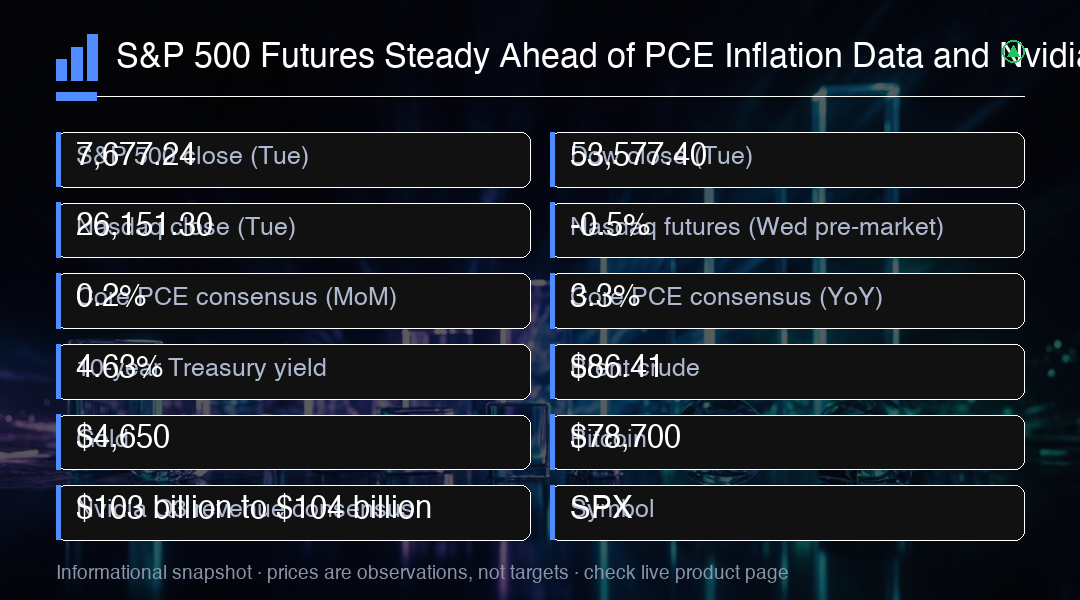
Tuesday's session itself was a broad-based recovery. The S&P 500 rose 0.3% to close at 7,677.24, the Dow Jones Industrial Average added 0.3% to close at 53,577.40, and the Nasdaq Composite climbed 0.7% to close at 26,151.30 as technology shares rebounded from Monday's selloff. Market breadth was positive, meaning gains extended beyond a handful of mega-cap names rather than being concentrated in just a few stocks.
Semiconductor and AI-linked names led the advance. Nvidia gained 2.2% ahead of its own earnings report, Meta Platforms rose nearly 2%, and Micron Technology added 2.5%, lifting the broader semiconductor index by 1.4%. AMD jumped 4.9% after Raymond James upgraded the stock to Strong Buy and raised its price target, a standalone catalyst covered in more detail elsewhere in this coverage. The across-the-board strength suggested traders were positioning ahead of Nvidia's results rather than reacting to any single company-specific news item.
That optimism did not fully carry into Wednesday's pre-market session. Nasdaq futures were down around 0.5%, S&P 500 futures edged lower and Dow futures held roughly flat, a more cautious tone that reflects the market's need to clear two major hurdles, the PCE inflation print and Nvidia's earnings, before extending Tuesday's rebound. These futures levels are a specific pre-market snapshot and can move quickly once the PCE data and any pre-market Nvidia-adjacent headlines land.
July's personal consumption expenditures price index, the Federal Reserve's preferred inflation gauge, is due at 8:30 a.m. ET Wednesday. Consensus estimates going into the release pointed to headline PCE rising approximately 0.1% month over month, with core PCE, which excludes volatile food and energy prices, expected to rise 0.2% month over month and hold near 3.3% on an annual basis. These are pre-release consensus figures rather than confirmed results, and the actual print could move markets meaningfully in either direction. A softer-than-expected reading would tend to pressure Treasury yields lower, a dynamic that typically benefits rate-sensitive technology and growth stocks, while a hotter print could revive dollar strength and rate-hike speculation.
Interest-rate futures pricing ahead of the release implied a solidly better-than-even probability that the Federal Reserve holds rates steady at its September meeting, with estimates from different rate-futures data providers clustering in the roughly 60% to 65% range, alongside a smaller residual probability of a quarter-point cut priced in by year-end. Fed Chair Kevin Warsh is scheduled to deliver his first Jackson Hole keynote as chair on Friday at the Kansas City Fed's annual symposium, giving traders a second major monetary-policy data point to digest within the same week as the PCE release and Nvidia's earnings.
Commodity and cross-asset markets showed a mixed but coherent pattern heading into Wednesday. Brent crude fell for a third consecutive session, sliding more than 2% toward $86.41 a barrel, after Iran and Oman resumed discussions concerning the management of traffic through the Strait of Hormuz; no reopening or de-escalation agreement had been reached at the time of writing, but the talks alone were enough to ease some of the geopolitical risk premium built into oil prices. Lower oil helped pull the 10-year Treasury yield toward 4.63%, supporting the broader disinflation narrative markets are positioning for ahead of Wednesday's PCE data.
Asian markets traded cautiously ahead of Nvidia's report, with Japan's Nikkei slipping 0.4%, South Korea's chip-heavy Kospi easing 0.2%, and the broader Asia-Pacific benchmark adding a modest 0.1%. The US dollar index held near the 99 level, trading close to its softer levels for the year, while gold traded around $4,650 an ounce, not far from its three-month high, and Bitcoin hovered near $78,700. The combination of a soft dollar, firm gold and resilient Bitcoin pricing is broadly consistent with a market that remains wary of US fiscal conditions and is hedging against further currency softness even as equities grind higher.
Nvidia's fiscal second-quarter report, due after Wednesday's close, is the single most consequential event on the calendar for index direction this week. The company's own guidance pointed to revenue near $91.0 billion, plus or minus 2%, while analyst consensus estimates clustered slightly higher, in the $91.7 billion to $92.2 billion range. For the current quarter, Wall Street was looking for revenue guidance of roughly $103 billion to $104 billion, with $104.2 billion representing one specific consensus estimate rather than company-issued guidance. Given how heavily this year's index gains have concentrated in AI-linked mega-caps, Nvidia's actual results and forward guidance carry outsized influence over whether Tuesday's rebound extends or reverses.
Taken together, Wednesday functions as a sequencing day rather than a single-catalyst event: the PCE print sets the tone before the opening bell, index-level trading digests that data through the session, and Nvidia's results after the close either confirm or undercut whatever direction the market established earlier in the day. Treasury bond buyback activity, ongoing fiscal-policy concerns, and the PCE outcome all remain live sensitivities across equities, the dollar, gold and Bitcoin, and traders should size index exposure with the understanding that two major, largely uncorrelated catalysts are landing within the same trading session.
Trading Insight
Approach Wednesday as a two-stage event rather than a single catalyst. The PCE print at 8:30 a.m. ET sets the tone for rate expectations and the dollar heading into the open, while Nvidia's after-the-close report will likely determine whether Tuesday's broad-based rebound, led by semiconductors and AI-linked names, extends into the rest of the week. A soft PCE print paired with in-line-or-better Nvidia guidance would support continuation of the recovery, while a hot inflation print or disappointing Nvidia guidance, particularly on the roughly $103 billion to $104 billion third-quarter revenue consensus, could quickly reverse Tuesday's gains. With Brent crude easing, the 10-year yield near 4.63% and the dollar index holding near 99, cross-asset positioning already reflects some disinflation optimism that both catalysts could either confirm or unwind within hours of each other.