


KEY POINTS: The Dow Jones Industrial Average lost 341.41 points, or 0.7%, to 51,179.87 on Wednesday, retreating from record closes alongside the S&P 500 and Nasdaq Composite, which each slipped 0.2%. The US 10-year Treasury yield hovered around 5.3%, near its highest levels since 2002, while the dollar index held near an 18-month high around 102.23. Broadcom is seeking more than $50 billion in financing for custom OpenAI chips, and Samsung forecast a 783% increase in quarterly operating profit to 107.4 trillion won ($72 billion).
Wall Street's pullback carried into Thursday's early trading as expensive oil and massive AI financing plans kept borrowing costs in focus. S&P 500 and Nasdaq futures were little changed, while Japan's Nikkei fell 0.9% and South Korea's Kospi dropped 0.6%. European stock futures edged higher, offering a tentative recovery after Wednesday's losses. The cautious tone reflected a market still digesting the implications of elevated Treasury yields and the growing capital demands of AI infrastructure expansion. Traders remained wary of committing fresh capital until there was clearer evidence that the recent pressure on equities had run its course.
The Dow Jones Industrial Average lost 341.41 points, or 0.7%, to 51,179.87 on Wednesday. The S&P 500 and Nasdaq Composite each slipped 0.2%, retreating from record closes. Stocks recovered some earlier losses after strong demand at a Treasury auction helped ease bond-market pressure. The intraday recovery suggested that buyers remained active at lower levels, but the underlying pressure from higher yields continued to weigh on equity valuations. The decline marked a notable shift in sentiment after the indices had reached record territory, with the latest price action suggesting that sellers had regained control of the short-term trend.
The US 10-year Treasury yield hovered around 5.3%, near its highest levels since 2002. Higher yields increase financing costs and make bonds more competitive with stocks. September's Fed minutes kept further tightening in view, although traders assigned only about 19% odds to an October hike. The combination of elevated yields and persistent rate expectations created a challenging environment for risk assets across multiple sectors. When borrowing costs rise, companies face higher expenses for debt servicing, which can compress profitability and reduce the present value of future earnings.
The dollar index held near an 18-month high around 102.23. EURUSD traded near $1.1200 as concerns about France's finances weighed on the euro and neighbouring bond markets. USD/JPY eased toward 157.80 after Japan reported a stronger-than-expected current-account surplus. Currency moves reflected both US rate expectations and local developments, with the strong dollar adding another layer of pressure on multinational corporate earnings. A stronger dollar makes US exports more expensive overseas and reduces the value of foreign earnings when repatriated, creating a headwind for companies with significant international operations.
Broadcom is seeking more than $50 billion in financing for custom OpenAI chips, while Oracle is exploring funding and SpaceX is discussing a $40 billion package for Nvidia purchases. SpaceX shares fell 2.5% Wednesday. These proposed deals underline how heavily AI expansion increasingly depends on outside capital. The scale of the financing requirements raised questions about whether the market can absorb such large debt issuance without disrupting existing credit conditions. When multiple large companies seek financing simultaneously, it can tighten liquidity and push borrowing costs higher across the board.
Samsung forecast a massive 783% increase in quarterly operating profit to 107.4 trillion won ($72 billion), supported by booming AI memory demand. Revenue is expected to reach 195 trillion won. Its shares nevertheless edged lower, a reminder that extraordinary earnings can still disappoint investors looking for evidence that growth will remain sustainable. The divergence between strong fundamentals and weak price action highlighted the broader market's cautious stance toward risk. Even exceptional results can fail to lift a stock if investors believe the peak of the growth cycle has already passed.
Micron climbed 4.1% Wednesday following a bullish analyst price-target revision, providing a notable exception to the broader retreat. Elsewhere, Wells Fargo fell 1.5% amid scrutiny of its homeownership commitments, while Levi Strauss slipped about 2% after hours following a quarterly revenue miss. The mixed performance across individual names suggested that stock-specific factors continued to drive outcomes even as macro pressures dominated the broader indices. When the overall market is under pressure, investors tend to focus more on company-specific news and less on broad thematic trends.
Applied Digital reported quarterly revenue of $341.9 million, up 322%, well above expectations. Its net loss also widened to $221 million. The results illustrate the distinction traders should watch across AI infrastructure: rapid revenue growth needs to translate into cash generation after construction costs, debt servicing and operating expenses. The widening loss underscored the capital-intensive nature of the AI buildout and the challenges of achieving profitability at scale. Companies in the AI infrastructure space often require massive upfront investment before they can generate positive cash flow.
Brent crude gained 1.3% to $101.53 a barrel, with WTI rising to $89.39, as attacks on Gulf shipping renewed supply concerns. The rebound followed Wednesday's decline after the IEA backed faster reserve releases. Expensive energy can prolong inflation pressure and complicate monetary policy, giving central banks less room to ease. Rising oil prices feed into broader inflation expectations, which in turn maintains the pressure on interest rates and equity valuations. The energy market remains sensitive to geopolitical developments, and any disruption to supply can quickly push prices higher.
Spot gold recovered 0.5% to around $4,130 after touching a two-month low. Silver edged up to $60.36. A slightly softer dollar offered relief, but elevated yields remain a headwind for non-interest-bearing metals. Traders still priced roughly 80% odds of a December Fed hike. Bitcoin steadied near $83,300 after losing approximately 2.6% Wednesday, with the session's low around $82,800 providing a recent downside reference and a recovery requiring a return toward $85,500. The precious metals market continued to struggle under the weight of high real yields, which increase the opportunity cost of holding assets that pay no interest.
Today's checkpoints are Fed Governor Christopher Waller's remarks, PepsiCo earnings and US jobless claims. PepsiCo reports at 6 a.m. ET, with claims due at 8:30 a.m. ET. Watch consumer volumes and labour-market resilience alongside Treasury yields: those signals will help test whether earnings optimism can withstand tighter financial conditions. The interplay between corporate results and macro data will likely determine whether the market can stabilize or if the recent pullback extends further. Fed officials' comments will be scrutinized for clues about the future path of interest rates, while earnings reports will reveal whether companies can maintain pricing power in an environment of elevated costs.
交易洞察
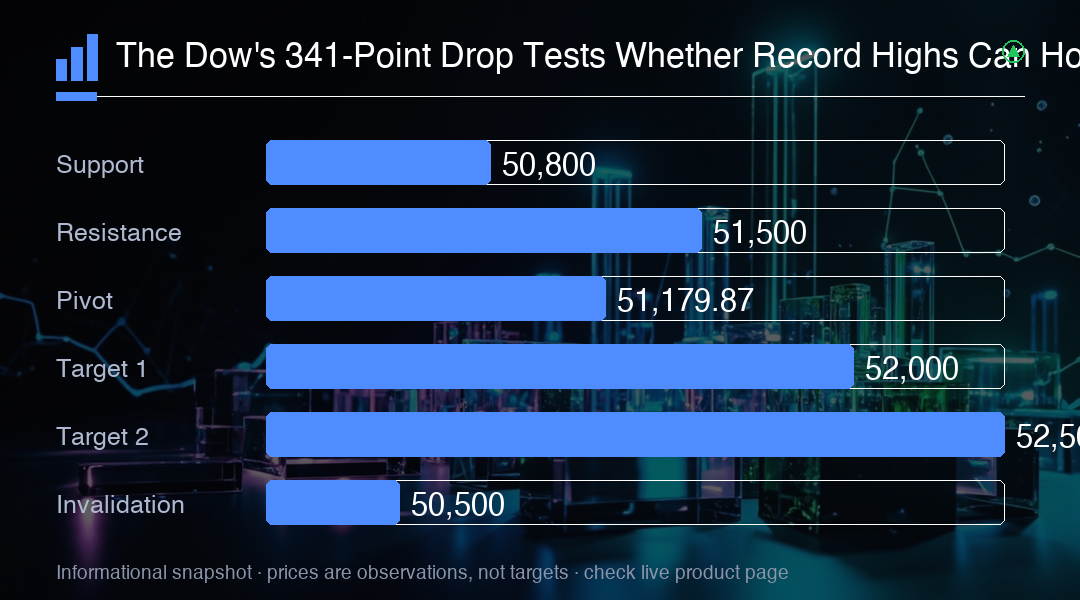
The Dow's 341-point drop to 51,179.87, combined with the 10-year Treasury yield near 5.3% and the dollar index at an 18-month high around 102.23, suggests that financial conditions remain tight enough to cap equity upside. A sustained break below 50,800 would likely accelerate selling toward 50,500, while a recovery above 51,500 would signal that buyers have absorbed the pressure. The near-term outlook depends heavily on whether Treasury yields stabilize and whether earnings can withstand the tighter financial conditions.