


KEY POINTS: The Nasdaq Composite fell 1.3% Thursday, losing 345 points to close at 27,193.34, two sessions after reaching a record. OpenAI's annualized revenue approaching $50 billion, below the $70 billion figure previously circulated, supplied the catalyst for the tech selloff. US futures indicated a modest rebound early Friday, with Nasdaq-100 contracts gaining roughly 0.5% and S&P 500 futures rising approximately 0.3%.
The Nasdaq Composite fell 1.3% on Thursday, losing 345 points to close at 27,193.34, two sessions after reaching a record. The decline was concentrated in chip stocks, with Nvidia falling 2.9%, Broadcom losing 4.3% and Micron dropping 4.8%. Despite the headline drop, roughly two-thirds of S&P 500 stocks advanced, suggesting the selling was narrow and driven by specific concerns rather than broad risk aversion. The S&P 500 slipped 0.5% to 7,765.36, while the Dow gained 0.1%, highlighting the divergence between tech-heavy and more diversified indexes. The concentration of losses in a handful of semiconductor names meant that the headline index suffered even though the broader market was relatively stable.
OpenAI supplied the catalyst for the tech selloff. A report indicated that annualized revenue was approaching $50 billion, well below the $70 billion figure previously circulated. Accounting differences involving cloud-partner sales complicate the comparison, so the revenue gap does not establish a sudden collapse in demand. Still, the discrepancy was enough to trigger a reassessment of AI-related valuations across the market, particularly for companies tied to the AI infrastructure buildout. The speed of the selloff demonstrated how concentrated the AI trade has become and how sensitive it is to any hint that expectations may have been set too high.
The funding concerns extended beyond OpenAI. Nvidia-backed Australian data-center operator Firmus shelved its proposed $5 billion IPO on Friday and will pursue private capital instead. The company's intended valuation was nearly triple August's funding-round valuation, a reminder that enthusiasm for AI does not guarantee demand at every price. The decision to withdraw the IPO signaled that public markets may not be willing to support the most aggressive AI infrastructure valuations, at least not yet. This development added to the nervousness around AI capital spending and raised questions about whether the buildout can continue at its current pace.
US futures indicated a modest rebound early Friday, with Nasdaq-100 contracts gaining roughly 0.5% and S&P 500 futures rising approximately 0.3%. These are tentative overnight gains ahead of the cash-market opening, and they followed a session where the Nasdaq remained approximately 17% higher for the year despite Thursday's setback. The futures bounce suggested that some buyers viewed the selloff as an overreaction, though the gains were modest enough to leave room for doubt about follow-through. Traders would want to see sustained buying before concluding that the worst of the selling is over.
International markets showed the global reach of the AI concerns. Japan's Nikkei fell about 1% in early trading, with OpenAI investor SoftBank sliding 5.4%. The broader Topix declined only 0.2%, illustrating the concentrated pressure on technology exposure rather than a broad-based retreat. South Korean and Taiwanese markets were closed for holidays, limiting the immediate regional spillover but leaving questions about how those markets would react when they reopened. The fact that SoftBank, a major OpenAI backer, was among the hardest hit highlighted the interconnected nature of the AI trade.
Bonds offered some relief even as oil remained expensive. The US 10-year Treasury yield steadied around 5.23% following strong auction demand, below Wednesday's 24-year high. Lower yields can support technology valuations and non-yielding assets like gold, but persistent oil-driven inflation could limit that relief. Brent traded near $103.70 after Thursday's 4% surge, keeping energy costs a complicating factor for the inflation outlook. The combination of elevated oil prices and still-high Treasury yields left the Fed in a difficult position, with rate expectations remaining the common pressure point across markets.
Geopolitical tensions added another layer of uncertainty. Trump's assurance against attacking Iran before November's midterms eased immediate fears, but shipping risks remain important for inflation. Higher oil prices feed into transportation and manufacturing costs, creating a secondary inflationary impulse that monetary policy cannot easily address. The combination of elevated energy prices and still-high borrowing costs left the Fed in a difficult position, with rate expectations remaining the common pressure point across markets. Gold rose 1.5% to $4,200 an ounce, while silver gained 1.7% to $60.50 as yields and the dollar eased.
The dollar's rally paused without surrendering its broader advantage. EUR/USD traded around $1.1226, heading toward a fifth consecutive weekly decline, while GBP/USD stood near $1.3243 and USD/JPY around 158 yen. A stronger dollar makes US assets relatively more expensive for international buyers, dampening demand from non-US participants. This dynamic limits the upside potential for risk assets even as shorter-term rate expectations soften, because the currency headwind persists regardless of what the Fed does next. Bitcoin recovered toward $82,500 after briefly dipping to just above $80,000, showing that the pressure on risk assets was broad-based.
Individual stocks still found reasons to rally despite the broader tech weakness. Chipotle jumped 6% after a report that Starbucks explored acquiring the chain, though no agreement was announced. PepsiCo gained 3.7% despite cutting its earnings outlook, while Palantir advanced 2.4% after Goldman Sachs upgraded the stock to Buy. These moves showed that company-specific news could still drive gains even in a risk-off environment, and they offered a reminder that the market was not uniformly bearish. The fact that these gains occurred alongside the Nasdaq's decline suggested that capital was rotating rather than fleeing.
Rate expectations remain the common pressure point for all risk assets. Traders assigned approximately 17% probability to an October Fed hike and 83% to a December increase. The divergence between near-term and longer-term expectations created a complex backdrop: the immediate pressure from a potential October tightening has eased, but the broader tightening cycle appears far from over. Lower yields can support technology valuations and non-yielding gold, but persistent oil-driven inflation could limit that relief. The coming weeks will reveal whether the Fed can navigate between supporting growth and controlling inflation.
Friday's focus turns to consumers and corporate guidance. Michigan's preliminary sentiment reading is expected near 47.5 versus 48.1 previously, with inflation expectations particularly relevant. A morning rebound does not resolve the policy outlook, and the combination of elevated oil prices, still-high Treasury yields and AI funding concerns leaves the market searching for a clear directional catalyst. The Nasdaq's ability to hold above 27,000 in early Friday trading would suggest the selloff was largely a positioning event, while a break below that level would indicate deeper concerns about the sustainability of AI-driven valuations. Investors will be watching both the data and the price action for signs of stabilization.
交易洞察
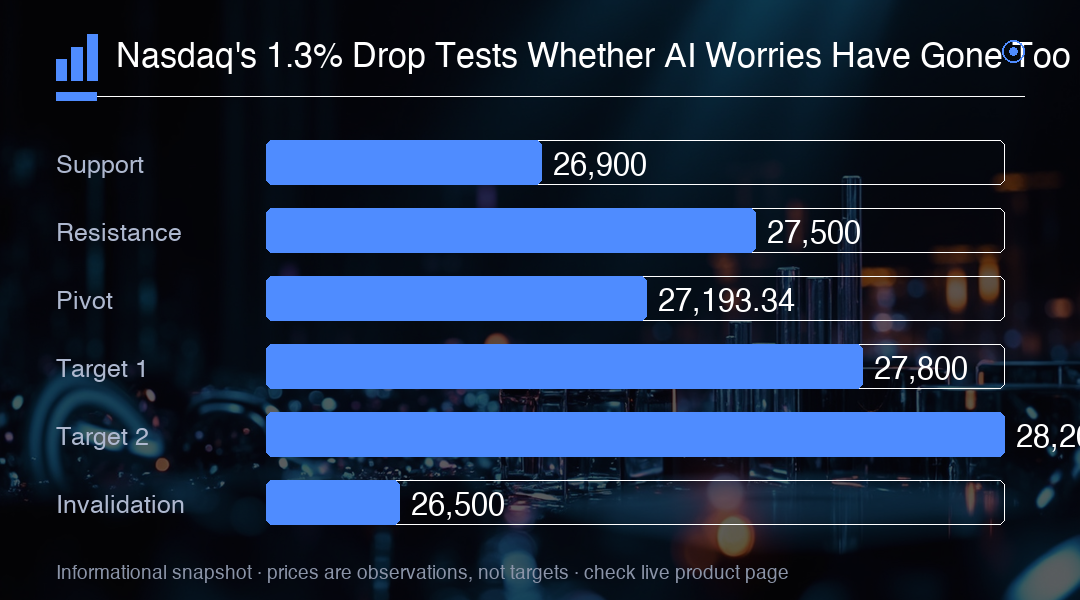
The Nasdaq's 1.3% drop to 27,193.34 tests whether AI worries have gone too far, with futures pointing to a modest 0.5% rebound. A sustained break above 27,500 would confirm the selloff was an overreaction, while a failure to hold 26,900 would invalidate the bounce and expose the index to a retest of 26,500. Watch Friday's Michigan sentiment reading and the 10-year yield, which steadied around 5.23% after hitting a 24-year high.