


KEY POINTS: Bitcoin slipped below $83,000 in early Thursday trading, extending a retreat from this week's high near $87,000. US spot Bitcoin ETFs recorded $485 million in net outflows on Wednesday, reversing the previous day's $118.8 million inflow. The US 10-year Treasury yield hovered near 5.3% and the dollar index held around 102.23, close to an 18-month high. The combination of technical breakdown and institutional outflows creates a challenging setup for Bitcoin in the near term.
Bitcoin BTCUSD slipped below $83,000 in early Thursday trading, extending the retreat from this week's high near $87,000. Prices approached $82,750, leaving buyers defending the lower end of the recent range as the cryptocurrency struggled to recover Wednesday's losses. The move marks a significant shift in sentiment after Bitcoin had traded as high as $87,000 earlier in the week, with the latest price action suggesting that sellers have regained control of the short-term trend. The $83,000 level had served as a psychological support zone, and its breakdown could trigger additional technical selling from traders who had placed stop-loss orders just below that threshold.
Wednesday's decline was 2.6%, taking Bitcoin from around $85,550 to $83,300. The latest price puts it roughly 4.6% below Monday's high. Thursday's comparatively modest move follows a much sharper adjustment earlier in the week, indicating that the selling pressure may be slowing but has not yet been fully absorbed by buyers. The $83,000 level had served as a psychological support zone, and its breakdown could trigger additional technical selling. Market participants are now watching whether the $82,750 area can hold as a floor, or whether the recent lows will be retested and potentially broken in the coming sessions.
The weakness spread across digital assets. Ether lost 5% on Wednesday, while XRP fell about 5.5%. Crypto-related stocks also retreated. The broader selling suggests traders were reducing exposure across the sector as financial conditions tightened. When Bitcoin breaks key support levels, altcoins typically suffer disproportionate losses as liquidity dries up and risk appetite diminishes across the entire digital asset space. The correlation between Bitcoin and altcoins tends to increase during periods of market stress, as traders exit positions across the board rather than rotating between different cryptocurrencies.
The US 10-year Treasury yield hovered near 5.3%, while the dollar index held around 102.23, close to an 18-month high. Higher returns on interest-bearing assets raise the hurdle for speculative investments. The combination of elevated yields and a strong dollar creates a headwind for risk assets, as investors can obtain attractive returns from government bonds without taking on the volatility associated with cryptocurrencies. The dollar's strength also makes Bitcoin more expensive for international buyers, potentially reducing demand from outside the United States. This dynamic has been a persistent source of pressure on Bitcoin and other risk-sensitive assets throughout the current tightening cycle.
The Fed minutes kept further tightening in view, even though traders assigned only about 19% odds to an October hike. December hike expectations remained near 80%. A pause this month would therefore offer limited reassurance if markets continue expecting higher rates before year-end. The Federal Reserve's commitment to maintaining restrictive monetary policy for an extended period has been a persistent source of pressure on Bitcoin and other risk-sensitive assets. The minutes indicated that policymakers remain concerned about inflation persistence, particularly in the services sector, and are prepared to keep rates higher for longer to ensure that inflation returns to the 2% target.
Brent crude climbed above $101 a barrel as attacks on Gulf shipping renewed supply concerns. Expensive energy can prolong inflation pressure and complicate monetary policy. Rising oil prices feed into broader inflation expectations, which in turn gives central banks less room to ease monetary policy. This dynamic creates a challenging environment for Bitcoin, as it faces both tightening financial conditions and reduced liquidity. The energy market disruption adds another layer of uncertainty to an already complex macroeconomic backdrop, and traders are weighing the potential for further supply shocks against the impact of higher prices on consumer spending and inflation.
US spot Bitcoin ETFs recorded $485 million in net outflows on Wednesday. BlackRock's IBIT saw $207.7 million leave, Fidelity's FBTC recorded $105.1 million, and Ark's ARKB logged $101.7 million. That reversed Tuesday's $118.8 million inflow. The outflows represent a significant shift in institutional demand, as ETFs have been a primary source of buying pressure for Bitcoin since their launch. The reversal of inflows suggests that even institutional investors are becoming more cautious in the current macroeconomic environment. The concentration of outflows across the three largest ETFs indicates that the selling was broad-based rather than concentrated in a single product, which could signal a more sustained shift in institutional sentiment.
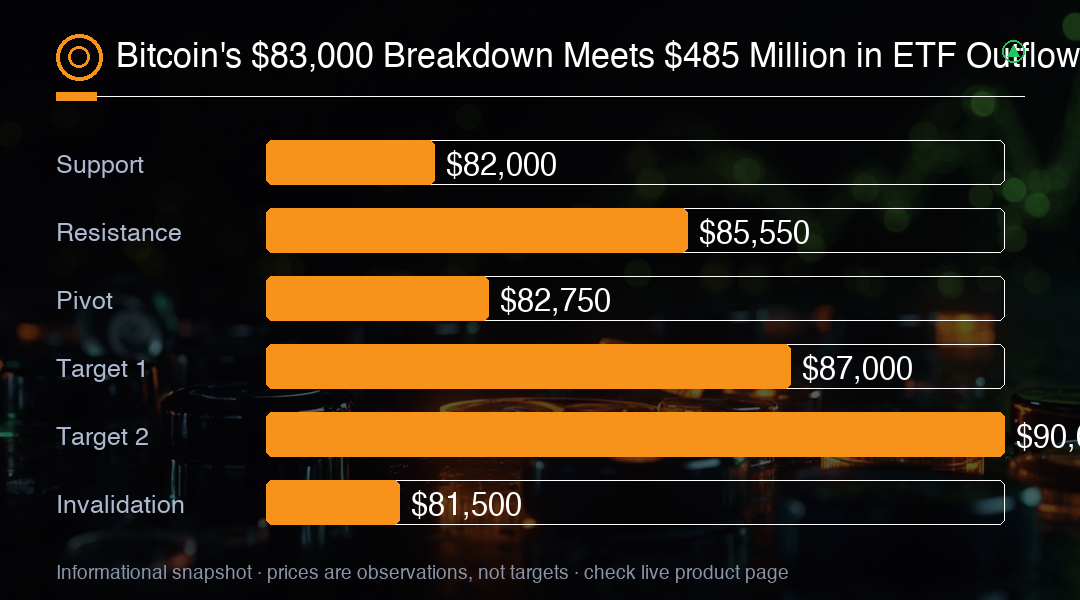
The recent lows around $82,750 provide the immediate downside reference. A sustained break would put the $82,000 round number in focus. The $82,000 level represents a key psychological threshold, and a break below it could trigger additional selling from traders who had placed stop-loss orders just below the round number. The $82,750 level has been tested multiple times in recent sessions, and its repeated defense suggests that buyers are still active at these levels. However, each successive test of a support level weakens it, and a break below $82,750 would likely accelerate the selling pressure as more stop-loss orders are triggered.
On a recovery, Wednesday's opening area near $85,550 and this week's high around $87,000 are useful checkpoints for judging how much selling pressure buyers have absorbed. A move back above $85,550 would indicate that the breakdown below $83,000 was a false signal, while a recovery to $87,000 would suggest that the uptrend from earlier in the week remains intact. Traders will be watching these levels closely for signs of renewed buying interest. The $85,550 level is particularly important because it represents the opening price from Wednesday's session, and a return above it would suggest that the selling pressure has been fully absorbed by buyers.
Watch whether ETF demand returns alongside any price rebound. One positive flow session would not establish a lasting recovery, but repeated inflows would strengthen the evidence of renewed buying. The ETF flow data provides a real-time gauge of institutional sentiment, and a sustained return to inflows would suggest that the recent selling has been absorbed. Conversely, continued outflows would indicate that institutional investors remain cautious and are reducing their exposure to Bitcoin. The interplay between price action and ETF flows will be a key indicator of whether the current pullback is a temporary correction or the start of a more sustained downtrend.
The combination of ETF outflows, elevated Treasury yields, and a strong dollar creates a challenging environment for Bitcoin. A break below $82,750 would likely accelerate selling toward $82,000, while a recovery above $85,550 would signal that buyers have regained control. The near-term outlook depends heavily on whether the macroeconomic headwinds ease or intensify, and traders should monitor both the price action and the ETF flow data for clues about the next directional move. The $82,000 level represents a critical threshold, and its defense or break will likely determine the direction of the next significant move in Bitcoin's price action.
交易洞察
Bitcoin's break below $83,000 combined with $485 million in ETF outflows suggests that sellers remain in control of the near-term trend. A sustained move below $82,750 would likely accelerate selling toward $82,000, while a recovery above $85,550 would signal that buyers have regained control. The macroeconomic backdrop of elevated Treasury yields and a strong dollar continues to weigh on risk assets, making it difficult for Bitcoin to sustain a rebound without a shift in the broader financial conditions.