


OpenAI's annualized revenue reached approximately $50 billion at the end of September, falling well short of the $70 billion figure previously indicated to investors. The gap stems largely from differing accounting treatments of cloud-partner sales between OpenAI and its rivals. AI-linked stocks sold off sharply on the news, with the Nasdaq Composite declining 1.3% and the semiconductor index shedding 3.4%.
The $50 billion run rate represents a monthly revenue pace of roughly $4.2 billion, multiplied by twelve to produce an annualized figure. This is a snapshot of current momentum rather than a completed fiscal year, and it does not capture profit, cash generation, or the full complexity of OpenAI's business model. Investors had been working with a higher number, and the discrepancy forced a rapid reassessment of the company's near-term trajectory. The difference between the two figures, approximately $20 billion, is substantial enough to matter for valuation models and growth expectations across the entire AI sector.
The $70 billion estimate emerged from attempts to make OpenAI directly comparable with Anthropic, its closest rival in the generative AI market. Anthropic includes sales made through cloud partners such as AWS and Google Cloud in its reported revenue, while OpenAI's calculation treats those transactions differently. When analysts tried to align the two companies on the same basis, the higher figure gained currency in market discussions, even though it did not reflect OpenAI's own accounting. The confusion illustrates how quickly estimates can circulate and become embedded in investor thinking before being tested against actual disclosures.
A report indicated that OpenAI still expects to reach or exceed the $70 billion annualized level by December, driven largely by enterprise growth. That would require the run rate to climb approximately 40% from September's pace in just three months. Whether the company can close that gap is now a testable forecast, and investors will watch quarterly disclosures for evidence that the target is within reach. The enterprise segment, which includes business customers integrating AI tools into their operations, is seen as the most likely source of the incremental revenue needed to bridge the gap.
The revenue disappointment hit AI-linked equities across the board on Thursday. Nvidia fell 2.9%, Micron lost 4.8%, Broadcom dropped 4.3%, and Intel slid 5.3%. The semiconductor index shed 3.4%, reflecting broad concern that the AI buildout may not translate into revenue as quickly as the market had priced in. The Nasdaq Composite declined 1.3%, with the heaviest losses concentrated in the names most exposed to AI infrastructure spending. The synchronized nature of the declines suggested that investors were repricing the entire AI complex rather than singling out individual companies.
The selloff underscored how sensitive the AI trade has become to fundamental checkpoints. For months, the sector's rally has been driven by expectations of exponential growth, and any data point suggesting a slower path can trigger rapid repricing. The 1.3% Nasdaq decline may seem modest in isolation, but the concentration of losses in semiconductor names revealed the market's underlying anxiety about the pace of monetization. When the narrative shifts from growth at any cost to scrutiny of actual revenue, the multiple compression can be swift and unforgiving.
Beyond the revenue question, OpenAI is discussing another fundraising round of at least $30 billion, targeting a $1.4 trillion valuation before the new money enters the capital structure. Against the current $50 billion revenue pace, that implies roughly 28 times annualized sales. The multiple is steep by historical standards, but it reflects the market's belief that OpenAI's growth rate will justify the premium over time. For context, most mature technology companies trade at a fraction of that multiple, which means investors are paying for a growth trajectory that remains unproven at scale.
The financing need highlights a central tension in the AI industry. Rapid sales growth still leaves substantial cash requirements, as the company invests heavily in infrastructure to support its expanding user base and enterprise offerings. A report indicated that projected cash burn could approach $280 billion through 2030 as OpenAI scales its operations. That figure dwarfs current revenue and underscores the scale of the bet investors are being asked to make. The gap between revenue and expenditure is the fundamental reason OpenAI continues to seek external capital rather than relying on its own cash flow.
OpenAI has pushed its IPO plans into at least next year, giving the company time to address questions about financial disclosure and reporting consistency. The delay suggests that management recognizes the need to present a clearer picture of revenue, profitability, and cash requirements before entering the public markets. For investors, the postponement removes a near-term catalyst but also reduces the risk of a poorly timed debut. The additional time could allow OpenAI to align its reporting with market expectations and reduce the kind of surprises that triggered Thursday's selloff.
The broader AI trade now faces a period of recalibration. The $50 billion revenue figure, while impressive in absolute terms, fell short of the narrative that had been building in market circles. The 40% growth required to hit $70 billion by December is ambitious, and any shortfall could extend the current volatility in AI-linked equities. Traders will be watching for signs that enterprise adoption is accelerating enough to close the gap. The next earnings disclosure from OpenAI, whenever it comes, will be a critical test of whether the company can meet the targets it has set for itself.
For the semiconductor sector, the revenue miss is a reminder that AI demand, while real, is not immune to the laws of financial arithmetic. Nvidia, Micron, Broadcom, and Intel all saw significant declines, reflecting their outsized exposure to AI infrastructure spending. The 3.4% drop in the semiconductor index suggests that investors are reassessing the timeline for returns on the massive capital expenditures being made across the industry. If AI revenue growth slows even modestly, the implications for semiconductor demand could be significant, given how much of the sector's recent growth has been tied to AI-related orders.
The coming months will test whether OpenAI can deliver on its revenue ambitions and whether the AI trade can regain its footing. The $30 billion fundraising round and the $1.4 trillion valuation target will keep the company in the spotlight, while the path to $70 billion by December offers a concrete milestone for investors to track. For now, the market has spoken: the AI trade is no longer immune to disappointment, and the premium for growth has narrowed. The question going forward is whether the sector can rebuild confidence through consistent execution or whether further surprises lie ahead.
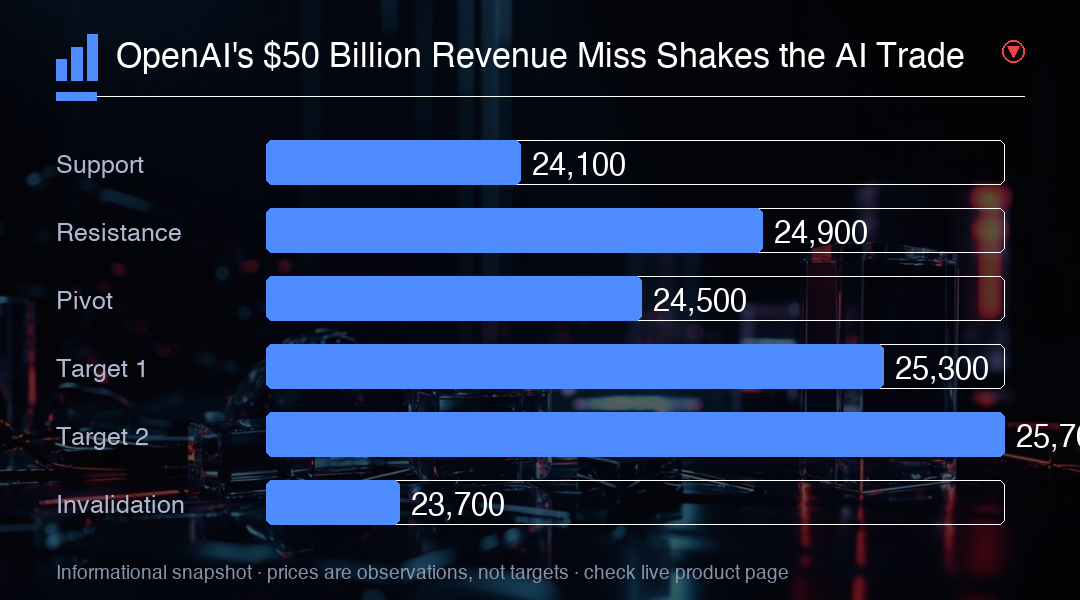
交易洞察
The Nasdaq-100's 1.3% decline reflects a market that is repricing AI growth expectations after OpenAI's revenue shortfall. Support at 24,100 is the first line of defense for the index, and a break below that level could open the door to a deeper pullback toward 23,700. Resistance at 24,900 caps the upside, and a move above that level would suggest the market has absorbed the disappointment and is looking ahead to OpenAI's December revenue target. Traders should watch for a sustained break below 24,100 as a signal that the AI trade is entering a more prolonged period of volatility.