


KEY POINTS: Gold rose 1.5% to $4,200 an ounce early Friday, extending its recovery from Wednesday's two-month low. The US 10-year Treasury yield steadied near 5.23%, below Wednesday's 24-year high. Traders assigned approximately 17% probability to an October Fed increase and 83% to a December hike, keeping rate expectations the key driver for precious metals.
Gold rose 1.5% to $4,200 an ounce early Friday, extending its recovery from Wednesday's two-month low. US gold futures climbed to around $4,210, confirming that buyers were stepping in to defend the psychologically important round number. The rebound came after a difficult week for precious metals, with the yellow metal having fallen sharply during September as the dollar and bond yields climbed. The recovery, while welcome, remains fragile and dependent on further easing in the macro backdrop.
The dollar and bond market gave buyers some breathing room. The US 10-year Treasury yield steadied near 5.23%, below Wednesday's 24-year high, while the dollar's rally slowed. Lower yields reduce the opportunity cost of holding gold, which pays no interest, while a softer dollar helps overseas buyers. These two factors combined to create a more constructive environment for precious metals, but the improvement is relative rather than absolute, with yields still elevated and the dollar retaining its broader advantage.
Silver joined the rebound, gaining 1.7% to $60.50 an ounce. Platinum and palladium also advanced, although all three remained on course for weekly losses. Friday's improvement therefore provides relief within a difficult stretch for precious metals, rather than signalling a decisive turn in the broader trend. The fact that silver outperformed gold is consistent with its higher beta and its greater sensitivity to changes in risk sentiment. When silver leads, it often suggests that buyers are returning to the broader metals complex rather than simply seeking the relative safety of gold.
An October Fed pause would leave further tightening on the table rather than removing it entirely. Governor Christopher Waller said additional hikes would probably be needed but could be spaced out. Traders assigned approximately 17% probability to an October increase and 83% to a December hike. This pricing structure means that even if the Fed holds in October, the market will remain focused on the December meeting, limiting the scope for a sustained rally in precious metals. Any surprise in either direction could trigger significant repricing.
September showed how powerful the pressure from rising yields can become. Gold fell 8.5% during the month, as the 10-year Treasury yield rose 53 basis points and the dollar index gained 2%. Rising borrowing costs overwhelmed substantial investment buying, demonstrating that even strong demand cannot fully offset a hostile macro environment. The speed of the decline surprised many investors who had viewed gold as a safe haven, but the metal's inverse relationship with real yields reasserted itself forcefully.
Demand nevertheless held up beneath the falling price. Global gold ETFs attracted $10 billion, equivalent to 67 tonnes, in September. Meanwhile, managed-money futures positioning contracted sharply. This divergence helps explain why strong fund inflows can coexist with a selloff when derivatives traders reduce exposure and macro conditions worsen. The ETF demand provides a floor under the market, but it is not sufficient to overcome the headwind from rising yields and a stronger dollar. The interplay between physical demand and derivatives positioning will determine whether the current rebound can sustain itself.
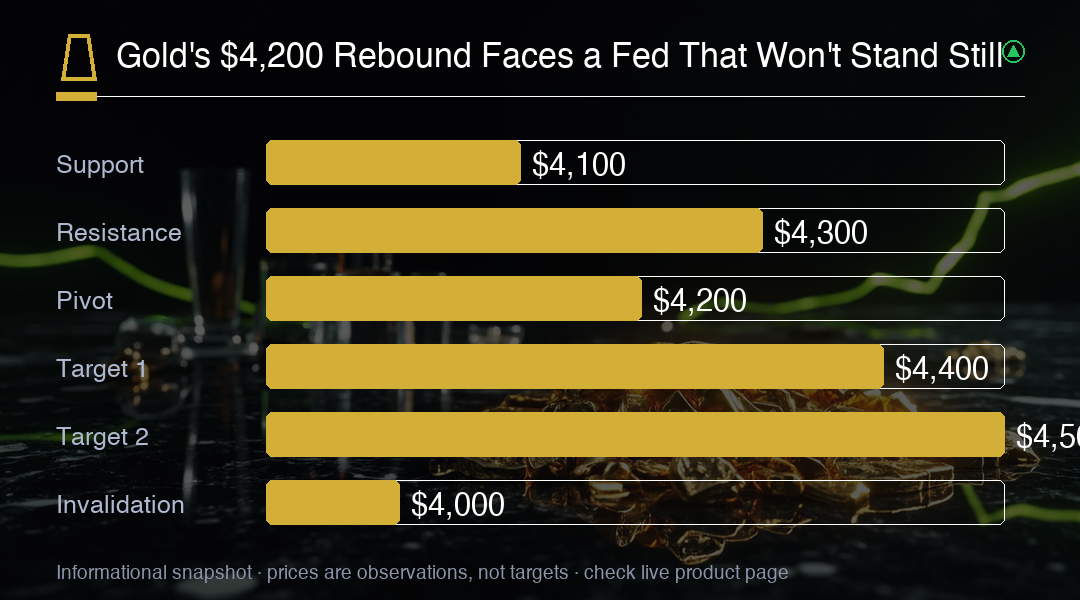
For spot gold, $4,200 is the immediate round-number checkpoint. A sustained move above it would strengthen the recovery case and could attract additional buying from trend-following accounts. Rejection at this level would leave the rebound vulnerable and could trigger a retest of Wednesday's low. The round-number significance of $4,200 makes it a focal point for both technical and fundamental traders, increasing the likelihood of volatile price action around it. How gold behaves at this level will signal whether the worst of the selling is over or whether the broader downtrend remains intact.
Below the market, $4,100 and $4,000 provide useful psychological reference points. These levels frame potential reactions rather than establishing a confirmed trend reversal. A break below $4,100 would suggest that the rebound has failed and that sellers remain in control, while a move toward $4,000 would represent a more significant decline that could trigger fresh technical selling. The fact that these levels are round numbers means they attract additional attention from traders, increasing the probability that they will act as magnets for price action.
Government-debt concerns complicate the usual relationship with yields. Higher bond returns can discourage gold ownership by increasing the opportunity cost, but investors may also buy bullion when those yields reflect fiscal or inflation anxiety rather than economic strength. This dual dynamic means that rising yields are not uniformly negative for gold; the reason behind the rise matters. If yields are climbing because of strong growth and contained inflation, gold suffers. If they are climbing because of fiscal stress or inflation fears, gold may benefit despite the higher opportunity cost.
Friday's Michigan consumer survey supplies the next test for the precious-metals market. Sentiment is expected near 47.5 versus 48.1 previously, with inflation expectations particularly relevant. A rise in inflation expectations could reinforce concerns about persistent price pressures and keep the hawkish Fed scenario intact, which would be negative for gold. Conversely, a decline in inflation expectations could ease some of the pressure on the Fed and provide additional support for precious metals. The survey's inflation component may matter more than the headline sentiment figure.
The broader outlook for gold remains dependent on the trajectory of US yields and the dollar. Until there is clear evidence that inflation is under control and that the Fed is finished tightening, precious metals will struggle to sustain a meaningful rally. The current rebound is a welcome respite, but it should be viewed within the context of a difficult month that saw gold fall 8.5%. Investors should watch the $4,200 level closely, as it will determine whether the recovery has legs or whether it is simply a pause in a broader downtrend. The coming weeks will reveal whether the macro backdrop is genuinely turning more favourable or whether current conditions persist.
交易洞察
Gold's rebound to $4,200 faces resistance from a Fed that is not done tightening, with 83% probability still assigned to a December hike. A sustained break above $4,200 would strengthen the recovery case and target $4,300, while a rejection at this level would leave the rebound vulnerable to a retest of $4,100. Watch Friday's Michigan inflation expectations for the next directional catalyst.