


KEY POINTS: Samsung Electronics forecast third-quarter operating profit of 107.4 trillion won, around $80 billion, up 783% from a year earlier. Revenue is expected to reach 195 trillion won, up 126.6% year over year, implying an operating profit ratio of roughly 55%. Shares slipped 0.2% in early Thursday trading despite the surge in projected earnings, remaining more than 25% below June's record high.
The preliminary guidance marks a dramatic recovery for the South Korean chipmaker, which had struggled with weak memory demand and inventory write-downs in prior quarters. Operating profit measures earnings from the business before interest and taxes, and it is distinct from net income. The 783% year-over-year increase reflects both a depressed base effect from a year ago and a sharp acceleration in memory pricing driven by AI-related demand. Thursday's guidance also showed a 20% increase from the previous quarter, underscoring the momentum building inside the semiconductor division.
Revenue is expected to reach 195 trillion won, up 126.6% year over year. Those figures imply an operating profit ratio of roughly 55%, calculated by dividing operating profit by sales. Profit growing much faster than revenue shows how strongly the memory cycle has improved Samsung's earnings power. The profit ratio expansion suggests that the company has significant operating sensitivity, meaning that each additional won of revenue flows through to profit at an elevated rate once fixed costs are covered.
Shares slipped 0.2% in early Thursday trading, despite roughly doubling this year. They remain more than 25% below June's record. The restrained response suggests investors are assessing how long exceptional profitability can last, with much of the earnings improvement already baked into prices. When a stock has already rallied substantially, even extraordinary earnings guidance can fail to generate additional buying if the results merely confirm what the market had already anticipated.
The boom extends beyond specialist AI chips. Tight supplies of conventional DRAM and NAND memory have helped raise prices alongside demand for high-bandwidth memory, or HBM. DRAM supports active computing tasks, NAND stores data, and HBM supplies the rapid data access required by advanced AI processors. The convergence of shortages across all three categories has created a pricing environment that benefits memory producers across the board, rather than concentrating gains in a single product line.
Samsung's HBM bit shipments increased nearly 50% from the previous quarter, with HBM4 making a growing contribution. Bit shipments measure the quantity of memory capacity delivered, rather than revenue. The rapid growth in bit shipments indicates that Samsung is not only benefiting from higher prices but also from expanding volumes, which together drive the sharp increase in operating profit. HBM4 represents the next generation of high-bandwidth memory, and its growing contribution suggests that Samsung is maintaining its competitive position in the most advanced segment of the memory market.
Higher memory prices also squeeze Samsung's consumer businesses. Analysts estimate losses exceeding 1 trillion won in its smartphone and consumer-electronics division. Components that strengthen semiconductor earnings can simultaneously increase the cost of making phones and other devices, leaving the group's performance increasingly dependent on memory profits. This dynamic creates a paradox where the same force that drives record semiconductor profits also undermines profitability in other divisions, making the conglomerate's overall earnings more cyclical and concentrated.
A stronger South Korean won adds another complication. Dollar-denominated overseas sales translate into fewer won when the local currency appreciates, potentially reducing reported earnings. That makes exchange rates relevant alongside chip demand, particularly when assessing whether analyst forecasts leave enough room for currency pressure. Samsung generates a substantial portion of its revenue from exports, which means that exchange-rate fluctuations can have a material impact on the translated value of overseas sales and the competitiveness of its products in foreign markets.
Detailed results arrive October 29, including divisional earnings and further discussion of shareholder returns. Investors will scrutinize the breakdown between semiconductor and non-semiconductor divisions to assess the true quality of the earnings recovery. The disclosure of shareholder returns could provide additional support for the stock if the company announces buybacks or dividend increases, signaling management's confidence in sustained profitability. Until then, the market must rely on the preliminary guidance and analyst estimates, which may prove conservative or optimistic depending on how memory prices evolve in the coming weeks.
The divergence between Samsung's surging profit forecast and its muted share price highlights a broader question facing AI-related stocks. When earnings growth is already extraordinary, the market must decide whether current prices reflect a temporary peak or the beginning of a sustained upcycle. The 0.2% decline on Thursday suggests that many investors have adopted a wait-and-see approach, preferring to validate the durability of memory demand before committing additional capital. This cautious stance is consistent with the broader market's recent behavior, where even strong earnings have failed to lift shares when valuations are already elevated.
The memory cycle's trajectory will likely determine Samsung's share price direction in the coming months. If DRAM and NAND prices continue to rise, the company could exceed its own guidance and analyst estimates, providing a catalyst for the stock to retest its June highs. Conversely, any sign of weakening demand or increasing supply could trigger a sharp reversal, as the market would quickly reprice the earnings outlook downward. The concentration of profits in the semiconductor division means that Samsung's equity story is now inseparable from the memory cycle, making it essential for investors to monitor inventory levels, pricing trends, and end-demand indicators across the AI and consumer electronics sectors.
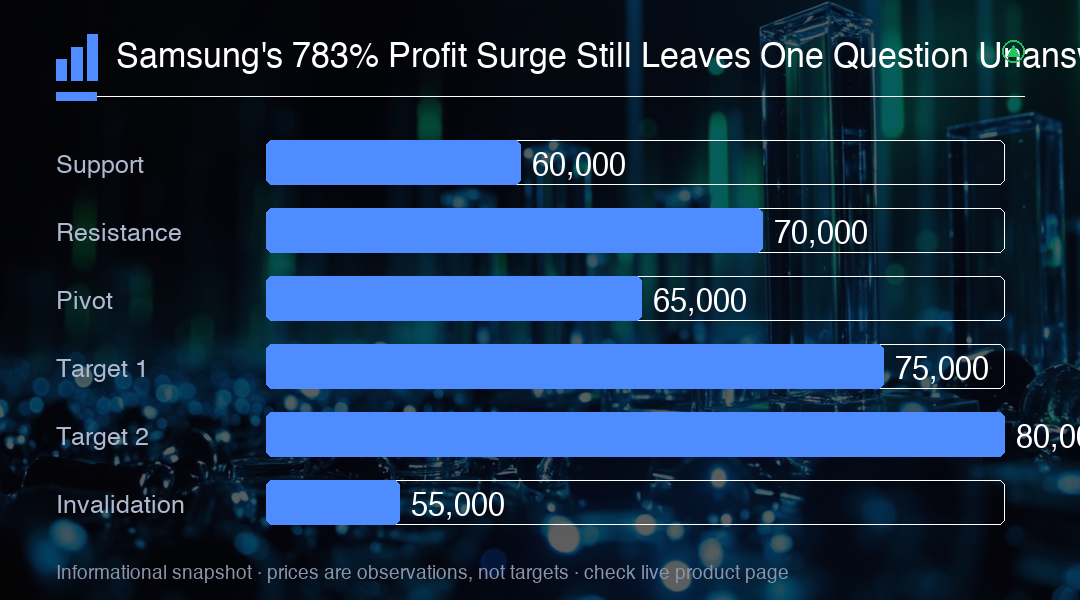
For now, the key levels to watch are the June record high and the recent support zone that has contained the pullback. A sustained move above the June peak would signal that the market has fully priced in the earnings recovery and is looking toward the next leg of the AI-driven memory boom. A break below recent support would suggest that investors are rotating away from AI-related names or that the memory cycle is peaking sooner than expected. The October 29 earnings release will provide the next major catalyst, with divisional detail and management commentary offering clues about whether the 783% profit surge is a one-quarter anomaly or the start of a new earnings baseline.
交易洞察
Samsung's 783% profit forecast to 107.4 trillion won confirms the AI memory boom is real, but the muted 0.2% share price response shows the market is pricing in durability rather than celebrating the headline. A sustained move above the June record high would signal that investors believe the memory upcycle has further to run, while a break below recent support would suggest the market views the current earnings peak as cyclical rather than structural. The October 29 detailed results will be the next catalyst, with divisional breakdown and HBM4 shipment data offering the clearest evidence of whether this profit surge represents a new baseline or a temporary spike.