


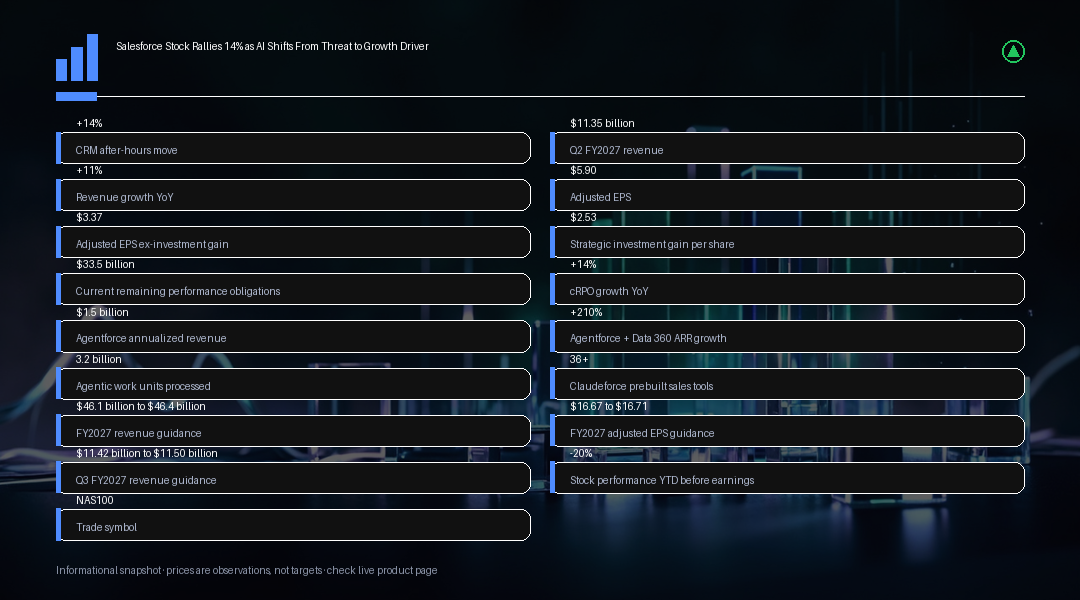
Salesforce shares rose roughly 14% in extended trading after fiscal second-quarter results beat expectations and management raised its full-year outlook, giving the software giant its clearest evidence yet that artificial intelligence products can support growth rather than erode it. The move, one of Salesforce's largest single-session reactions in years, comes after the stock had been down roughly 20% year to date heading into the report as investors weighed whether generative AI tools would eventually displace the company's core software platforms rather than extend them.
The numbers behind the rally were strong on their own terms. Fiscal second-quarter revenue, for the period ended July 31, 2026, rose 11% year over year to $11.35 billion, narrowly ahead of what the market had been looking for. Adjusted diluted earnings per share more than doubled to $5.90, though that headline figure needs context: roughly $2.53 per share of the beat, tied to an estimated $2.6 billion gain on Salesforce's strategic investment in Anthropic, came from investment appreciation rather than core software operations. Strip that gain out and adjusted EPS was closer to $3.37, a more representative read on operating performance.
A forward-looking demand signal also stood out. Current remaining performance obligations, revenue already contracted but not yet recognized over the next 12 months, rose 14% to $33.5 billion, indicating that the sales pipeline behind Salesforce's subscription business remains intact even as growth investors debate the pace of the AI transition.
On the AI product side, Agentforce and Data 360 combined annualized recurring revenue surged more than 210% to nearly $3.9 billion, with Agentforce's own annualized revenue topping $1.5 billion, up roughly 240% from a year earlier. Customers processed 3.2 billion agentic work units during the quarter, tasks completed autonomously by AI agents rather than simply demonstrated in a sales pitch. Management frames this as evidence that AI is becoming an incremental growth driver, though a single quarter of accelerating usage does not by itself prove the trend can be sustained at a similar pace, and annualized revenue figures do not automatically translate into equivalent recognized revenue in future periods.
Salesforce also deepened its relationship with Anthropic through a new offering called Claudeforce, which layers Claude models onto Salesforce's customer data, governance controls and workflow automation. The first release ships with more than 36 prebuilt sales tools, an approach designed to let enterprise customers deploy AI agents without building custom integrations from scratch. The expanded partnership directly addresses one of software investors' biggest fears this year: that large language models would eventually bypass established platforms like Salesforce and interact directly with enterprise data. Salesforce's counter-argument is that businesses still need trusted permissions, governance and workflow structure around any AI model, and that owning those layers keeps the company relevant even as the underlying models evolve.
Guidance moved higher across the board. Salesforce raised its fiscal 2027 revenue outlook to a range of $46.1 billion to $46.4 billion, up from a prior $45.9 billion to $46.2 billion, and lifted adjusted EPS guidance to $16.67 to $16.71 per share from $14.06 to $14.12, reflecting stronger core operations, the Anthropic-related investment gain and a reduced share count from buybacks. Third-quarter revenue is guided to a range of $11.42 billion to $11.50 billion. Management pointed to Agentforce, Data 360 and Slack as offsetting continued softness in traditional license revenue, with the pending Contentful and Fin acquisitions expected to contribute once they close.
The scale of the after-hours move suggests investors had priced in a far more cautious outcome. Entering the print, the stock's roughly 20% year-to-date decline reflected genuine uncertainty about competitive displacement risk from AI-native software startups. One strong quarter does not resolve that debate completely, but it does provide the clearest data point yet that Agentforce adoption is translating into measurable annualized revenue rather than remaining a pilot-program curiosity.
Traders should watch whether Agentforce and Data 360 growth can continue without leaning on further gains tied to the Anthropic stake, since investment gains are inherently more volatile than recurring subscription revenue. The durability of Agentforce's roughly 240% annualized growth rate across consecutive quarters, rather than any single print, will likely determine whether the market keeps rewarding the stock at current levels. Execution risk around the still-pending Contentful and Fin acquisitions is a second variable that could affect whether the raised full-year guidance holds through the rest of fiscal 2027.
Salesforce's print landed alongside a broader rotation into AI-linked software and cybersecurity names this week, with cybersecurity vendor CrowdStrike and identity-management specialist Okta also posting strong post-earnings gains. That grouping suggests investors are increasingly willing to reward established enterprise software vendors that can show tangible AI monetization, rather than assuming AI upside accrues only to chipmakers and hyperscale cloud providers. For Salesforce specifically, the read-through is that its scale advantage, an existing base of enterprise customers with entrenched data and workflows, may prove more durable against AI disruption than bears had assumed earlier in the year.
Options markets and short-dated implied volatility around Salesforce's earnings had priced in a sizable move given the binary nature of the AI-threat-versus-AI-driver debate. With the stock still well off its 2026 highs even after this rally, near-term price action is likely to hinge on whether the next cash session confirms follow-through buying or whether some of the extended-hours gain fades once broader market participants weigh the quality of the earnings beat, particularly the split between recurring operating profit and one-time investment gains.
Trading Insight
For traders positioning around CRM, the key distinction is between recurring operating strength and one-time investment gains. The 11% revenue growth, 14% rise in current remaining performance obligations and accelerating Agentforce annualized revenue are the more durable signals, while the roughly $2.53 per share Anthropic-related gain should be treated as a balance-sheet event rather than a repeatable earnings driver. MC Markets does not cite exact source levels without independent market-data verification, so confirm current support and resistance zones independently before sizing any position. A sustained move above the stock's pre-earnings trading range would suggest the market is starting to price in durable AI monetization, while a reversal back toward the prior range would indicate the rally was driven mainly by relief that the AI-disruption thesis did not play out this quarter. Either way, upcoming quarters will need to show Agentforce growth continuing without heavy reliance on investment gains for the bullish case to hold.