

Nvidia’s fiscal second-quarter report arrives with two stories competing for control of the market reaction: another steep step-up in AI revenue, and reports that some complete AI server systems could cost more than 15% more next year. The earnings test is not simply whether revenue beats consensus; it is whether pricing power, memory costs and the next-quarter outlook still support a durable expansion.
That distinction matters well beyond one stock. Nvidia sits at the centre of semiconductor expectations and the AI-capex cycle, so its results can move chip shares, Nasdaq futures and high-beta risk appetite in the same session.
Key takeaways
- NVIDIA is scheduled to release Q2 FY2027 results on Aug. 26 after the US close.
- Wall Street expects about $91.9B in revenue, only modestly above the company’s $91.0B guidance midpoint.
- The reported 15%+ server-price increase matters through demand, gross margin and forward guidance — not as a standalone bullish signal.
When does Nvidia report, and what is the baseline?
NVIDIA plans to publish results at approximately 1:20 p.m. Pacific time on Wednesday, Aug. 26, 2026, followed by its conference call at 2:00 p.m. PT. The company says the quarter ended July 26.
The starting point is unusually high. NVIDIA reported $81.6 billion of Q1 FY2027 revenue, up 85% from a year earlier, with Data Center revenue of $75.2 billion, up 92%. For Q2, management guided to approximately $91.0 billion, plus or minus 2%. IG’s Aug. 25 preview put consensus across roughly 60 analysts near $91.9 billion and adjusted earnings near $2.09 per share.
The narrow gap between guidance and consensus makes the quality of the result important. A small beat may say less than the mix of data-centre demand, the gross-margin path and management’s description of the next product cycle.
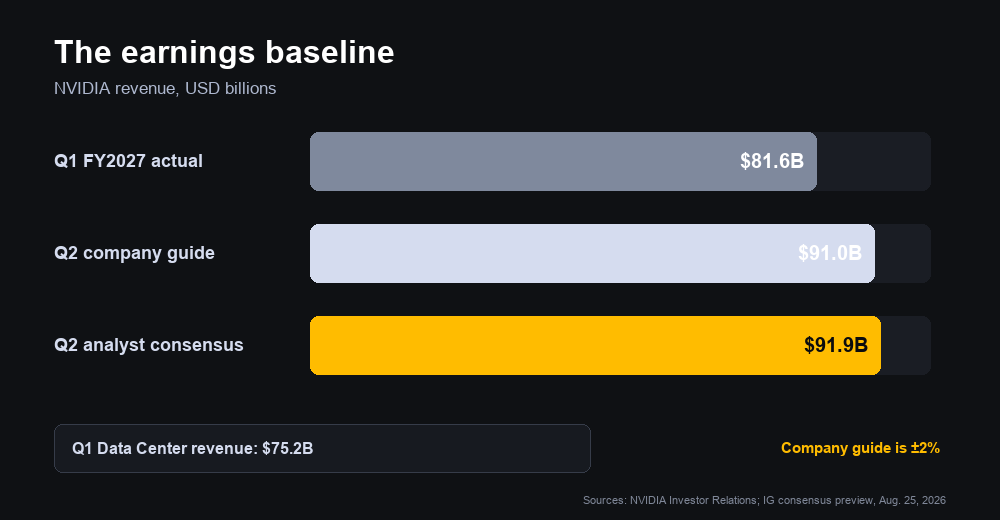
Revenue figures are in US dollars. Company guidance is a midpoint with a ±2% range; analyst consensus can change before the release.
What do the reported 15% server price hikes actually mean?
They point to pricing pressure across complete AI server systems, not a confirmed blanket increase in every NVIDIA chip. Bloomberg reporting, summarized by Yahoo Finance on Aug. 23, said servers containing NVIDIA AI chips are expected to rise by more than 15% in many cases for systems shipping early next year. The size reportedly varies by chip generation and memory configuration, including systems built around Vera Rubin and Grace Blackwell.
That detail creates two plausible readings. The demand reading is that customers are still competing for scarce accelerated-computing capacity, allowing the supply chain to pass through higher costs. The cost reading is that expensive high-bandwidth and conventional memory could absorb more of the system economics. NVIDIA’s reported price is therefore only the start of the analysis; traders need to hear who captures the increase and whether customers change order timing.
The claim also has a timing mismatch with this quarter. Systems shipping early next year may shape the forward order book and customer budgets, but they do not automatically lift Q2 revenue. Treat it as evidence for the outlook discussion, not a shortcut to the reported number.
Why could guidance matter more than a narrow earnings beat?
Because current expectations already sit just above management’s Q2 midpoint, the market may focus more on Q3 revenue and gross margin than on a small historical beat. IG reported Q2 gross-margin targets of 74.9% on a GAAP basis and 75.0% on a non-GAAP basis. If revenue clears consensus but the margin outlook weakens, the market may conclude that input costs or product-transition expenses are rising faster than pricing power.
The reverse is also possible. A modest Q2 result paired with stable margins, firm demand and confident shipment commentary could keep the longer AI-capex story intact. Traders should separate three questions on the call: Are customers taking available supply? Can higher component costs be passed through? Does the next-quarter guide show acceleration, stability or a pause?
Product commentary matters as well. The market will listen for Blackwell Ultra execution, the Vera Rubin production and shipment timetable, and any constraints around China-related data-centre sales. These are forward indicators; none should be inferred from a headline EPS beat alone.
How can traders read the first market reaction?
Start with the combination of revenue guidance and gross margin, then check whether the reaction broadens beyond NVDA. A single after-hours move can be noisy. Confirmation becomes stronger when semiconductor peers, Nasdaq futures and other growth-sensitive assets move in the same direction after management provides guidance.
| Evidence after the release | What it may indicate | What would weaken that read |
|---|---|---|
| Revenue and Q3 guide above expectations; margins steady | Demand and pricing power are absorbing higher system costs | Weak order commentary or a margin step-down later in the call |
| Revenue beat; Q3 guide or margins disappoint | The historical quarter was strong, but forward expectations were too high | Clear evidence that weakness is temporary supply timing rather than demand |
| NVDA rises with semiconductor breadth and Nasdaq futures | The market is treating the result as an AI-cycle signal, not a company-only event | NVDA holds but chip peers and index futures fade |
| NVDA falls while broader risk assets hold | The disappointment may be concentrated in valuation or company execution | Contagion into semiconductors, Nasdaq futures and high-beta crypto |
For broader context, compare the reaction with MC Markets’ review of global indices around AI earnings and its analysis of the memory cycle’s effect on Micron and the chip complex.
What should crypto and index traders watch next?
Watch whether the earnings message changes broad risk appetite, rather than assuming every NVDA move must carry into Bitcoin or Nasdaq futures. A strong guide with stable margins can reinforce the AI-capex narrative and support growth-sensitive assets. A weak guide can tighten risk budgets, especially if semiconductor breadth deteriorates at the same time.
Crypto adds its own liquidity, regulatory and positioning drivers, so the link is not mechanical. The useful sequence is NVDA’s after-hours response, semiconductor breadth, Nasdaq futures after the call, then whether Bitcoin and other high-beta assets confirm or diverge. Divergence is information: it can show that the earnings shock remains sector-specific.
Final thoughts
The reported server-price increases make this earnings event more nuanced, not more predictable. They can signal exceptional demand, real cost inflation, or both. The clearest reading will come from how NVIDIA connects revenue, gross margin and the next-quarter outlook — and whether the rest of the market accepts the same interpretation after the call.