

Micron and SanDisk's relief bounce has put the AI-memory trade back on traders' screens just as NVIDIA reaches its biggest test of the quarter. The rebound can hold only if NVIDIA's result and outlook confirm that data-centre demand is still strong enough to support the wider semiconductor supply chain.
That makes this more than a one-stock earnings event. NVIDIA is the demand signal; Micron and SanDisk are two different memory read-throughs; semiconductor breadth and NAS100 show whether the market believes the message.
Key takeaways
- NVIDIA is due to release Q2 FY2027 results at about 1:20 p.m. PT on Aug. 26, before a 2:00 p.m. call.
- Tuesday's rebound broadened across chips, but premarket and closing returns were not equally strong in every name.
- The clean confirmation is a chain: guidance, memory demand, semiconductor breadth, then NAS100.
What actually rebounded after the semiconductor selloff?
Technology and chip shares recovered on Aug. 25, but the move was a relief rally rather than proof that the prior selloff was over. Reuters reported that NVIDIA closed 2.2% higher, Micron gained 2.5% and the PHLX Semiconductor Index added 1.4%. The Nasdaq Composite rose 0.66%, ahead of the S&P 500's 0.32% gain.
The context matters. Reuters said the semiconductor index had fallen 2.7% in the previous session. Lower oil prices and falling longer-dated Treasury yields helped growth shares on Tuesday, so part of the recovery came from a friendlier macro backdrop, not from new company results.
SanDisk shows why timestamps cannot be mixed. TipRanks recorded the stock about 3.7% higher in Tuesday premarket trading, while Micron was indicated about 2.1% higher. Those are premarket observations, not official closing returns. The attempted bounce was real, but it did not give every memory stock the same end-of-day outcome.
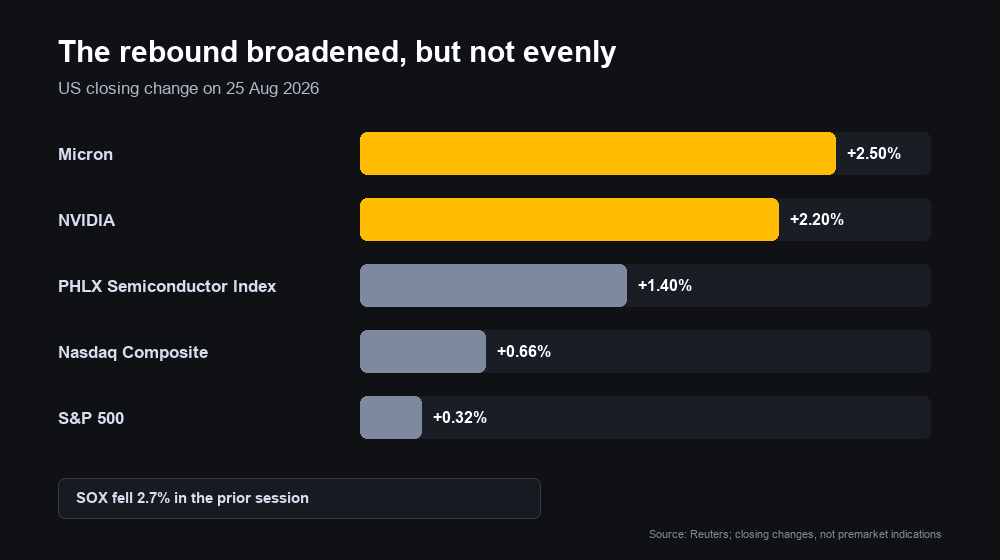
Reuters closing changes for Aug. 25, 2026. The SanDisk figure discussed above is a separately labelled premarket indication.
What must NVIDIA deliver for the rebound to hold?
NVIDIA needs to pair a solid Q2 result with an outlook that preserves confidence in the next leg of AI infrastructure spending. The company's starting point is already demanding. NVIDIA reported $81.615 billion of Q1 FY2027 revenue, including a record $75.2 billion from Data Center. Management then guided Q2 revenue to $91.0 billion, plus or minus 2%, with non-GAAP gross margin around 75.0%.
TipRanks cited Wall Street expectations of about $92.1 billion in revenue and $2.09 in adjusted earnings per share. That leaves only a modest gap between the company's revenue midpoint and consensus. A narrow beat may therefore matter less than Q3 guidance, gross-margin direction and what management says about customer budgets, supply and deployment timing.
There is another important boundary in the baseline: NVIDIA said its Q2 outlook assumed no Data Center compute revenue from China. Traders should not treat any China commentary as an automatic upside contribution. The question is whether the reported business and forward guide outperform the baseline as it was actually set.
The result is scheduled for approximately 1:20 p.m. Pacific time on Aug. 26, followed by the call at 2:00 p.m. PT. The first after-hours move can change once written commentary and analyst questions reveal the quality of the guide.
Why do Micron and SanDisk read through differently?
Micron is the more direct high-bandwidth-memory and DRAM read-through, while SanDisk gives a different view of NAND and storage demand. Both can benefit from AI infrastructure growth, but they do not sell the same mix of memory into the same parts of the system.
For Micron, the key link is whether accelerator deployments keep pulling advanced HBM and server DRAM through the supply chain. NVIDIA does not need to name Micron for that signal to matter. Strong data-centre demand, stable margins and confident shipment guidance can support the industry's volume and pricing assumptions; a softer deployment outlook can challenge them.
SanDisk's exposure sits more heavily in NAND flash and storage economics. AI inference, data pipelines and storage-intensive workloads can help the demand story, but NAND has its own inventory, pricing and supply cycle. A strong NVIDIA report can improve sentiment without guaranteeing the same earnings effect for SanDisk.
This distinction is the article's main guardrail: a shared AI narrative can lift both stocks, yet their confirmation data are different. Traders should resist turning “memory” into one undifferentiated trade.
How can traders test whether the rebound is durable?
Use a four-link sequence instead of judging the event from NVIDIA's headline percentage move. Start with the result and guidance, then ask whether the message carries through memory shares, the semiconductor index and NAS100.
| Evidence after the release | Constructive reading | What would weaken it |
|---|---|---|
| NVIDIA Q3 revenue guide and gross margin | Demand remains strong without a material loss of pricing quality | A revenue beat paired with softer guidance or a margin step-down |
| Micron and SanDisk reaction | Both hold gains after the call, with the different memory stories still supported | NVDA rises while memory names fade or diverge sharply |
| Semiconductor breadth | The PHLX Semiconductor Index confirms rather than relying on one mega-cap | A narrow NVDA move with weak chip participation |
| NAS100 after-hours and next session | Growth-market risk appetite accepts the earnings message | An initial spike reverses once US cash liquidity returns |
The order matters. A headline beat is historical; guidance is forward-looking; breadth shows whether investors generalise the result. For the margin and server-pricing side of the event, see MC Markets' NVIDIA earnings and server-price preview. For the longer memory-cycle setup, see the Micron rally confirmation test.
What does NVIDIA earnings mean for NAS100 and crypto traders?
For NAS100 traders, the event is a test of index breadth and valuation tolerance; for crypto traders, it is a risk-appetite signal rather than a direct earnings input. NVIDIA's scale means a large move can affect the technology complex immediately, but the more useful signal is whether other semiconductors and growth shares confirm it.
A strong guide, steady margins and broad chip participation can support the AI-capex narrative. A beat that fails to lift peers may reveal that expectations were already crowded. A weak guide combined with falling semiconductor breadth can tighten risk appetite more widely.
Bitcoin and other high-beta assets can respond to the same liquidity and positioning shifts, but the link is not mechanical. Crypto has its own flow, policy and leverage drivers. If NAS100 and chips react strongly while crypto does not, that divergence suggests the earnings shock remains concentrated in equities.
Final thoughts
Tuesday's rebound repaired some of the semiconductor damage; it did not settle the argument. NVIDIA now has to show that the demand behind the AI buildout is still translating into credible forward growth. The best read will come from the chain, not the first candle: guidance, memory shares, sector breadth and then NAS100.