

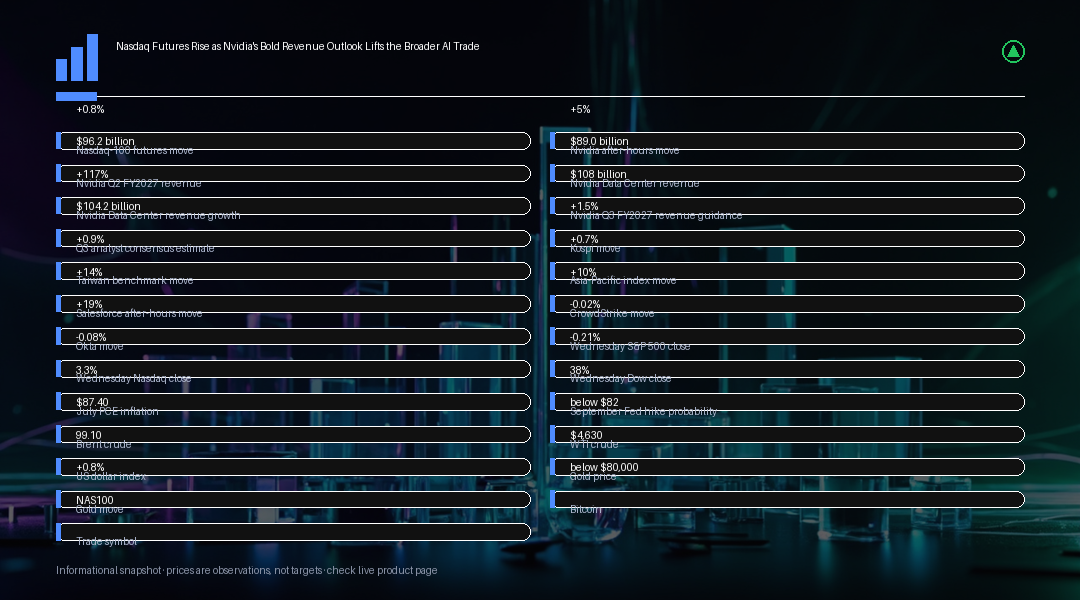
Nasdaq-100 futures rose around 0.8% Thursday, with S&P 500 and Dow futures also advancing, after Nvidia's latest earnings report and forward guidance renewed risk appetite across AI-linked technology stocks in both the United States and Asia. The premarket move followed a comparatively quiet Wednesday cash session, in which the S&P 500 slipped 0.02%, the Nasdaq eased 0.08% and the Dow fell 0.21% as elevated inflation data kept a lid on broader risk-taking.
Nvidia shares rose roughly 5% in after-hours trading after the company reported fiscal second-quarter revenue of $96.2 billion, up 106% year over year, alongside non-GAAP diluted earnings per share of $2.22. Data center revenue, the company's core AI computing segment, reached $89.0 billion, up 117% year over year. Nvidia guided fiscal third-quarter revenue to approximately $108 billion, plus or minus 2%, above the roughly $104.2 billion analyst consensus reported ahead of the print.
Chief Financial Officer Colette Kress also told investors Nvidia expects approximately 70% revenue growth in fiscal 2028, well above analyst expectations of roughly 45% heading into the report. That figure is management commentary on the company's longer-term outlook rather than formal quarterly guidance, and it remains subject to execution, supply availability and continued hyperscaler capital spending, but the size of the gap against prior Street expectations helped fuel the broad AI-sector rally that followed.
Nvidia's outlook lifted AI hardware suppliers across Asia during the region's Thursday session. South Korea's Kospi gained 1.5%, Taiwan's benchmark advanced 0.9% and the broader Asia-Pacific index added 0.7%, with memory and networking suppliers SK Hynix and Samsung Electronics among the notable gainers as demand for memory and data-center hardware showed no sign of slowing.
The rally extended beyond hardware. Salesforce jumped roughly 14% after hours after raising its annual revenue and profit forecasts and expanding its partnership with Anthropic, while cybersecurity vendor CrowdStrike rose more than 10% and identity-management company Okta advanced roughly 19% on their own post-earnings strength. The breadth of the move, spanning chips, enterprise software and cybersecurity, suggests investors are rewarding AI-linked business models broadly rather than concentrating gains in semiconductor names alone.
The broader risk-on tone comes against a more complicated inflation backdrop. July personal consumption expenditures inflation held at 3.3%, keeping alive the possibility of another Federal Reserve rate move, with markets pricing roughly a 38% probability of a September rate hike. Federal Reserve Chair Kevin Warsh is scheduled to speak Friday at the Jackson Hole symposium, and traders will be listening for whether his remarks suggest the central bank is prepared to act on persistent price pressures or continue to hold steady.
Energy markets moved in the opposite direction of equities. Brent crude fell for a fourth consecutive session, trading toward $87.40, while West Texas Intermediate slipped below $82 as Iran, Oman and Qatar pursued talks over the Strait of Hormuz, though no reopening agreement has been reached. The US dollar index held near 99.10, gold rose about 0.8% to $4,630, and Bitcoin remained under $80,000, a mix that suggests some investors are still hedging against fiscal and currency-debasement concerns even as equity risk appetite improves.
Thursday's regular cash session will be the more meaningful test of whether Nvidia's print can translate premarket optimism into a broader, sustained equity advance, or whether Wednesday's more cautious tone, driven by sticky inflation, reasserts itself once the initial earnings reaction fades. The combination of a still-elevated 38% probability of a September Fed hike and Warsh's upcoming Jackson Hole remarks means the macro backdrop remains just as important to Nasdaq direction this week as any single earnings report.
For index traders, the setup illustrates how concentrated the current market narrative has become around a handful of AI-linked mega-cap names. Nvidia's results and guidance are being treated as a proxy for the health of the entire AI infrastructure cycle, meaning Nasdaq-100 futures are likely to remain unusually sensitive to updates from the small group of companies, chipmakers, hyperscalers and now enterprise software vendors, that anchor the AI capital-spending narrative in the months ahead.
The move also underscores how much index-level performance now depends on a narrow set of AI infrastructure and software names. Nasdaq-100 constituents tied to AI chips, cloud computing and enterprise automation carry an outsized weight in the index relative to their share of the broader economy, which means a single company's earnings report can move futures well beyond what a typical single-stock reaction would imply for a diversified benchmark. That concentration cuts both ways: it can amplify index gains on strong prints like this one, but it also raises the stakes for any disappointment from the same handful of companies in future quarters.
Cross-asset signals from Thursday's session were not uniformly risk-on. Gold's roughly 0.8% advance to $4,630 alongside a resilient US dollar index near 99.10 suggests some investors are maintaining hedges against inflation and fiscal risk even while rotating into AI-linked equities, a combination that points to a market still hedging its bets rather than moving into full risk-on mode across every asset class simultaneously.
Trading Insight
For traders watching Nasdaq-100 exposure, this session is as much about macro confirmation as it is about Nvidia's specific numbers. A clean follow-through in the regular cash session, with breadth extending beyond mega-cap tech into software and semiconductors broadly, would support the case that the AI trade has genuine additional room to run. A fade back toward Wednesday's more cautious tone would suggest the premarket reaction was driven mainly by a single outsized earnings beat rather than a durable shift in risk appetite. MC Markets does not cite exact source levels without independent market-data verification, so confirm current index support and resistance independently before trading around this move. Keep a close watch on Friday's Jackson Hole commentary from Fed Chair Kevin Warsh, since a hawkish surprise on inflation could quickly offset any AI-driven optimism built into index pricing this week.