


Dick's Sporting Goods shares fell sharply on Tuesday after the sporting-goods retailer reported fiscal second-quarter results that missed profit expectations and management cut its outlook for the year, with the Foot Locker business at the center of the disappointment. The decline, on the order of 30 percent during the session, reflected investor concern that the roughly $2.5 billion Foot Locker acquisition has exposed the combined company to a far more promotional athletic footwear and apparel market than management anticipated when the deal closed in September 2025.
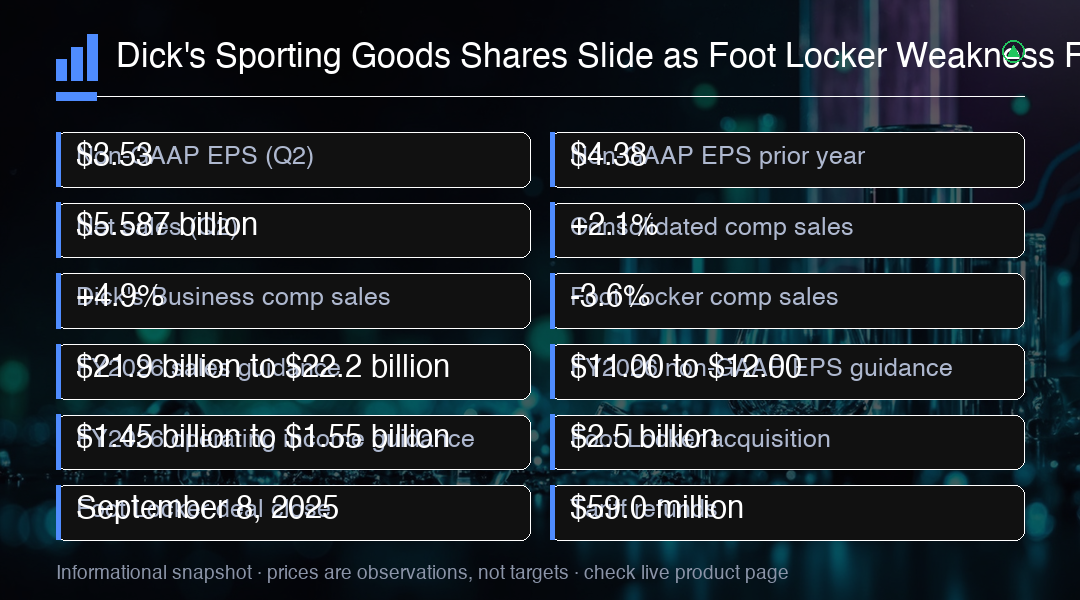
For the quarter, net sales rose 53.2% year over year to $5.587 billion, a jump driven almost entirely by the inclusion of the Foot Locker business rather than organic growth at existing Dick's stores. Non-GAAP diluted earnings per share came in at $3.53, down from $4.38 in the prior-year period, while GAAP diluted EPS was $3.50. Both profitability lines fell even as the top line expanded, a combination that tends to unsettle investors because it signals margin compression rather than simple scale growth.
Beneath the headline figures, the quarter told two very different stories. The core Dick's Sporting Goods business delivered comparable-sales growth of 4.9%, a healthy result that shows the legacy chain's merchandising and store execution remain sound. Foot Locker, however, posted a 3.6% decline in pro forma comparable sales, a metric that adjusts for the fact that Foot Locker will not be folded into the standard year-over-year comparable-store calculation until the fourth quarter of fiscal 2026. Combined, consolidated pro forma comparable sales rose 2.1%, a figure that masks how much weaker Foot Locker's trajectory has become relative to the core banner.
Management responded by lowering guidance across nearly every headline metric for fiscal 2026. Consolidated net sales guidance moved to $21.9 billion to $22.2 billion, non-GAAP diluted EPS guidance was cut to $11.00 to $12.00, with GAAP EPS guidance of $10.94 to $11.94, and GAAP operating-income guidance was reduced to $1.45 billion to $1.55 billion. The comparable-sales outlook split further: Foot Locker's pro forma comparable-sales guidance was revised to a range of negative 2.0% to flat, while the core Dick's Business outlook remained positive, in a range of 2.5% to 4.0% growth. That divergence is the clearest evidence that the deterioration is concentrated in the newly acquired banner rather than the underlying Dick's franchise.
The Foot Locker transaction, completed on September 8, 2025, carried total consideration of approximately $2.5 billion, made up of roughly $2.1 billion in Dick's shares, $223.0 million in cash, and $111.6 million tied to Dick's pre-existing stake in Foot Locker. The deal was framed at the time as a way to broaden Dick's reach into sneaker culture, mall-based retail and international markets. Management now attributes the Foot Locker weakness to a more promotional athletic footwear and apparel environment, elevated exposure to legacy sneaker silhouettes, fewer new product launches, and weaker performance from the launches that did occur. The company also disclosed it is reviewing unproductive assets, including inventory optimization and the closure of underperforming stores, as part of the integration.
Separately, Dick's reported $59.0 million in tariff refunds tied to the International Emergency Economic Powers Act, plus $2.1 million of related interest income, both recorded as a reduction to cost of goods sold. The company's release does not state that those refunds were used to directly fund promotional markdowns, and traders should treat any claim linking the two as company-level cost accounting rather than a targeted discounting strategy.
The market's reaction was severe, with shares giving up roughly 30% of their value during the session as the combination of a second-quarter miss and a materially lower full-year outlook forced a rapid repricing of the stock. Because independently verified intraday price and market-capitalization figures for the session were not confirmed at the time of writing, MC Markets does not cite exact source levels without independent market-data verification. Traders should instead focus on the fundamental trajectory embedded in the new guidance, since Foot Locker's swing from a modestly positive comparable-sales outlook to a range spanning negative 2.0% to flat is the single data point most likely to determine whether the stock stabilizes or continues to reprice lower.
Looking ahead, the next several quarters will show whether Dick's can stabilize Foot Locker's comparable-sales trajectory without permanently ceding margin. Key signals to track include whether Foot Locker's pro forma comparable sales move back toward the upper end of the newly guided range, whether inventory levels normalize enough to reduce the promotional intensity management described, and whether the core Dick's Business can continue delivering comparable-sales growth in the 2.5% to 4.0% range it reaffirmed. A widening gap between the two banners' performance would suggest the acquisition still has integration work ahead, while convergence would support the market-share and cross-selling rationale behind the original deal.
The read-through extends beyond Dick's itself. A more promotional athletic footwear and apparel market implies pressure on margins across the sector's discounting cycle, a dynamic worth monitoring for other consumer-discretionary and retail names exposed to similar mall traffic and inventory pressures. For index traders, the episode is a reminder that even companies posting double-digit revenue growth can see sharp valuation resets when that growth comes with weaker profitability and a materially lowered outlook. Position sizing around consumer-discretionary retail names should account for the binary nature of quarterly guidance resets like this one, where a single earnings report can reprice a stock by a large percentage in a single session.
The setup from here hinges on execution rather than optics. If Foot Locker's comparable-sales trend improves toward the guided range and inventory discipline holds, the market may begin pricing in stabilization rather than continued deterioration. If comparable sales stay near the low end of guidance or slip further, expect continued pressure on the stock and renewed scrutiny of the price paid for the Foot Locker acquisition. Either way, the fiscal 2026 guidance reset now serves as the baseline against which every future quarter will be measured.
Trading Insight
For traders watching DKS, the fiscal 2026 guidance reset is the key data point, not any single day's price move. MC Markets does not cite exact source levels without independent market-data verification, so treat any specific support or resistance figure with caution until it can be verified against current market data. Instead, track fundamentals: whether Foot Locker's pro forma comparable sales move back toward the top of the newly guided negative 2.0% to flat range, whether the core Dick's Business sustains its 2.5% to 4.0% comparable-sales guidance, and whether operating-income guidance of $1.45 billion to $1.55 billion holds or requires a further cut. A stabilization in Foot Locker's comparable-sales trend would be the clearest signal that the worst of the guidance-reset pressure has passed, while further deterioration would argue for continued caution on the stock and the broader promotional athletic-retail trade.