


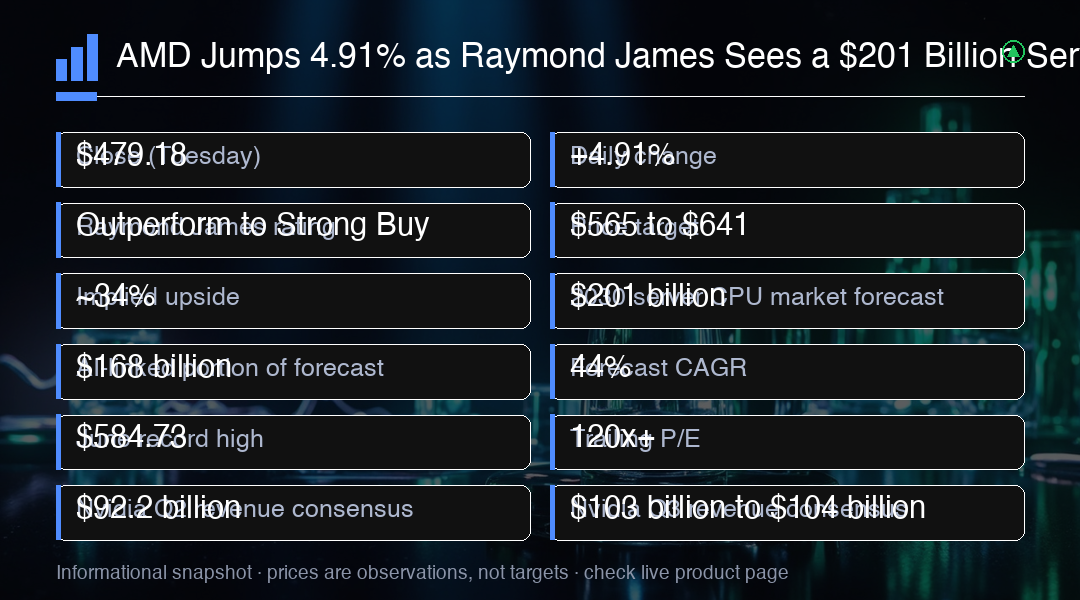
AMD shares jumped 4.91% on Tuesday to close at $479.18 after Raymond James upgraded the chipmaker to Strong Buy from Outperform, arguing that server CPUs, not just graphics processors, could become one of the next major growth engines inside the artificial intelligence buildout. The timing is notable: Nvidia reports its own results after Wednesday's close, giving the market an almost immediate opportunity to test whether the broader AI data-center demand thesis underpinning the AMD upgrade actually holds.
Raymond James analyst Simon Leopold raised his price target on AMD to $641 from $565, implying roughly 34% upside from Tuesday's closing price. That is an unusually aggressive call for a stock that has already had a strong run, and it reflects a specific thesis rather than a broad re-rating of the semiconductor sector: Raymond James believes AMD offers the strongest combination of AI-linked earnings exposure, data-center positioning and market-share potential among server CPU suppliers.
The bullish case centers on server CPUs, the general-purpose processors that coordinate data-center workloads rather than perform the heavy parallel calculations GPUs handle. Raymond James projects the server CPU market tied to artificial intelligence could grow at a 44% compound annual rate to roughly $201 billion by 2030, with approximately $168 billion of that figure directly linked to AI use cases, split between roughly $83 billion in AI head-end CPU demand and roughly $85 billion tied to agentic AI workloads. Agentic AI systems, which independently plan and execute multi-step tasks rather than simply respond to prompts, are expected to be a meaningful new source of CPU demand because they require far more orchestration, data management and workflow coordination than earlier generations of AI applications. These figures are Raymond James's own market forecast rather than an independently confirmed industry consensus, and the actual pace of agentic AI adoption remains unproven at this scale.
The framing matters for how investors think about AMD relative to Nvidia. AMD is usually cast as a discounted challenger trying to close the gap with Nvidia's dominant position in AI accelerators. Raymond James's upgrade instead argues that AMD does not need to win that GPU fight to benefit meaningfully from the AI buildout: it can capture revenue from the CPUs that sit beside GPUs in increasingly complex AI server architectures, managing data flow and keeping expensive accelerators fully utilized. The firm also forecasts that AMD could overtake Intel in server CPU market share by 2027, though that too remains a projection rather than a confirmed outcome and depends heavily on execution against Intel's own data-center roadmap.
Valuation is the clearest counterweight to the bullish narrative. AMD remains roughly 18% below its June record high near $584.73, even after Tuesday's rally, and the stock now trades at a trailing price-to-earnings ratio above 120, among the more expensive multiples in the semiconductor sector. That premium already prices in a substantial amount of future growth, meaning the server CPU opportunity described by Raymond James needs to materialize largely as projected for the current valuation to look reasonable in hindsight rather than stretched.
Nvidia's report Wednesday is the more immediate catalyst. Analysts were looking for second-quarter revenue near $92.2 billion, and third-quarter revenue guidance in the region of $103 billion to $104 billion, with $104.2 billion representing one consensus estimate rather than company-issued guidance. Strong data-center demand commentary from Nvidia would tend to support the broader AI capital-spending thesis that AMD's CPU story depends on, even if Nvidia continues capturing the large majority of AI accelerator spending for itself. A soft outlook from Nvidia, on the other hand, could weigh on the entire semiconductor complex regardless of the specific merits of AMD's server CPU opportunity, since sentiment around AI infrastructure spending tends to move together across the sector in the near term.
For traders, the practical setup splits into two separate time horizons. The near-term catalyst is Nvidia's earnings and guidance Wednesday, which will act as a sentiment gauge for the entire AI trade rather than a direct read on AMD's own fundamentals. The medium-term catalyst is whether AMD can actually begin converting the server CPU opportunity Raymond James describes into reported revenue and market-share gains against Intel, a process that management commentary and quarterly results over the coming year should start to clarify.
Risk framing matters here more than usual because the bullish case rests on a forecast rather than a confirmed trend. If agentic AI adoption disappoints, if hyperscalers slow data-center capital spending, or if Intel's own server roadmap proves more competitive than Raymond James assumes, the $201 billion 2030 opportunity could fail to materialize at the scale projected, leaving AMD's premium valuation vulnerable to a re-rating lower. Conversely, if Nvidia's Wednesday results confirm continued strength in AI infrastructure demand and AMD begins showing tangible server CPU share gains in coming quarters, the stock could have room to extend Tuesday's move toward the new $641 target.
The broader read-through extends across the semiconductor and AI infrastructure trade. AMD's rally alongside a pending Nvidia report highlights how closely correlated sentiment has become across AI-linked names, even when the underlying investment thesis, GPU dominance for Nvidia versus CPU-adjacent share gains for AMD, is genuinely different. Traders positioning around either name should watch Wednesday's Nvidia print as the dominant near-term driver for the group, with AMD's own server CPU narrative playing out over a much longer multi-year window.
Net, Tuesday's move reflects one influential analyst's specific and clearly attributed forecast rather than a confirmed shift in AMD's near-term earnings power. The stock's premium valuation means the market has already extended AMD a considerable amount of credit for that thesis to prove out, which raises the stakes for both Wednesday's Nvidia report and AMD's own execution against the server CPU opportunity over the next several years.
Trading Insight
Treat Wednesday's Nvidia earnings as the dominant near-term catalyst for AMD, since a strong data-center demand signal from Nvidia would tend to support the broader AI infrastructure thesis behind the Raymond James upgrade, while a disappointing outlook could pressure semiconductor names broadly regardless of AMD's specific server CPU opportunity. Keep the $641 Raymond James price target and the 44% CAGR, $201 billion 2030 server CPU forecast clearly labeled as one firm's projection rather than a confirmed outcome. With AMD trading at a trailing price-to-earnings ratio above 120 and still about 18% below its June record near $584.73, position sizing should account for two-sided event risk around Nvidia's print and the multi-year, execution-dependent nature of the CPU thesis itself.