


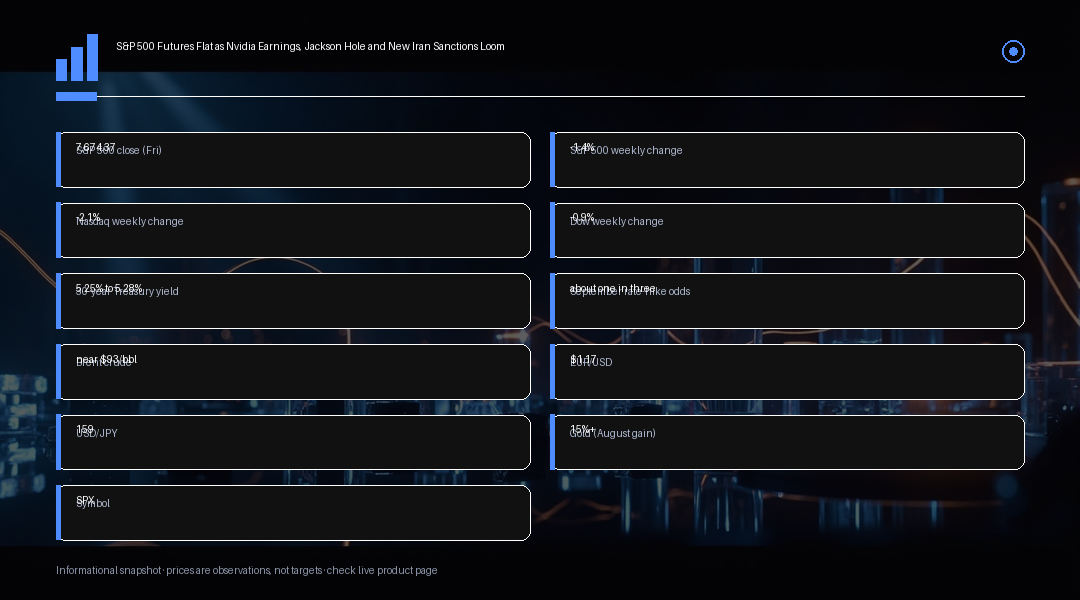
US stock index futures opened the week on a cautious, flat note, with S&P 500 futures little changed, Dow futures modestly higher and Nasdaq futures down about 0.1%. The muted tone follows a Friday rebound that still was not enough to erase a losing week: the S&P 500 closed Friday at 7,674.37, up 0.4% on the day, the Nasdaq added 0.4% and the Dow jumped roughly 518 points, or about 1%, yet all three indexes finished the week lower, with the Nasdaq's 2% decline the steepest of the group.
Asian markets offered little reassurance to start the new week. South Korea's Kospi fell about 1.9%, Chinese blue-chip shares lost around 0.8%, and the broader Asia-Pacific benchmark slipped roughly 0.9%. Japan's Nikkei was little changed after tumbling nearly 4% the prior week, leaving regional sentiment fragile heading into a US calendar packed with earnings and macro catalysts.
Nvidia's Wednesday earnings report, covered in detail elsewhere in this coverage, sits at the center of the week's attention, with consensus revenue near $92 billion testing whether the artificial intelligence capital-spending cycle still has room to run. It is not an isolated event: Salesforce and CrowdStrike are also expected to report around midweek, with Marvell and Workday following on Thursday, widening the test of corporate technology and cybersecurity spending well beyond chips alone.
Monetary policy adds a second major thread. Federal Reserve Chair Kevin Warsh is scheduled to speak Friday at the Jackson Hole symposium, his first appearance there since taking the role, with US GDP data and the Federal Reserve's preferred inflation gauge, the PCE index, arriving beforehand. Market pricing currently implies roughly a one-in-three chance of a September rate increase, with a small residual probability assigned to a cut, meaning the PCE print and Warsh's tone could meaningfully shift those odds in either direction before the week is out.
Geopolitics rounds out the calendar. Treasury Secretary Scott Bessent is expected to unveil new sanctions targeting Iran on Monday, with early characterizations describing the package as among the most extensive to date and aimed in part at countries that continue purchasing Iranian oil. Brent crude eased around 1.5% toward $93 a barrel heading into the announcement, a pullback that followed a 6.6% gain the previous week, leaving oil markets sensitive to how aggressively the sanctions are enforced.
Bond markets remain a persistent source of pressure on equity valuations. The 30-year Treasury yield sits near 5.25% to 5.28%, not far from a 19-year high above 5.32% touched earlier in the week, despite an expanded Treasury bond buyback program aimed at supporting liquidity in longer-dated debt. Elevated long-term borrowing costs compete directly with equities for investor capital and reduce the present value of future corporate earnings, a dynamic that weighs most heavily on richly valued growth and technology names.
Currency and cross-asset markets reflect the same uneasy backdrop. The US dollar remains near multi-week lows, with EUR/USD holding close to $1.17 and USD/JPY trading around 159, above its 200-day moving average. Gold has surged more than 15% during August, while bitcoin trades near $77,000 after gaining roughly 23% over the past week, underscoring how broadly the current mix of softer yields and a weaker dollar has lifted assets viewed as inflation or currency hedges.
Taken together, the week ahead offers a genuine stress test for the recent equity rebound. A strong Nvidia report paired with a benign PCE print and a measured tone from Warsh at Jackson Hole would likely support a continuation of Friday's bounce. Conversely, disappointing guidance from Nvidia, a hotter-than-expected inflation reading, or a hawkish surprise from the Fed chair could quickly reintroduce the kind of volatility that pushed all three major indexes lower last week, particularly with long-term yields already elevated and geopolitical risk rising alongside the new Iran sanctions.
Traders should treat this as a week defined by sequencing rather than a single catalyst: earnings first, inflation data next, and Fed commentary last, with each event capable of amplifying or offsetting whatever sentiment the prior one establishes. For active traders, that sequencing argues for sizing positions conservatively into Wednesday's Nvidia report rather than committing full conviction before any single data point arrives, since a strong print could be undone by a hawkish PCE surprise or vice versa. Monday's Iran sanctions announcement adds an early, harder-to-hedge risk that sits outside the earnings-and-Fed narrative entirely, meaning energy-sensitive positions may warrant separate risk management from broad index exposure. Traders who wait for confirmation across at least two of the three catalysts, rather than reacting to the first data point in isolation, are likely to have a clearer read on whether this week extends Friday's rebound or reopens last week's selloff.
Sector rotation is worth monitoring alongside the headline index levels. Last week's Nasdaq underperformance relative to the Dow suggests investors were already trimming exposure to the most richly valued technology names ahead of this week's earnings and macro calendar, a pattern that could either reverse sharply on a strong Nvidia print or extend further if guidance disappoints. Cyclical and value-oriented sectors have shown relative resilience during the recent pullback, which may continue if long-term yields stay elevated and growth-stock valuations remain under pressure.
Credit markets and volatility measures also deserve attention this week. Options-implied volatility across major indexes has ticked higher heading into the Nvidia report and Jackson Hole, reflecting the market's own uncertainty about how these catalysts will resolve. A sustained move higher in implied volatility, even without a large index decline, would suggest institutional investors are paying up for downside protection, a signal worth weighing alongside the headline price action described above.
Trading Insight
Approach this week as a layered risk calendar rather than a single event. Use Nvidia's Wednesday report as the first checkpoint for risk appetite in technology and broader index exposure, then reassess ahead of the PCE inflation data and Warsh's Friday Jackson Hole remarks, since both could shift September rate-hike odds quickly from the current roughly one-in-three pricing. Keep an eye on the 30-year Treasury yield as a valuation headwind for index exposure broadly, and treat the new Iran sanctions as an oil-market risk factor that could spill into broader risk sentiment if enforcement proves more aggressive than markets currently expect.