


Nvidia closes at a record. Market cap approaches $6 trillion. Share buyback expanded to $235 billion. The semiconductor leader continues to ride the AI infrastructure boom, with investors piling into the stock as data-center demand shows no signs of slowing. The company's dominance in accelerated computing has made it the single most important equity story in global markets, with its price action now capable of influencing the direction of entire indexes.
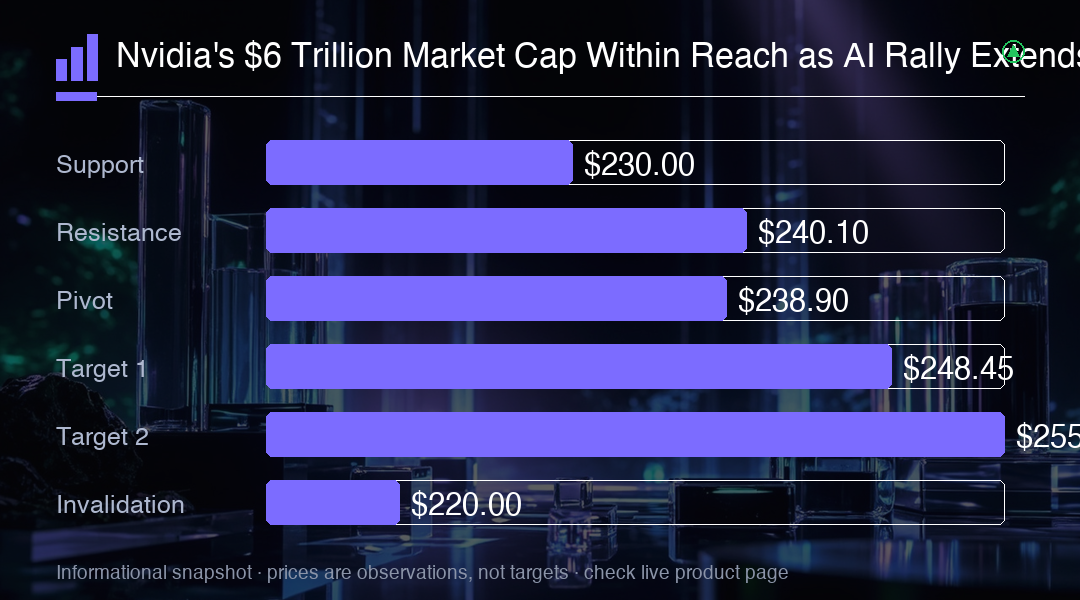
Nvidia NVDA climbed 2.1% to $238.90 on Monday, setting a record closing price. Shares reached $240.10 during the session, leaving the close roughly 0.5% below that intraday peak. The advance helped lift the Nasdaq Composite to a record of its own, with the chipmaker's outsized influence on the index playing a significant role in the broader market's upward momentum. Trading volume remained elevated throughout the session, reflecting strong institutional interest and the continued participation of retail investors who view Nvidia as a proxy for the entire AI trade.
The chipmaker's market capitalization now stands at $5.76 trillion, about $230 billion short of $6 trillion. With roughly 24.15 billion shares outstanding, that milestone would require a price around $248.45, assuming the share count stays unchanged, which would represent another 4% gain from Monday's close. The $6 trillion threshold is more than just a symbolic number; it would place Nvidia in a category of its own among global companies, exceeding the entire market capitalization of most nations' stock markets combined. Such a valuation would represent a remarkable concentration of wealth in a single equity, raising questions about systemic risk and the potential impact of any reversal on broader market stability.
Shares are up 28% this year, a remarkable pace for a company already valued in the trillions. Nvidia's size also makes the move consequential beyond semiconductor portfolios: its heavy weighting in major US indexes means a strong session can support the headline benchmarks even when gains elsewhere are less convincing. This index effect creates a feedback loop where passive inflows and benchmark tracking amplify the stock's moves in both directions. When Nvidia rises, the S&P 500 and Nasdaq Composite tend to follow, regardless of what is happening in other sectors of the economy.
A major server manufacturer, Nvidia's biggest hardware partner, reported 47% growth in third-quarter revenue to $95.4 billion, beating forecasts. Strong AI demand largely drove that increase, as data-center operators continue to expand capacity at an unprecedented rate. The results from this key supply-chain partner serve as a real-time proxy for Nvidia's own order book, suggesting that the chipmaker's next reporting period could deliver another round of substantial growth. The 47% year-over-year increase in revenue for this manufacturing partner indicates that the AI infrastructure buildout is accelerating rather than decelerating, with orders for servers and related equipment continuing to surge.
Nvidia's own latest results showed quarterly revenue rising 106% to $96.2 billion. Data-center sales increased 117% to $89 billion, accounting for more than 92% of total revenue. This extraordinary growth rate underscores just how much the company has transformed from a gaming-focused chip designer into the primary beneficiary of the global AI infrastructure buildout, with hyperscale cloud providers and enterprise customers competing for limited supply. The 117% growth in data-center revenue is particularly striking because it demonstrates that demand is not merely keeping pace with Nvidia's expanding production capacity but is actually outstripping it, creating a supply-constrained environment that allows the company to maintain premium pricing.
That concentration explains why spending on AI infrastructure remains the most important driver of its earnings outlook. When more than 92% of revenue comes from a single segment, the company's fortunes are inextricably tied to the capital expenditure budgets of a relatively small number of large customers. Shareholder returns provide another support, but the fundamental story remains one of demand concentration and the sustainability of AI spending at current levels. If even a handful of major cloud providers were to pause or slow their data-center investments, the impact on Nvidia's revenue trajectory would be immediate and severe, given the lack of diversification in the company's end markets.
Nvidia authorized an additional $150 billion of buybacks on September 28, taking its remaining program to $235 billion, expected to be executed through fiscal 2028. Repurchases can lift earnings per share by reducing the share count, effectively returning capital to shareholders while simultaneously making each remaining share claim a larger portion of the company's profits. The sheer scale of this program, larger than the entire market capitalization of most S&P 500 companies, signals management's confidence in sustained cash generation. At current prices, the $235 billion authorization represents roughly 4% of Nvidia's market value, providing a meaningful floor under the stock as the company deploys its substantial free cash flow.
Despite its enormous market value, Nvidia trades at around 20x forecast earnings, compared with around 30x trailing earnings. The difference reflects expectations for substantial profit growth, with analysts modeling continued double-digit revenue expansion over the next several years. This forward multiple is notably lower than the trailing figure because earnings are growing so rapidly that the denominator in the valuation equation is expanding almost as fast as the stock price itself. The 20x forward multiple suggests that investors are already pricing in significant growth, but the gap between 20x and 30x trailing earnings indicates that the market expects earnings to grow roughly 50% faster than the current pace, which is an aggressive assumption that leaves little room for error.
Traders should recognize the dependency: weaker earnings forecasts would make today's valuation look more demanding without any increase in the share price. If data-center customers begin to moderate their spending or if competition intensifies, the compression in the multiple could be severe, as investors would be asked to pay a similar price for a company with a less certain growth trajectory. The stock's premium valuation leaves little room for disappointment. A reduction in the forward multiple from 20x to, say, 15x would imply a 25% decline in the share price even if earnings estimates remained unchanged, illustrating the sensitivity of the stock to changes in investor sentiment about future growth.
Management's next-quarter revenue guidance is $108 billion, plus or minus 2%, with gross margins around 74%. Interestingly, that outlook assumes no data-center compute revenue from China, effectively treating the entire Chinese market as a zero for planning purposes. This conservative assumption provides a cushion, as any resumption of China sales would represent pure upside to the guided figures, but it also highlights the geopolitical risks embedded in the company's revenue base. The 74% gross profit guidance is particularly noteworthy because it suggests that Nvidia is maintaining its pricing power even as it ramps up production, a sign of the company's continued dominance in the AI chip market and the lack of viable alternatives for customers seeking to build large-scale AI systems.
On the chart, $240.10 is the immediate reference high, followed by the roughly $248-249 area associated with a $6 trillion price tag. That second level is milestone arithmetic, not established technical resistance. A sustained move beyond Monday's high could provide stronger evidence of momentum than a brief intraday spike, potentially triggering a new wave of buying from momentum-focused traders and algorithmic systems programmed to respond to round-number breakthroughs. The psychological significance of the $6 trillion milestone should not be underestimated, as it would likely attract significant media attention and could bring a new cohort of investors into the stock, further fueling the upward trajectory.
Trading Insight
Nvidia's $6 trillion milestone is now a question of when, not if. The $248-249 level is the arithmetic target; a sustained break above $240.10 would confirm momentum. However, the concentration of revenue in data-center AI (92% of sales) means any slowdown in capex spending could compress the multiple rapidly. Watch the $108 billion Q4 guidance and China exposure assumptions closely.