


Euro digs a deeper hole to $1.1160. France debt weighs on currency. Euro logs fourth straight week of red.
EURUSD pair fell as low as $1.1160 Monday, its weakest level since May 2025, before trading around $1.1190. The decline follows four consecutive weekly losses, extending a retreat that has persisted through changing expectations for US interest rates. The pair has now surrendered more than 4% from its recent highs, with the latest leg lower driven by a combination of dollar strength and growing unease about the eurozone's fiscal outlook. Monday's break below the $1.1200 round number accelerated selling pressure, as algorithmic traders and momentum followers reacted to the technical breach.
The pressure extends beyond the dollar pair. The euro also weakened roughly 0.4% against the Swiss franc and 0.3% against the UK pound. Those cross-currency moves point to concerns about the euro itself, alongside the broader strength of the greenback. When the euro falls against currencies that are not themselves rallying strongly, it suggests that capital is leaving the euro area rather than simply rotating into the dollar. The Swiss franc, in particular, has long served as a safe-haven alternative within Europe, and sustained euro weakness against the franc often reflects deeper structural concerns about the single currency's stability.
France's 10-year borrowing premium over Germany reached roughly 150 basis points Friday, levels associated with the eurozone debt crisis over a decade ago. That means investors demand about 1.5 percentage points more yield to hold French debt. Political gridlock and doubts about budget discipline are weakening confidence. Some analysts warn that this may turn into a broader issue across the euro zone. The 150bp threshold is significant because it was roughly the level at which the European Central Bank first intervened during the sovereign debt crisis of 2011-2012. Spreads at that level suggest that markets are pricing in a meaningful risk premium for French sovereign risk, something that was unthinkable just two years ago when the spread hovered near 30bp.
Traders now price roughly a one-in-five chance of an October Fed hike, down from around 64% a week earlier. Yet the US 10-year Treasury yield remains near 5.26%. Reduced expectations for the next policy meeting have left substantial yield support for dollar assets. The sharp repricing in hike odds followed the weaker-than-expected payrolls report, which showed the labor market cooling faster than anticipated. However, the yield curve has not adjusted proportionally, suggesting that either markets believe the Fed will remain hawkish for longer, or that term premium is building in response to elevated government borrowing.
Europe has inflation pressure of its own. September headline inflation accelerated to 3.8%, while core inflation edged up to 2.5%, keeping further ECB tightening in view. The acceleration in headline inflation was driven primarily by energy base effects, but the rise in core prices is more concerning for policymakers because it suggests that price pressures are becoming more entrenched in services and goods. For the ECB, this creates a difficult dilemma: raising rates to combat inflation increases borrowing costs for heavily indebted governments like France, but failing to act risks letting inflation expectations become unanchored.
But higher rates also increase financing costs. When investors worry about debt sustainability, rising yields can accompany a weakening currency. This dynamic creates a potential feedback loop: higher yields raise debt service costs, which worsens fiscal deficits, which in turn pushes yields higher still. France's debt-to-GDP ratio, already above 110%, leaves little room for fiscal maneuver. If borrowing costs remain elevated, the government may be forced to implement austerity measures that further slow economic growth, adding to the euro's fundamental headwinds.
An ECB rescue is not automatic. Its Transmission Protection Instrument, a bond-buying tool, addresses unwarranted and disorderly financing stress. Reports indicate that France's fiscal position complicates eligibility. The TPI was designed to prevent fragmentation of eurozone bond markets, but its activation requires that a country's fiscal policies remain within the framework of the EU's fiscal rules. France's repeated breaches of the deficit limit and its political instability may make the ECB reluctant to deploy the tool, as doing so could be seen as fiscal dominance, effectively monetizing government debt.
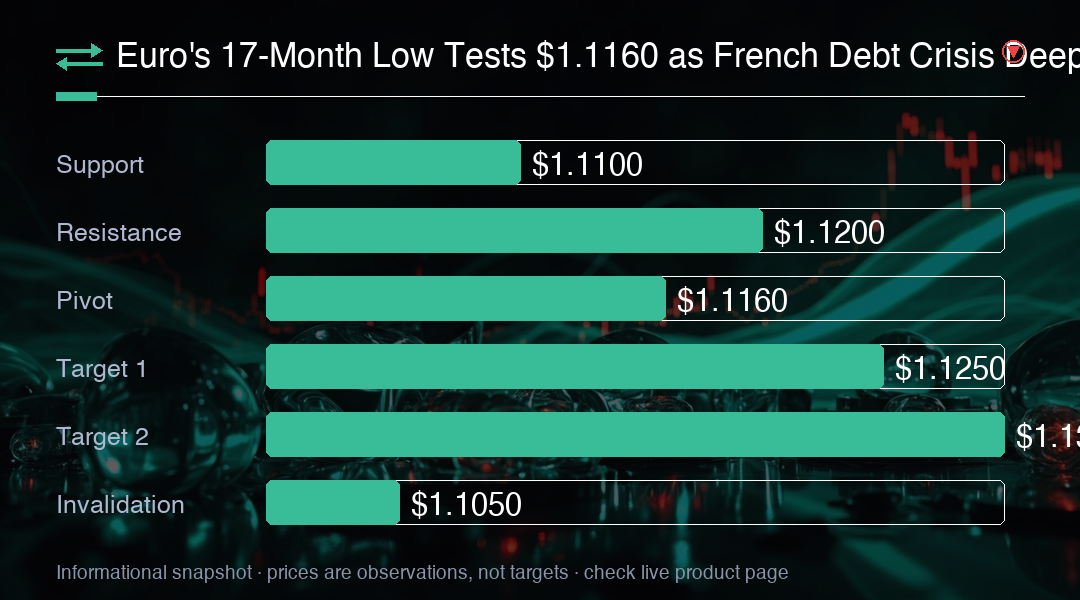
In the near-term price picture, $1.1200 is the immediate round-number reference overhead. Monday's low marks the first downside reference; $1.1100 is the next psychological area below it. These are levels to monitor, rather than established support zones confirmed by repeated tests. A sustained break below $1.1100 would likely trigger additional technical selling, potentially opening the way toward the $1.1000 psychological barrier. Conversely, a recovery back above $1.1200 would suggest that the immediate selling pressure has been absorbed, though a more convincing reversal would require a move back above $1.1250.
US ISM services report arrives Monday at 10 a.m. ET, with employment and prices particularly relevant after the weak payrolls report. The services sector accounts for roughly 80% of US GDP, and its health is a key indicator of the economy's resilience. A strong ISM reading, particularly in the employment and prices paid components, could revive expectations for further Fed tightening and push the dollar higher. Conversely, a weak report could reinforce the narrative that the labor market is cooling, potentially easing pressure on the euro.
Softer hiring alongside persistent cost pressure would complicate the Fed outlook. Wednesday's minutes provide further context, although they describe discussions before the latest jobs data. The minutes may reveal how concerned policymakers are about the labor market's trajectory and whether they see the recent weakness as a temporary pause or the beginning of a more pronounced slowdown. Markets will also look for any hints about the balance of risks between inflation and growth, which could influence the dollar's direction.
Thursday's jobless claims and Friday's Michigan sentiment survey add further tests, particularly around inflation expectations. A firmer euro recovery would be easier to sustain if US yields ease and French bond spreads stabilize. The coming week's data calendar could prove pivotal: if US economic indicators continue to soften while French political uncertainty persists, the euro may struggle to find a floor. However, any sign of progress on the French budget front or a dovish shift in Fed rhetoric could provide the catalyst for a relief rally.
Trading Insight
The euro's slide to a 17-month low reflects a toxic mix: French fiscal fragility, sticky eurozone inflation, and a dollar propped up by sticky US yields. The 150bp France-Germany spread is the key metric; a sustained move above 175bp would signal systemic stress. For traders, $1.1100 is the next line in the sand; a daily close below it opens the path to $1.1000. Watch French OAT spreads and ECB commentary for signs of TPI activation.