


KEY POINTS: SpaceX agreed to acquire Grain Management's nationwide 800 MHz portfolio, reportedly for $8 billion. T-Mobile closed Friday down 13.3%, AT&T lost 9.8% and Verizon fell 8.8%. Tower operators rallied on the news, as the deal suggested that wireless spectrum assets carry strategic value that incumbent carriers may need to match or exceed in their own holdings.
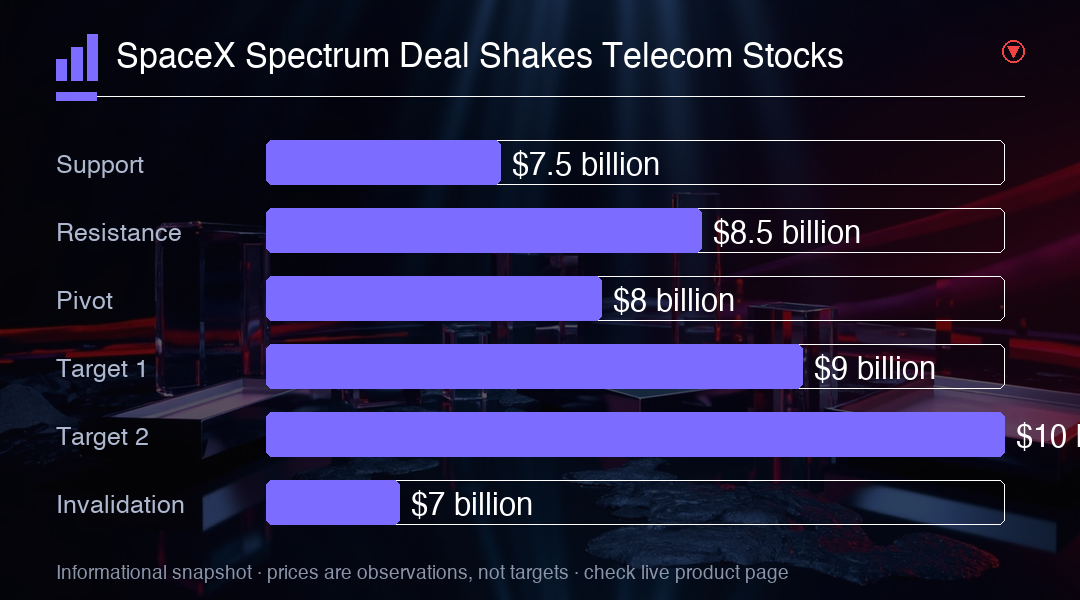
SpaceX's agreement to acquire Grain Management's nationwide 800 MHz spectrum portfolio for $8 billion sent shockwaves through the telecommunications sector on Friday, triggering one of the most dramatic single-day repricings in recent memory. The deal represents a significant expansion of SpaceX's wireless ambitions and poses a potential competitive threat to established carriers that have dominated the US market for decades. The $8 billion price tag underscores the strategic value of spectrum assets in an increasingly connected world where wireless capacity has become a critical resource for both consumers and businesses, and where the availability of new spectrum has been constrained by regulatory limitations for years.
T-Mobile US bore the brunt of the selling pressure, closing Friday down 13.3% in a single session that erased billions of dollars in market value. The decline reflected investor concern that SpaceX's entry into the wireless market could erode T-Mobile's market share and pricing power over time, particularly in the consumer segment where T-Mobile has been the most aggressive competitor. As the most aggressive competitor in the US wireless market, T-Mobile has the most to lose from a new entrant with deep pockets and disruptive technology that could fundamentally change how wireless services are delivered. The magnitude of the decline suggested that the market had not previously priced in the possibility of SpaceX as a serious wireless competitor capable of acquiring major spectrum assets.
AT&T lost 9.8% on the news, as the company faces the prospect of competing with a well-funded new entrant that has a proven track record of disrupting established industries ranging from satellite launches to internet service provision. AT&T has invested heavily in its own network infrastructure and spectrum holdings over many years, spending tens of billions of dollars to build out its 5G network and acquire the spectrum licenses needed to support it. The SpaceX deal raises serious questions about whether those investments will generate the expected returns in a more competitive landscape where a new entrant could bypass traditional infrastructure entirely. The stock's decline indicated that investors were reassessing the long-term competitive dynamics of the wireless market and the durability of AT&T's market position.
Verizon fell 8.8%, completing the trio of major carriers that suffered significant losses on the announcement and collectively shed tens of billions of dollars in market value. Verizon has positioned itself as the premium network provider in the US market, commanding higher prices based on the perceived quality and reliability of its network. The SpaceX deal introduces significant uncertainty about the future of wireless competition and the sustainability of the premium positioning that Verizon has cultivated over many years. The company's substantial spectrum holdings and network investments may face renewed scrutiny from investors who are now forced to consider a new competitive threat that could render traditional network quality advantages less relevant.
Tower operators rallied on the news, as the SpaceX deal suggested increased demand for wireless infrastructure across the board regardless of which carrier ultimately prevails. Companies that own and operate cell towers stand to benefit from any expansion of wireless services, because more spectrum and more networks require more physical infrastructure to host the equipment. The divergence between carrier stocks and tower operators highlighted the market's nuanced read on the deal's implications for different segments of the telecom value chain, with infrastructure owners positioned as potential winners regardless of the competitive outcome among service providers.
The telecom repricing was swift and severe, with the three major carriers shedding significant market value in a single session that caught many investors off guard. The magnitude of the declines indicated that the market had not previously priced in the possibility of SpaceX as a wireless competitor with the financial resources to acquire major spectrum assets and the technical capability to deploy them. The deal forces a fundamental reassessment of the competitive dynamics that have shaped the US wireless market for decades, and the full implications for pricing, market share and profitability may take months or even years to become clear as the regulatory process unfolds.
SpaceX's wireless ambitions extend well beyond this single acquisition and represent a long-term strategic vision for the company. The organization has been building a satellite-to-cell service that could complement or compete with traditional terrestrial networks, and the Grain Management deal provides the spectrum assets needed to offer a comprehensive wireless service that bypasses conventional infrastructure. The combination of satellite technology and ground-based spectrum could create a new type of wireless network that delivers coverage in areas where traditional carriers have struggled to build out service, potentially opening up entirely new market segments that have been underserved by the existing carriers.
The $8 billion price tag for the spectrum portfolio reflects the scarcity value of wireless spectrum in the current market environment. Regulatory constraints have limited the availability of new spectrum for years, making existing holdings increasingly valuable as demand for wireless data continues to grow at an exponential rate driven by video streaming, IoT devices and autonomous vehicles. SpaceX's willingness to pay this price signals its commitment to becoming a major player in the wireless market, and the company's substantial financial resources suggest it can sustain a long-term investment horizon that shorter-term focused competitors may struggle to match.
Investors are now weighing the long-term implications of SpaceX's entry into wireless and the potential for further disruption across the sector. The company's track record of disrupting industries, from satellite launches to internet service provision, suggests that the telecom sector should take the threat seriously rather than dismissing it as a distant concern. The carrier stocks' sharp declines reflected this concern, as investors priced in the possibility of increased competition and pressure on profitability across the sector. The question now is whether the carriers can respond effectively to this new competitive threat, or whether they will continue to lose ground to a competitor with superior technology and deeper pockets.
The deal also raises important questions about the future of spectrum policy and regulation in the United States. SpaceX's acquisition of a major spectrum portfolio could prompt scrutiny from regulators concerned about market concentration and competition in the wireless sector, particularly given the already concentrated nature of the US carrier market. The outcome of any regulatory review will be critical in determining whether SpaceX can proceed with its wireless plans, and the process could take months or even years to resolve. The regulatory uncertainty adds another layer of complexity for investors trying to assess the long-term implications of the deal for the telecom sector.
For the broader market, the telecom repricing is a powerful reminder that technological disruption can quickly reshape industry valuations and competitive landscapes in ways that few investors anticipate. The SpaceX deal demonstrates that even well-established industries with significant barriers to entry are not immune to disruption from well-funded new entrants with innovative technology and a long-term strategic vision. Investors should monitor the situation closely, as further developments including regulatory decisions, additional spectrum acquisitions and technological announcements could have significant implications for the telecom sector and the broader equity market in the weeks and months ahead.
交易洞察
SpaceX's $8 billion spectrum acquisition has fundamentally altered the telecom competitive landscape. The sharp declines in T-Mobile, AT&T and Verizon reflect genuine concern about future market share and pricing power. Tower operators may benefit from increased wireless infrastructure demand. Monitor regulatory developments and any additional SpaceX wireless announcements for further direction.