


The Warsh futures selloff was chiefly a rates story: comments from Federal Reserve Chair Kevin Warsh lifted expectations for a September rate increase, pushed the policy-sensitive two-year Treasury yield higher and weighed most heavily on growth-oriented Nasdaq futures. Higher oil prices added a separate inflation concern, giving the weekly open two forces pointing toward tighter financial conditions.
Reuters reported in its Aug. 31 Asian-session update that Nasdaq futures were down 0.5%, compared with a 0.4% decline in S&P 500 futures. Those are opening snapshots, not a completed-session verdict. The more durable question is whether rate expectations, short-dated yields and oil continue to move together.
Key takeaways
- Markets put the implied probability of a September rate hike at 57% after Warsh’s inflation comments.
- The two-year Treasury yield traded around 4.33%–4.34%, raising the discount-rate pressure on long-duration equities.
- Brent and WTI rose 2.8% and 2.5%, respectively, adding an oil-led inflation impulse to the rates move.
What moved in the Warsh futures selloff?
Nasdaq futures underperformed as the market repriced near-term Federal Reserve policy. Reuters reported Nasdaq futures down 0.5% and S&P 500 futures down 0.4% in its Aug. 31 Asian-session update. The same report put the market-implied chance of a September hike at 57% and the two-year US Treasury yield at 4.34%.
A second Reuters report, published less than an hour later, showed the two-year yield at 4.33% and the dollar index at 99.6. The small difference between the two yield readings is a reminder that both stories captured a moving market. The useful evidence is the shared regime: a short-dated yield above 4.3%, stronger hike expectations and weaker US equity futures.
| Market input | Reuters snapshot | Why it mattered |
|---|---|---|
| September policy odds | 57% implied probability of a hike | Raised the market’s near-term policy-rate path |
| Two-year Treasury | 4.33%–4.34% | Expressed the policy repricing in the rate-sensitive part of the curve |
| Nasdaq futures | −0.5% | Showed greater pressure than S&P 500 futures at −0.4% |
| Brent / WTI | $90.60 / $85.50; +2.8% / +2.5% | Added energy-price pressure to the inflation discussion |
| Dollar index | 99.6 | Provided a cross-asset check on the tighter-policy repricing |
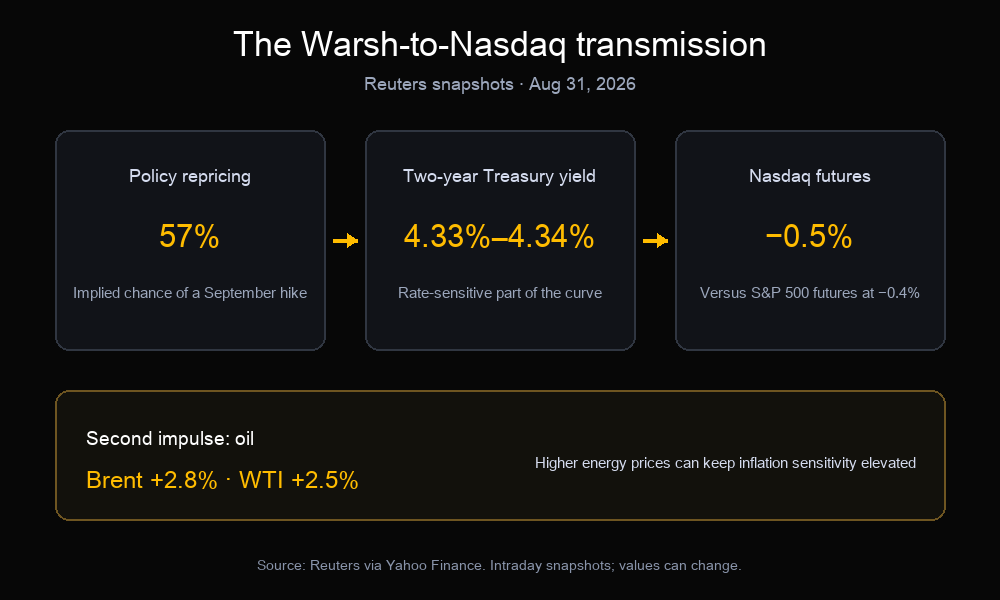
Reuters snapshots from Aug. 31, 2026. Intraday prices and implied probabilities can change.
How did Warsh’s comments change rate expectations?
They made the Fed’s 2% inflation objective sound binding enough for markets to price a greater chance of near-term tightening. Reuters quoted Warsh as saying the Fed would “have work to do” without confidence that inflation was heading toward 2%. The report said the comments fuelled September hike bets, taking the implied probability to 57%.
The chain begins with expectations, not an announced policy decision. Traders revised the possible path of the policy rate; the two-year Treasury, which is especially sensitive to that path, then reflected the revision. That distinction matters because implied odds can move again as new information arrives. The article’s framework explains the Aug. 31 snapshot; it does not turn 57% into certainty.
Why did the two-year yield matter more for Nasdaq futures?
A higher short-dated yield raises the return available from government debt and the discount rate applied to future corporate cash flows. The effect is often most visible in growth-heavy indices because more of their valuation depends on earnings expected farther into the future. When those future amounts are discounted at a higher rate, their present value falls, all else equal.
That duration logic fits the observed difference between Nasdaq futures at −0.5% and S&P 500 futures at −0.4%. It does not prove that yields caused every point of the decline, but it supplies a coherent cross-asset explanation supported by simultaneous policy and Treasury moves. A reversal in the two-year yield without improvement in Nasdaq futures would weaken that explanation and point traders toward other drivers.
Why was oil a second inflation impulse?
Oil mattered because higher energy prices can complicate the market’s confidence that inflation is moving toward target. Reuters reported Brent crude at $90.60, up 2.8%, and WTI at $85.50, up 2.5%. The rise was separate from Warsh’s remarks, but it pushed in the same broad direction for inflation sensitivity.
This does not mean a one-session oil move automatically changes Fed policy. It means the market opened with two inflation-relevant signals at once: firmer central-bank language and higher crude prices. If oil gives back the advance, that second impulse fades. If oil remains elevated while the two-year yield stays firm, the duration headwind has broader cross-asset confirmation.
What would confirm or weaken the rates-led interpretation?
Confirmation requires persistence across policy odds, the two-year yield and Nasdaq relative performance. No single opening print is enough. The framework is strongest when the links remain aligned and weakest when they separate.
| Check | Reinforces the interpretation | Weakens it |
|---|---|---|
| Policy pricing | September hike odds remain elevated or rise | Implied odds retreat materially |
| Two-year yield | Yield holds above the reported 4.33%–4.34% window | Yield falls while futures remain weak |
| Index breadth | Nasdaq futures continue to lag S&P 500 futures | Nasdaq relative weakness disappears |
| Oil | Brent and WTI retain their gains | Crude reverses, removing the second inflation impulse |
| Dollar | The dollar remains firm alongside yields | Dollar and yields diverge from the policy story |
The purpose of the dashboard is not to prescribe a position. It is to keep the explanation falsifiable. A rates-led selloff should continue to leave evidence in rates; an oil-amplified inflation concern should continue to leave evidence in crude.
Final thoughts
The Aug. 31 open connected a hawkish policy interpretation, a two-year Treasury yield above 4.3% and relative weakness in Nasdaq futures. Oil added a second inflation-sensitive pressure point. That combination explains why the Warsh move remained visible in futures, but it also identifies what can change the story: lower policy odds, softer short-dated yields or a reversal in crude. The strongest reading will come from whether those markets stay aligned after the opening snapshot.