


KEY POINTS: The S&P 500 slipped just 0.02% to 7,805.45 Tuesday, remaining close to last week's record. The Nasdaq lost 0.15% to 27,204.38 and the Dow fell 180 points to 51,670.10. S&P 500 futures were broadly unchanged in Wednesday's early Asian session ahead of US inflation data, with economists expecting 3.6% annual headline CPI and 0.2% monthly core inflation.
The S&P 500 slipped just 0.02% to 7,805.45 on Tuesday, a remarkably small move that left the index parked just below last week's record high. The Nasdaq Composite lost 0.15% to 27,204.38, while the Dow Jones Industrial Average fell 180 points to 51,670.10. The divergence between the three major indexes reflects the ongoing rotation within the market, where semiconductor weakness weighs on the Nasdaq while the Dow's more value-oriented components provide relative stability. S&P 500 futures were broadly unchanged in Wednesday's early Asian session, suggesting traders are waiting for the US inflation report before committing to a direction. The calm surface masks underlying tension, as market participants weigh approaching bank earnings against a CPI print that could reshape rate expectations.
Semiconductor stocks remained under pressure, with Micron dropping 3.6% and Applied Materials falling almost 7%. The declines reflect growing competition concerns in the memory and chip equipment sectors. Reports of technological advances at Chinese memory producer CXMT have complicated the investment case for US semiconductor companies. Rising AI demand can support sales across the industry, but stronger competition from CXMT puts pressure on pricing and profitability for incumbent players. The uncertainty created a difficult backdrop for chip investors, particularly those with exposure to the memory segment where pricing dynamics are already evolving rapidly.
Bank earnings failed to sustain early buying, with all four major institutions finishing lower. Citigroup finished down 5.6%, Wells Fargo lost 3.1%, JPMorgan declined 0.9% and Goldman Sachs slipped 0.2%. Both Citigroup and Goldman Sachs beat profit estimates, which underscores how expectations for future earnings can outweigh a strong quarter already delivered. The results highlight a market that is looking backward even as it tries to price forward, rewarding only the institutions that can demonstrate a clear path to sustained profitability rather than those that simply meet current-quarter targets. The declines in the banking sector contributed to the cautious tone across the broader market.
Apple closed at $341.27, just below the price needed for a $5 trillion valuation, after unveiling HomeView and updated home devices. The tech giant's new home hub generated excitement among investors, but the stock could not hold its intraday gains into the close. Meanwhile, Bumble surged 57% on a $1.3 billion agreement to go private. Product launches and takeover bids supplied stock-specific catalysts even as the broader indexes barely moved, illustrating how individual company news can drive significant price action regardless of the prevailing macro environment. The contrast between Apple's fade and Bumble's surge shows how quickly sentiment can shift when corporate events redefine a company's trajectory.
International markets presented a mixed picture. South Korea's Kospi gained 1.8% and Japan's Nikkei edged up 0.2%, with Samsung and SK Hynix recovering more than 2% as the semiconductor selloff showed signs of stabilizing in Asian trading. China's data added another dimension to the global picture, with exports jumping 36.3% annually while producer prices rose 5% against consumer inflation of just 0.9%. The divergence between China's producer and consumer inflation data highlights the uneven nature of the country's economic recovery, where strong manufacturing exports coexist with subdued domestic price pressure. This combination has implications for global inflation trajectories and central bank policy paths.
The dollar index eased toward 102.16, following Tuesday's 0.35% decline from near an 18-month high. EUR/USD traded around $1.1210, GBP/USD near $1.3260 and USD/JPY around 158.30 yen. The retreat gives other currencies some breathing room before the CPI report potentially changes the US interest-rate outlook. A sustained dollar decline could ease financial conditions globally, reducing pressure on emerging market assets and commodities priced in dollars. However, a hotter-than-expected inflation reading could reverse the dollar's weakness quickly by reviving expectations for Federal Reserve tightening.
Brent crude rose toward $106.60 a barrel, while US crude approached $94.96, as supply concerns persisted following Houthi attacks on Saudi Arabia. Expensive oil remains consequential across markets, raising business costs, squeezing household spending power and complicating central banks' efforts to contain inflation. The geopolitical risk premium embedded in oil prices adds another layer of uncertainty for traders assessing the inflation outlook. If oil continues climbing, it could offset any relief from softer core consumer price data, keeping the overall inflation picture more persistent than markets currently anticipate.
Gold held near $4,160 an ounce, while Bitcoin traded around $83,700, extending its recovery after Tuesday's roughly 1.6% gain. Both assets face Wednesday's inflation test, as a CPI surprise that lifts the dollar and bond yields could challenge their recent stability. The demand drivers for each asset differ significantly, with gold benefiting from its traditional role as an inflation hedge and Bitcoin attracting investors seeking alternative stores of value. Their correlated response to macroeconomic data suggests that both are being treated as dollar-sensitive assets in the current environment, regardless of their fundamentally different value propositions.
US CPI arrives Wednesday at 8:30 a.m. ET, with economists expecting 3.6% annual headline inflation and 0.2% monthly core inflation. Core excludes food and energy, helping traders assess broader price pressure across the economy. A stronger reading could increase the roughly 22% probability of an October Fed hike, while a softer print could reduce it further. The report is likely to be the most significant economic event of the week, with the potential to move equities, currencies, bonds and commodities simultaneously. Traders should pay particular attention to the core figure, as it provides a clearer signal of underlying inflationary trends than the headline number affected by volatile energy prices.
Bank of America, Morgan Stanley and BlackRock report Wednesday, opening a busy day for financial-sector earnings. Bank of America faces additional scrutiny after a $1.21 billion regulatory penalty over financial-crime monitoring failures. The bank expects a quarterly earnings impact of 17 cents a share, and its stock fell 2.7% after hours following Tuesday's 1.1% regular-session decline. The combination of regulatory penalties and earnings pressure creates a challenging narrative for Bank of America investors, even as the broader banking sector tries to move past the initial earnings surprises from earlier in the week. Results from Morgan Stanley and BlackRock will provide further insight into how financial institutions are navigating the current environment of elevated rates and persistent inflation.
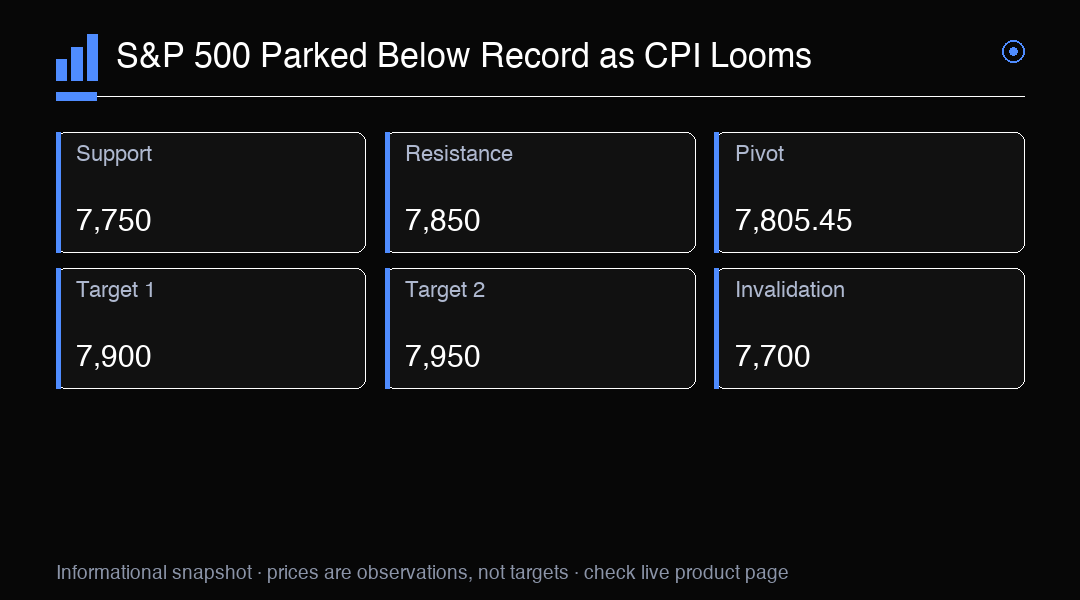
The trading outlook centers on Wednesday's CPI report and its implications for Federal Reserve policy. A hotter reading could revive pressure on bonds and equities, while a softer print could trigger a relief rally across risk assets. The S&P 500's position just below its record high suggests the market is waiting for confirmation that inflation is contained before committing to new highs. Support sits at 7,750, with resistance at 7,850 and the pivot at 7,805.45. A break above 7,850 would target 7,900, while a drop below 7,750 would expose 7,700. Traders should also monitor Thursday's producer price data and the ongoing earnings season for additional direction.
Trading Insight
The S&P 500 is parked just below its record high at 7,805.45, with Wednesday's CPI report as the key catalyst. Support sits at 7,750 and resistance at 7,850. A break above 7,850 would target 7,900, while a drop below 7,750 would expose 7,700. Watch the 3.6% headline and 0.2% core CPI figures, along with bank earnings from Bank of America, Morgan Stanley and BlackRock for direction.