


KEY POINTS: Goldman Sachs said it holds a positive view on payment stocks heading into third-quarter earnings, citing strong spending volumes and favorable structural trends. Spending volumes remained strong throughout the quarter and defied investor concerns about normalization. The bank highlighted NYSE:V, NYSE:MA, NYSE:TOST, and NYSE:GLBE as stocks to watch in the payments sector.
Goldman Sachs said spending volumes remained strong throughout the third quarter and defied investor concerns about normalization that had weighed on the sector for months. September spending trends stayed robust through the end of the quarter, providing a solid foundation for payment companies reporting results in the coming weeks. The bank's positive stance reflects confidence that consumer and business spending patterns remain healthy despite broader macroeconomic uncertainty and mixed signals from other areas of the economy. Strong volumes translate directly into transaction revenue for payment processors and card networks, which makes the spending data a critical input for earnings models and revenue forecasts across the sector.
Broader structural concerns affecting the payments sector have improved, with several regulatory and disruptive risks declining, Goldman Sachs noted in its analysis. The bank said payment stocks appear relatively protected from broader market concerns, including higher interest rates, higher inflation, and AI-driven disruption that has created uncertainty across other areas of the financial services industry. This relative insulation is a key reason the bank finds the sector attractive at current levels, particularly as investors search for areas of the market that can weather a volatile macro environment. Companies that process transactions rather than lend money are less exposed to interest rate cycles than traditional financials, which gives them a defensive quality that is particularly valuable in the current environment of elevated rates and persistent inflation.
Agentic commerce has emerged as a complementary growth driver for carded payments, according to the bank, and the concept involves AI agents autonomously executing transactions on behalf of consumers and businesses. This development could expand the total addressable market for payment processors by creating new transaction flows that did not exist before. Rather than displacing card networks, agentic commerce is expected to route transactions through existing payment infrastructure, benefiting the same companies that dominate carded payments today. The bank views this as a meaningful forward-looking growth narrative that supports higher valuations for the sector over time, as investors begin to price in the potential for AI-driven transaction growth alongside traditional consumer spending.
The bank said the payments sector trades at low valuations compared to historical levels after several years of multiple compression that has left many names trading well below their historical averages. This valuation reset creates a favorable risk-reward setup for investors entering positions ahead of earnings, particularly when combined with improving fundamentals and strong spending data. When a sector trades at a discount to its own history and the broader market, positive earnings surprises can produce outsized stock moves as analysts revise estimates upward and investors reassess growth trajectories. The combination of cheap valuations and improving fundamentals is the classic setup that value-oriented investors look for when deploying capital, and the bank believes the payments sector offers exactly this combination heading into the third-quarter earnings season.
Goldman Sachs highlighted NYSE:V and NYSE:MA as stocks to watch in the payments sector, citing their dominant positions in global carded payments and their direct benefit from any increase in spending volumes. The two card networks operate a duopoly that gives them significant pricing power and high profitability that are difficult for competitors to replicate or displace. Their scale advantages, extensive merchant networks, and strong brand recognition create formidable barriers to entry that protect their market positions over time. The bank holds a more constructive view on both names heading into earnings, reflecting confidence in their ability to sustain growth and profitability even in a challenging macro environment where other areas of the financial services industry face greater headwinds.
The bank also flagged NYSE:TOST and NYSE:GLBE as names worth monitoring for investors seeking exposure to the payments sector. Toast provides integrated payments and software platforms for restaurants, creating a sticky ecosystem that generates recurring revenue from both software subscriptions and payment processing. Global E-Commerce operates in the cross-border payments space, benefiting from the continued growth of international e-commerce and the increasing complexity of cross-border transactions. Both companies operate in niches that benefit from secular growth trends in digital payments adoption, and their smaller size and higher growth profiles make them more volatile than the card networks, but they offer greater upside potential if earnings exceed expectations and drive analyst estimate revisions.
Goldman Sachs holds a more constructive view on NASDAQ:PYPL and NASDAQ:RSKD heading into earnings, seeing both companies as well-positioned to benefit from sector tailwinds. PayPal has been working through a turnaround under new management, with initiatives aimed at improving monetization, expanding its checkout offerings, and simplifying its product suite to drive higher engagement. Riskified provides fraud prevention and chargeback protection for e-commerce merchants, a service that becomes more valuable as online transaction volumes grow and fraud attempts become more sophisticated. Both companies are positioned to benefit from the same tailwinds that support the broader payments sector, including strong spending volumes, increasing digital payment adoption, and the growth of agentic commerce that could drive additional transaction flows through their platforms.
The bank expressed a more cautious stance on NYSE:FIS, NYSE:FISV, and NYSE:FOUR, citing specific concerns about each company's competitive position and growth outlook. Fidelity National Information Services and Fiserv operate in the processing and merchant acquiring segments, which face profitability pressure from intense competition and technological change that is reshaping the industry. Shift4 Payments operates in the payments space but has a more concentrated customer base that creates idiosyncratic risk and makes the company more vulnerable to sector-specific downturns. The bank's caution on these names reflects concerns about their ability to sustain growth and profitability in a competitive environment where scale advantages and network effects increasingly determine which companies capture the most value from payment transaction flows.
The positive view on payment stocks comes at a time when the broader market faces multiple headwinds, including elevated interest rates, persistent inflation, and growing uncertainty about the economic outlook. Payment companies that earn revenue from transaction volumes rather than interest income are less sensitive to rate cycles than banks or lenders, which gives them a structural advantage in the current environment. This advantage means that payment stocks can perform well even when traditional financials struggle, making them a useful diversification tool for investors navigating an uncertain macro environment. The bank's analysis suggests that this structural advantage, combined with strong spending data and attractive valuations, creates a compelling setup for the sector heading into earnings season and beyond.
Third-quarter earnings for the payments sector will provide the next major test of the bank's thesis and could determine whether the positive setup translates into sustained stock price appreciation. Investors should watch spending volumes, revenue growth, profitability trends, and management commentary on the outlook for the fourth quarter and full year when evaluating earnings reports. Companies that beat expectations and raise guidance are likely to see significant stock price appreciation given the sector's compressed valuations and the potential for analyst estimate revisions to drive multiple expansion. Disappointing results, by contrast, could trigger sharp selloffs as investors reassess the growth outlook for the group and question whether the strong spending data can sustain revenue growth in a more challenging economic environment.
Goldman Sachs' positive stance on payment stocks reflects a combination of strong spending data, improving structural trends, and attractive valuations that create a favorable setup heading into third-quarter earnings. The bank's differentiation between constructive and cautious names provides a roadmap for investors looking to position ahead of earnings and manage risk within the sector. With spending volumes robust, structural risks declining, and valuations at multi-year lows, the setup favors the payment sector over the near term for investors willing to take positions ahead of earnings. Investors should monitor earnings reports from the highlighted names for confirmation of the bank's thesis and potential entry points, while paying close attention to management commentary about spending trends, competitive dynamics, and the impact of agentic commerce on future transaction volumes.
Trading Insight
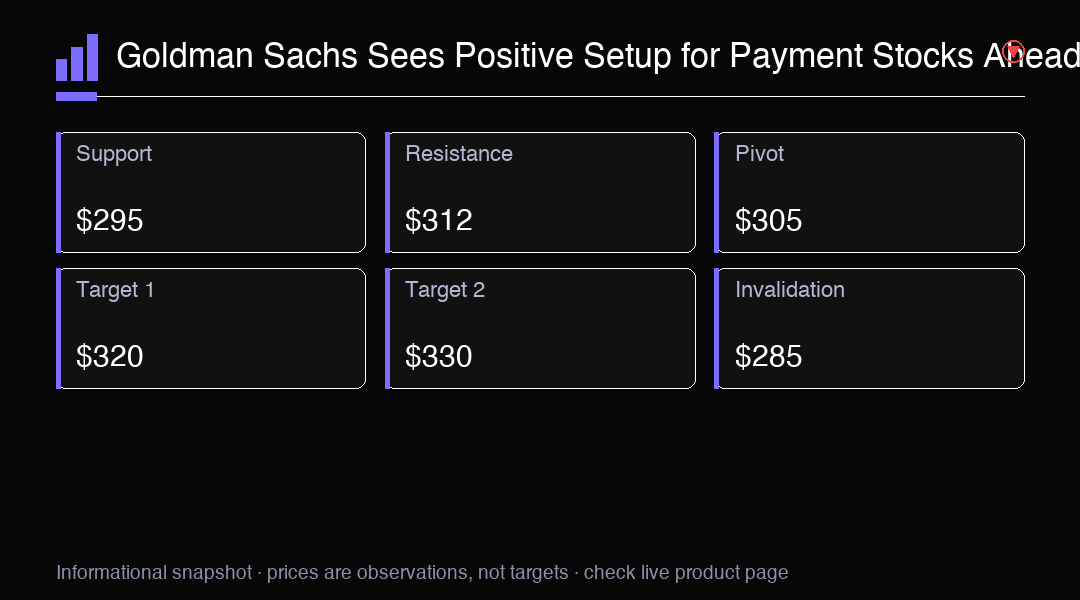
Goldman Sachs' positive stance on payment stocks is supported by strong spending volumes, declining structural risks, and compressed valuations. The bank favors NYSE:V, NYSE:MA, NASDAQ:PYPL, NYSE:GLBE, and NASDAQ:RSKD heading into earnings, while maintaining a cautious stance on NYSE:FIS, NYSE:FISV, and NYSE:FOUR. Visa at $305 is the key pivot, with support at $295 and resistance at $312. A break above $312 could target $320, while a drop below $295 would expose $285.