


KEY POINTS: Goldman Sachs earned $17.01 per share on Wednesday, comfortably beating the $12.86 consensus estimate. JPMorgan reported $5.57 per share, missing the $5.93 expected by analysts. Goldman gained approximately 3.8% in premarket trading while JPMorgan reversed an initial decline to trade around the flatline.
Goldman Sachs GS delivered third-quarter earnings of $17.01 per share, well ahead of the $12.86 consensus forecast. Net profit climbed 29% to $5.29 billion, while revenue increased 23% to $18.68 billion. The beat was driven primarily by the equities division, where revenue surged 72% to $6.44 billion, supported by derivatives activity and financing for institutional clients. Fixed income, currencies and commodities revenue slipped 1% to $3.47 billion, showing that the trading businesses moved in opposite directions within the same firm during the same quarter. The contrast between these two divisions underscores how the composition of a bank's revenue can shift dramatically when client activity rotates between asset classes, and it provides a template for interpreting the results of other large banks reporting in the coming days.
Investment banking fees at Goldman rose 21% to $3.22 billion, while asset and wealth management revenue increased 14%. The banking fees figure demonstrates continued strength in capital markets activity, though the sequential comparison revealed some moderation beneath the annual growth figures. Asset and wealth management provided a steadier revenue stream that complemented the more volatile trading and banking lines, giving the firm multiple sources of earnings beyond the markets businesses that tend to dominate quarterly headlines. The combination of trading upside and banking fee growth at Goldman created a balanced earnings profile that rewarded the market's confidence in the firm's ability to capture revenue across different parts of the capital markets.
JPMorgan JPM reported third-quarter profit of $15.3 billion, or $5.57 a share, below the $5.93 expected by analysts. Reported revenue rose 8% to $50.17 billion, missing the $51.23 billion forecast. Adjusted EPS was $5.75, excluding $498 million in after-tax investment securities losses. Markets revenue increased 15%, with equities up 49% but fixed income trading down 4%, a split that illustrates why market volatility affects desks differently depending on where clients trade, hedge and seek financing. The securities losses were a drag on the reported figure, but the underlying earnings power of the franchise remained intact, as demonstrated by the adjusted number that strips out that specific item and provides a cleaner read on the quarter's actual performance.
Lending remained a source of strength at JPMorgan. Average loans grew 10% and deposits increased 8% from a year earlier. Net interest income excluding markets rose 6% to $24.7 billion. The lending growth provided a counterweight to the earnings miss and helped stabilize the shares during premarket trading, as investors focused on the durability of the bank's core deposit franchise and its ability to generate steady earnings regardless of market conditions. Deposit growth of 8% was particularly significant because it showed that the bank was attracting and retaining customer balances even in a competitive environment, providing the raw material for continued loan expansion in future quarters.
JPMorgan projects 2026 net interest income of approximately $106.2 billion, including markets. Its preliminary 2027 central case calls for $107 billion excluding markets, compared with roughly $97.2 billion this year. The forecast above consensus was the specific catalyst that helped JPMorgan reverse its initial premarket decline, as traders recalibrated their view of the bank's earnings power through the rate cycle and recognized that the lending franchise was accelerating rather than decelerating. The $107 billion central case for 2027 represents a meaningful step up from the current year's $97.2 billion, suggesting that management expects the lending tailwind to persist and possibly strengthen as the rate environment evolves.
Jamie Dimon, the longstanding JPMorgan CEO, highlighted resilient investment and consumer spending, alongside risks from fiscal deficits, sticky inflation, elevated asset prices and rising rates. His commentary framed the results within a broader economic context that acknowledged both the strength of the recovery and the potential for policy and market risks to disrupt it. The balance between confidence and caution in his remarks reflected the mixed picture that the earnings data itself presented, and it provided investors with a framework for understanding how the bank's leadership views the trajectory of the economy and the implications for the firm's business lines.
The divergent reactions in the two stocks reflected the different compositions of their beats and misses. Goldman's outperformance was concentrated in the volatile trading and banking lines, which rewarded the market with upside surprise. JPMorgan's shortfall was in the headline earnings figure, but the underlying lending and deposit trends remained intact, allowing the stock to recover once the forward guidance was digested and analysts adjusted their models for the higher net interest income trajectory. The pattern of initial headline reaction followed by a more considered assessment of the underlying fundamentals is a recurring theme during earnings season, and it creates opportunities for traders who look past the first move.
The split between the two banks illustrates how earnings season is producing uneven momentum rather than a uniform direction. Goldman's equities surge of 72% and JPMorgan's fixed income decline of 4% show that desks exposed to different asset classes can produce sharply different results in the same quarter. The investment banking fee comparison, with Goldman up 21% and JPMorgan up 14% annually, reveals similar divergence in capital markets activity that favors firms with stronger equities franchises during periods of elevated trading volumes. The implication for the sector is that stock selection will matter more than sector beta as the earnings season progresses, because the dispersion between winners and losers is likely to widen as more banks report.
For the broader earnings season, the reports support continued banking activity while exposing the uneven momentum beneath the surface. It is only the start of the season with plenty of action still in the pipeline. The lending and deposit figures at both banks suggest that the core banking franchise remains healthy even as trading revenues fluctuate with market conditions, and the forward guidance from JPMorgan in particular provides a foundation for the stock to build on in coming quarters. The season is still young, and the results from these two money-center banks set a benchmark against which subsequent reports will be measured, particularly in the areas of trading revenue, lending growth and forward guidance.
Goldman's 3.8% premarket gain and JPMorgan's recovery to flatline both reflected reassessment rather than initial reaction. The market moved first on headline numbers and then on the composition of those numbers, a pattern that repeats throughout earnings season as analysts and traders digest the full release. The forward guidance from JPMorgan provided the specific catalyst that reversed its initial decline, demonstrating how quickly sentiment can shift when the underlying franchise strength is acknowledged and the market looks through a headline miss to the more durable trends beneath it.
The Q3 reports support continued banking activity while exposing uneven momentum across the sector. It is only the start of the earnings season with plenty of action still in the pipeline. The key takeaway is that headline earnings misses can be overcome by strong forward guidance and core franchise strength, while beats driven by volatile trading revenue may require more scrutiny before they are treated as durable improvements in earnings power. The divergence between these two money-center banks sets the tone for a season in which composition matters more than headline, and in which the ability to read through the trading noise to the lending and deposit fundamentals will separate the strongest performers from the rest.
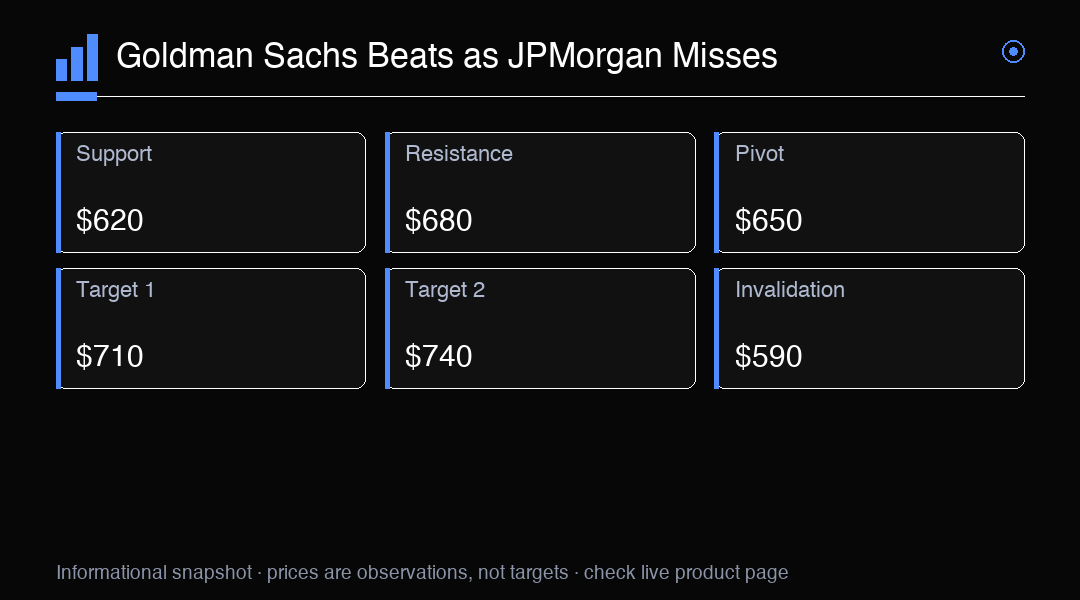
Trading Insight
Goldman Sachs' beat was driven by a 72% surge in equities revenue and 21% growth in investment banking fees, making the trading and banking lines the key drivers. JPMorgan's miss was overcome by a net interest income forecast of $106.2 billion for 2026 and a 2027 central case of $107 billion. GS at $650 is the key pivot, with support at $620 and resistance at $680. A break above $680 could target $710, while a drop below $620 would expose $590.