


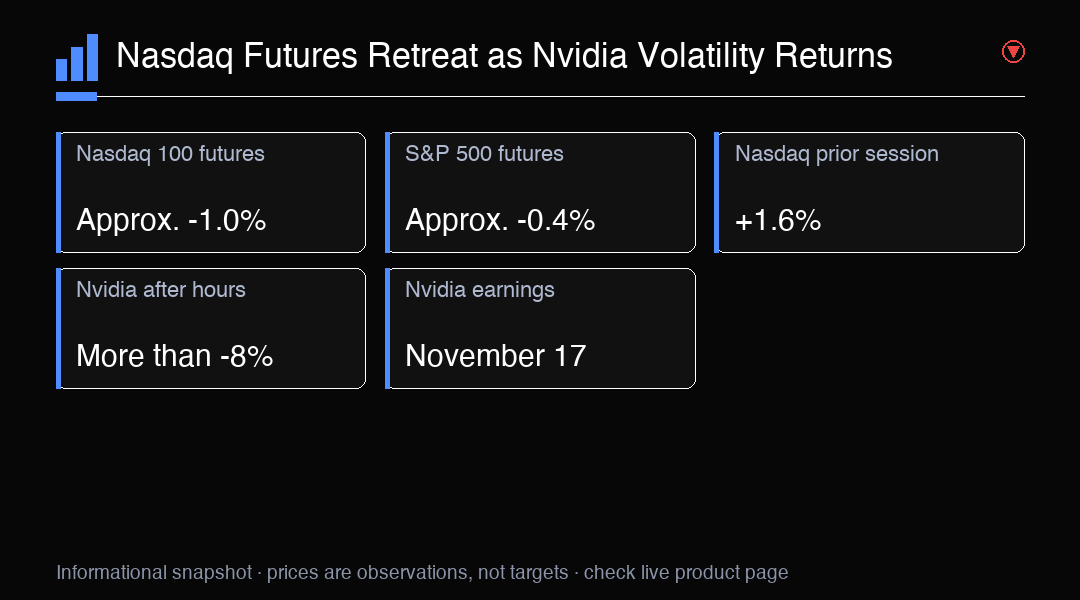
Nasdaq 100 futures fell about 1% early Thursday, November 12, while S&P 500 futures slipped about 0.4%. Dow futures were little changed to slightly higher. The overnight retreat followed a broad advance in the previous cash session, leaving investors to weigh a sharp change in tone against the strength of Wednesday’s close. Futures indicate where index contracts are trading before the regular US session; they do not determine how cash markets will finish. The early move therefore describes a point in the session, not a settled direction for the day. Different futures contracts and the underlying cash indexes can also move by different amounts as trading conditions change.
On Wednesday, November 12, the Nasdaq Composite gained 1.6%, the S&P 500 rose 1.3% and the Dow advanced about 0.5%. Those gains provide useful context for Thursday’s pullback: the market had entered the new session after a strong advance, rather than after an extended decline. A retreat after a rising session can reflect changing expectations, position adjustments or uncertainty around fresh information. The available figures do not establish a single cause. The sequence instead shows how quickly sentiment can shift when a major event is approaching and investors reassess the balance between recent gains and the risks still ahead.
Nvidia’s trading reversal was especially pronounced. The stock rose 2.9% during regular trading on Wednesday, then fell more than 8% in extended trading. The reported after-hours decline varied by timestamp, so the percentage should be understood as an approximate snapshot rather than a fixed closing measure. Extended-hours trading can be less liquid than regular trading, with fewer participants and wider price differences between buyers and sellers. A large move during that period may signal a material change in sentiment, but it does not guarantee that the same move will persist once regular trading resumes. Price, volume and market depth can all change as more participants return.
Nvidia was scheduled to report earnings on November 17, 2026. With the report approaching, investors may pay closer attention to expectations for demand, growth and the durability of spending tied to artificial intelligence. The verified information here does not establish what Nvidia will report or how management will address investor expectations. Nor does it confirm a completed leadership decision. Governance and leadership uncertainty had returned to focus, but uncertainty should not be treated as confirmation of an outcome. For markets, the distinction matters: confirmed results, announced decisions and unresolved questions can carry different implications for valuation and risk.
Nvidia’s size and role in technology benchmarks help explain why a sharp move in one stock can coincide with pressure in Nasdaq futures. Indexes combine many companies, but their members do not all contribute equally to price changes. When a small group of large companies accounts for a substantial share of an index’s market value, moves in those companies can have an outsized influence on the headline measure. That concentration can amplify both gains and losses. It does not mean every constituent shares the same outlook, and it does not mean one company alone explains every index move. Thursday’s futures decline and Nvidia’s after-hours reversal occurred in the same period, but the available facts do not prove that one mechanically caused the other.
The contrast between the Nasdaq and Dow futures also points to differences in index composition. Technology stocks can exert greater influence on technology-heavy benchmarks, while other indexes reflect different mixes of companies and sectors. Futures performance can therefore diverge without establishing that one measure is a complete proxy for the wider economy or for every investor’s holdings. Comparing the Nasdaq 100, S&P 500 and Dow can help frame whether a move appears concentrated or broadly shared. That comparison remains a snapshot: changes in constituents, market capitalization and trading hours can affect how closely the indexes track one another.
Currency and calendar developments added to the day’s market context. The dollar index traded near a 19-month high around 103, while USDJPY approached 160. The dollar index and USDJPY are separate measures: the first tracks the US dollar against a basket of currencies, while the second expresses the yen’s value relative to the dollar. A move in one does not by itself establish the cause or direction of the other. The US cash Treasury market was due to reopen after Veterans Day, making renewed trading in government bonds another point for investors to watch. Weekly jobless claims were scheduled for Thursday, with producer prices due Friday. These events can prompt reassessment as information arrives, but their outcomes were not yet known.
The timing of these events matters because a market can absorb new information in stages. Futures trade before the main cash session and can react while US stocks or Treasury markets are closed. When regular trading resumes, participants may respond to overnight price changes, updated orders and new information at the same time. Scheduled data can also change expectations without producing a uniform reaction across assets. Claims or producer price figures, for example, should be assessed against expectations and prior information once released; the calendar alone does not reveal whether a result will be supportive or adverse. No specific outcome or market response can be inferred in advance from the schedule.
Volatility around an earnings date can be considered through scenarios rather than a single prediction. If Nvidia’s results and outlook meet prevailing expectations, attention may turn to how investors had already positioned for that outcome and whether uncertainty recedes. If reported results or guidance differ from expectations, price reactions could be larger or smaller depending on the size and nature of the surprise. If uncertainty remains unresolved, price swings may continue even without a clear change in the company’s longer-term prospects. Each scenario is conditional. The known facts do not establish the outcome, a target price or the direction of the next move. The more useful question is how different outcomes could affect exposure and whether the risk is understood before the event.
Risk management begins by identifying what an instrument represents and how much of a portfolio’s exposure depends on a narrow group of companies. NAS100 is a broad index instrument. It is not direct exposure to Nvidia and does not act as a hedge for Nvidia shares. Its price reflects the broader index exposure, including Nvidia alongside other constituents, and the exact contribution of each company can vary. A trader assessing index exposure can distinguish the risk of a broad benchmark from single-company earnings risk, consider how overnight gaps may affect a position, and define in advance what loss would be tolerable. These are general planning considerations, not a recommendation to trade or a prediction about a specific price level.
The main signal from Thursday’s early session is a change in risk tone after Wednesday’s advance, alongside renewed volatility in Nvidia ahead of its scheduled earnings report. The confirmed figures describe different instruments and different trading windows, so they should not be combined into a precise forecast. A futures decline of about 1%, a cash-session gain of 1.6% the day before and an after-hours Nvidia drop of more than 8% each capture a distinct observation. Further price action could alter that picture. Watching how the broad indexes, large technology shares, bond trading and scheduled data evolve can help clarify whether the move remains concentrated or spreads across markets, while keeping the limits of each indicator in view.
Trading Insight
Nasdaq futures weakness followed a strong prior cash session and coincided with a sharp Nvidia reversal in extended trading ahead of scheduled earnings. Treat the reported moves as snapshots across different instruments and sessions. NAS100 is a broad index proxy, not direct Nvidia exposure or a hedge; event risk and index concentration can affect exposure differently.