


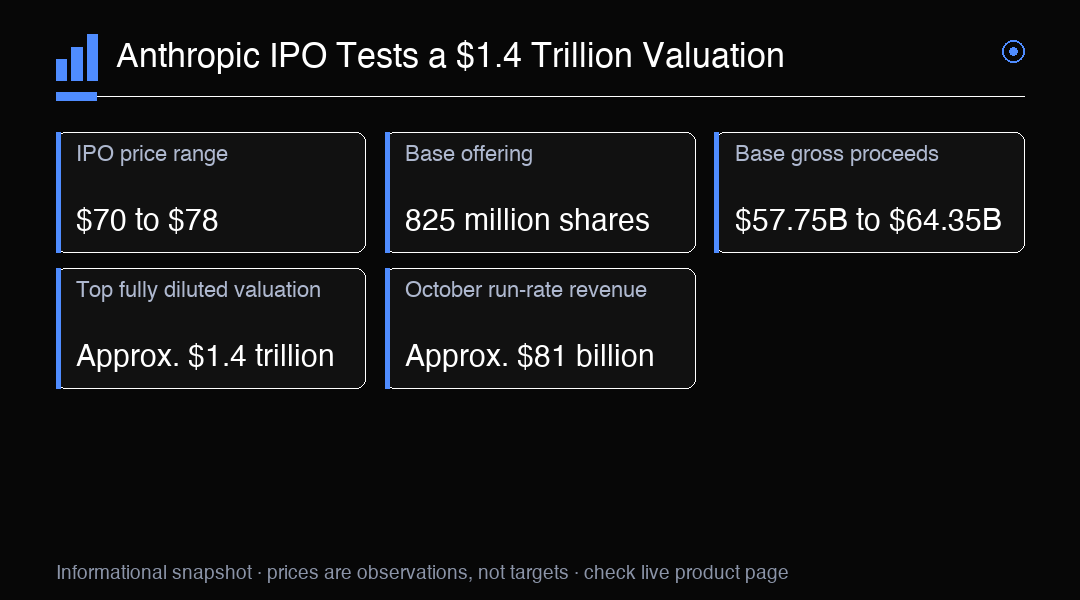
Anthropic’s amended preliminary prospectus, filed November 10, 2026, sets out an offering that would test investor appetite for one of the largest technology listings in recent memory. The company estimates a price range of $70 to $78 per Class A share and plans to offer 825 million shares in total. These are preliminary terms, not a final price or a guarantee that trading will begin on a particular date. The prospectus remains subject to completion, and effectiveness and final pricing are still conditions for the offering. That distinction matters: headline valuations calculated from the current range describe a possible transaction, while the value ultimately assigned in public trading could differ.
The 825 million base offering combines 801,351,354 shares from Anthropic with 23,648,646 shares from selling holders. At the stated price range, gross proceeds for the base offering would be approximately $57.75 billion to $64.35 billion before fees. At $78 per share, the company’s primary shares would account for about $62.5 billion before fees. The selling holders’ shares contribute to the total offering but are not proceeds to Anthropic. Underwriters may also purchase up to 123.75 million additional shares. That option could increase the number of shares sold if exercised, but it is not part of the 825 million base offering and should not be treated as a certain sale.
The top of the proposed range implies an approximately $1.4 trillion fully diluted valuation. Fully diluted calculations include shares and other share-linked instruments under the relevant assumptions; they are not the same as multiplying the offer price by outstanding shares alone. On an outstanding-share calculation, the valuation is closer to $1 trillion. Both figures describe different share-count bases, so comparing them without naming the basis can make the offer appear inconsistent. The fully diluted figure is the more expansive measure and reflects potential dilution. Neither calculation is a final market capitalization: the offer price remains preliminary, and the value investors assign after listing will depend on the final terms and subsequent trading.
Revenue growth provides one important reference point for evaluating that valuation. Anthropic reported run-rate revenue of approximately $81 billion on October 31, up $10 billion from September 30. A run rate is an annualized measure based on a recent period, rather than revenue already earned over a full year. It can communicate the pace of recent business activity, but it does not establish that the same pace will continue. Investors comparing the run rate with the proposed valuation should keep that time basis visible and distinguish it from reported period revenue. The $81 billion figure is therefore useful context for the offering, but it should not be substituted for audited or completed-year revenue in valuation comparisons.
The company also reported $33.242 billion of revenue for the nine months of 2026 and a net loss of $104.039 billion over that period. The reported loss was heavily affected by fair-value changes in convertible instruments. That detail is material when interpreting the headline result: a net loss that includes large valuation changes can differ substantially from operating performance, and the stated information does not establish that the loss will recur at the same scale. At the same time, the loss remains part of the reported financial picture. A balanced reading considers the revenue generated during the nine-month period, the accounting effect identified for the loss, and the limits of extrapolating either figure beyond its reporting period.
The gap between period revenue and run-rate revenue illustrates why investors should ask what each metric measures before using it. Nine-month revenue is a reported amount for a defined period. Run-rate revenue is an annualized snapshot tied to a specific date. The measures cannot be compared as if they covered identical time spans, and the run rate does not erase the reported net loss. Together, they show a company with a large recent revenue base and a material reported loss whose composition was heavily influenced by fair-value changes. The preliminary offering documents supply these figures as context for a possible listing; they do not resolve how investors will weigh growth, profitability, dilution, or valuation.
Anthropic applied to list its Class A shares on the Nasdaq Global Select Market under the symbol ANT. An application and proposed ticker identify the intended venue and symbol, but do not by themselves confirm that the listing is effective or that shares will begin trading on a specified day. In particular, a November 19 debut should not be treated as guaranteed. The prospectus remains preliminary, and final pricing and effectiveness remain conditional. Changes to the offer price, share count, timing, or other terms may affect calculations based on the current range. Investors following the proposed transaction should keep the filing’s preliminary status attached to each estimate and avoid treating a tentative schedule as a completed event.
Share supply is another part of the valuation picture. The company’s planned 801,351,354 primary shares would generate proceeds for Anthropic before fees, while 23,648,646 shares from selling holders would generate proceeds for those holders. The underwriters’ option for up to 123.75 million additional shares creates a further possible source of supply. If exercised, it would raise the number of shares sold beyond the base amount; whether and how much is exercised remains uncertain. These distinctions matter when reading both proceeds and per-share valuation figures. Gross proceeds do not equal net proceeds after fees, and the base offering does not include the full potential underwriter option.
A large preliminary valuation can also be read alongside the questions it leaves open. The stated figures do not guarantee future revenue, margins, or market value. Run-rate revenue is not a promise of future results, and the nine-month loss cannot be understood without its reported fair-value effects. Fully diluted valuation includes a broader share basis than outstanding-share valuation, while the final offering price and listing conditions remain unresolved. These facts create several separate points for analysis rather than a single verdict: what revenue period is being used, what share count underlies a valuation, how much of the offering is primary, and which financial measures are reported versus annualized. Keeping these distinctions clear makes comparisons more useful and less dependent on a headline number.
For broader market context, NAS100 can serve as a broad proxy for AI and technology exposure, but it does not provide direct exposure to Anthropic or hedge the risks of owning ANT. The index’s constituents and weighting differ from the company, and index performance cannot establish how a new listing will trade. Any relationship between a broad technology index and an individual IPO can change with market conditions. This distinction is especially relevant when the transaction has not yet reached final pricing or effectiveness. NAS100 offers a way to observe broad technology-market conditions, not a substitute for company-specific information or a direct measure of demand for Anthropic shares.
The clearest interpretation of the proposed deal starts with its terms and their limits. Anthropic has filed for a base offering of 825 million shares at an estimated $70 to $78, with a possible additional underwriter purchase of up to 123.75 million shares. The top of the range implies approximately $1.4 trillion on a fully diluted basis, while an outstanding-share calculation is closer to $1 trillion. The company reported approximately $81 billion in run-rate revenue at October 31, alongside $33.242 billion in nine-month revenue and a $104.039 billion nine-month net loss heavily affected by fair-value changes in convertible instruments. Final pricing, effectiveness, and first trading remain uncertain. Those qualifiers belong beside every valuation and calendar reference.
Trading Insight
Compare the preliminary fully diluted valuation with the share-count basis, offering mix, and time period behind each revenue figure. NAS100 provides broad AI and technology context, not direct ANT exposure or a hedge.