


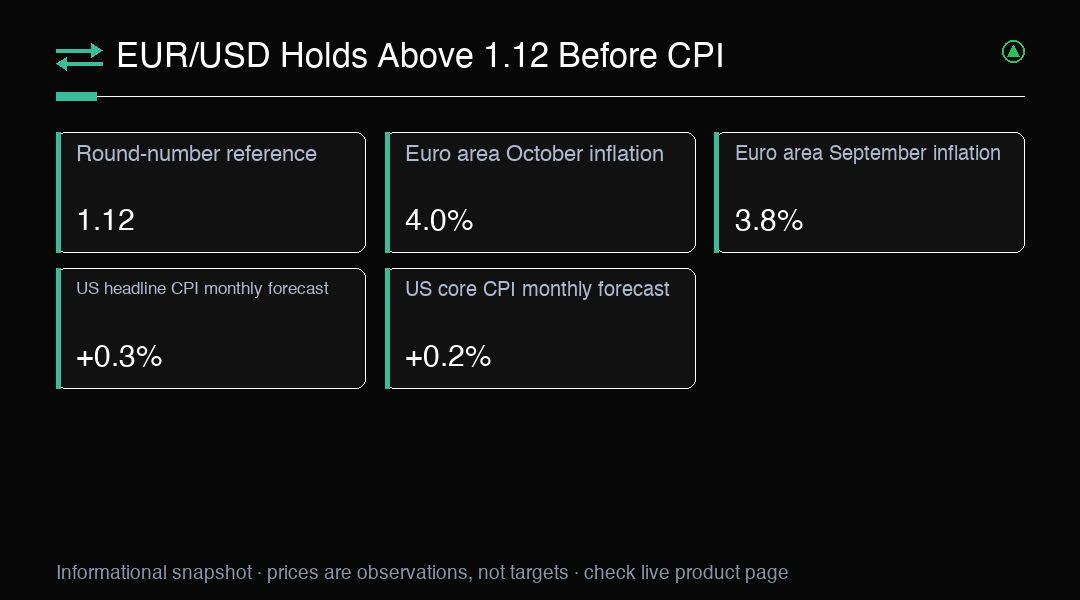
EUR/USD traded above 1.12 early Tuesday, Nov. 10, after advancing during Monday’s session. That left the round number in focus as traders weighed the euro’s recent advance against the possibility that fresh US inflation data could change expectations for monetary policy. The market had not yet received the scheduled October CPI figures, so forecasts remained expectations rather than observed results. The confirmed 1.12 reference and the verified macroeconomic inputs provide the relevant context without requiring a more precise intraday quote or range.
The timing of the advance matters. EUR/USD moved higher during Monday’s session as risk appetite improved and oil prices declined. Those developments coincided with the euro’s rebound, but available information does not establish either as the sole cause. Currency markets can respond to several influences at once, including interest-rate expectations, relative economic data, positioning, and changes in demand for perceived safety. A one-day move can therefore reflect a temporary balance of those forces rather than a durable change in the longer-term outlook. The early-Tuesday trade above 1.12 showed that attention remained on whether the advance could hold as the next major data release approached.
The 1.12 area provides a visible reference for judging the move because round numbers often attract market attention. It should not be treated as a guaranteed floor, ceiling, target, or forecast. A move higher would place attention on whether buyers continue to transact above the round number, while a move back below it would describe a retracement rather than prove that the broader euro move had ended. Without a verified timestamped quote series, more precise intraday boundaries would create false precision. Price behavior after new information arrives remains more important than any single reference.
The 1.1200 round number can attract attention because traders often use conspicuous figures as reference points. It is not, on the information available here, a confirmed floor or ceiling. The recent 1.1150 area is another reference zone identified in the market context, but it should not be treated as guaranteed support or resistance. Naming such zones helps explain where market participants may focus; it does not establish what they will do there. EUR/USD can trade through well-known numbers when expectations, liquidity, or new data shift. Any interpretation of these levels should retain that uncertainty.
Euro-area inflation added an important part of the policy backdrop. The October flash estimate put annual inflation at 4.0%, up from 3.8% in September. That increase points to firmer measured price growth in the latest estimate, but one monthly reading does not by itself determine the European Central Bank’s next move. The composition and persistence of inflation, incoming activity data, and the balance of risks all remain relevant to policy decisions. The 4.0% figure is an estimate for October, not a final reading, and it should be distinguished from the monthly US CPI forecasts due later Tuesday.
At its Oct. 29 meeting, the ECB kept its three key interest rates unchanged and retained a data-dependent approach. That decision supplies a clear policy reference, while the guidance leaves future decisions open to incoming evidence. It does not make a rate increase certain, and the October euro-area inflation estimate alone cannot establish that one is imminent. For EUR/USD, the euro-area outlook matters alongside the US outlook because exchange rates reflect relative conditions. If investors revise expectations for one central bank more than the other, the pair may respond, but the direction and scale would depend on how those revisions compare.
The next scheduled event was the US October CPI release at 8:30 a.m. Eastern Time on Nov. 10. The cited consensus expectations were a 0.3% monthly increase in headline CPI and a 0.2% monthly increase in core CPI. Those numbers are forecasts, not BLS results. The distinction is central to reading the setup: the release could differ from expectations, and the market response would depend on both the result and how it compares with what traders had already anticipated. Until publication, there is no basis to describe either forecast as an observed inflation outcome.
A headline reading in line with consensus would still need interpretation alongside core inflation and the details of the report. A result above or below forecast could prompt traders to reassess the likely path of US interest rates, but the currency response would not be automatic. The dollar could react to the data, while the euro side of the pair, broader risk appetite, and positioning could also shape price action. Even a clear surprise may produce an uneven response if other parts of the report point in different directions. The available figures support scenario analysis, not a specific forecast for EUR/USD.
The relationship between broad risk sentiment and individual assets also deserves care. A broad market proxy can help describe an overall shift in risk appetite, but it may not capture the company-specific factors that influence a single stock such as Rocket Lab. Its price can reflect business developments and other individual drivers that a broad proxy does not represent. This limitation matters when interpreting cross-market narratives: a general move in risk appetite may coincide with currency moves without explaining every asset’s performance. For EUR/USD, the Monday coincidence with improving risk appetite and lower oil prices is context, not proof of a direct or lasting causal link.
For the pair, the near-term question is whether trading above 1.12 persists after the CPI release. A brief move through that round number may differ from sustained trading on either side of it, and neither outcome can be described as guaranteed. The release time gives the market a defined moment for new information, but it does not remove uncertainty about the report, the reaction, or the durability of any move. Traders can compare the official result with consensus expectations while continuing to treat price levels as observations rather than promises.
The setup therefore combines a recent euro gain, an October euro-area inflation estimate of 4.0%, unchanged ECB rates with data-dependent guidance, and a pending US CPI release. Each is a separate input, and none alone resolves the outlook. The stated price references help frame what traders may monitor, while the CPI consensus offers a comparison point once the official figures arrive. Keeping estimates separate from results, and observed range references separate from guaranteed barriers, provides a more disciplined way to interpret EUR/USD as new information enters the market.
Trading Insight
EUR/USD traded above 1.12 early Nov. 10 as markets awaited the US October CPI release. The release was scheduled for 8:30 a.m. ET; 0.3% headline and 0.2% core monthly readings were consensus expectations, not results. The 1.12 round number is a reference, not a guaranteed barrier. Euro-area October inflation was estimated at 4.0%, up from 3.8% in September, while the ECB had kept its three key rates unchanged.