


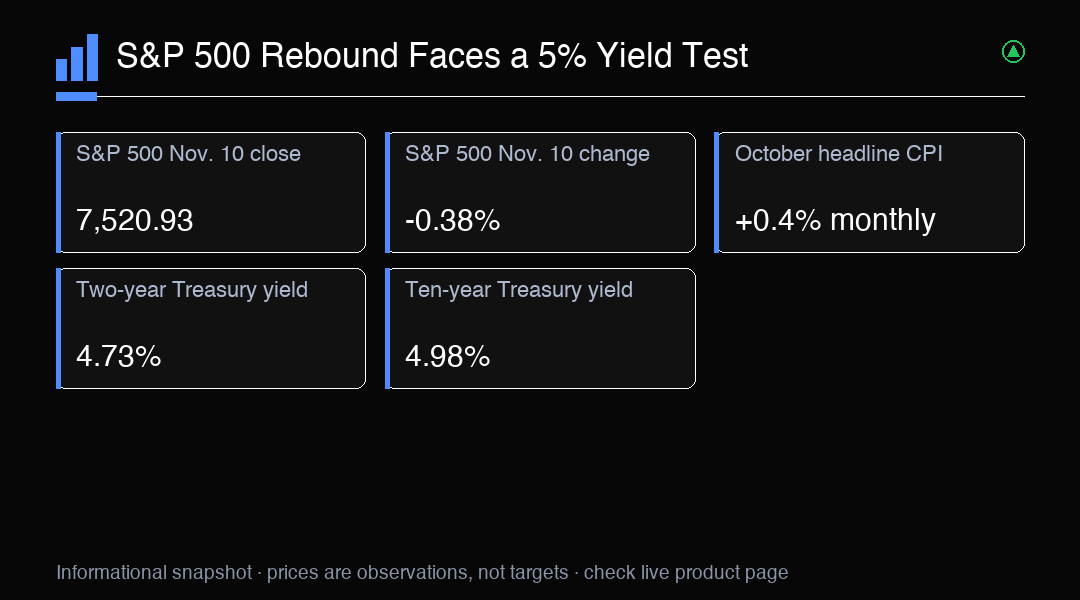
US equity futures pointed higher early Wednesday after a weaker Tuesday cash session, but the move remained a time-specific snapshot rather than confirmation of a durable rebound. S&P 500 futures were up about 0.6%, Nasdaq-100 futures gained 1.2% and Dow futures added 0.3% at that point. In the prior session, the S&P 500 closed at 7,520.93, down 0.38%; the Nasdaq Composite fell 0.74% and the Dow slipped 0.30%. Those different index moves show that the session was not uniform across market segments. A futures indication can change before the opening bell as traders respond to new orders and information, so the early percentages should remain approximate. The central question is whether buyers can sustain the advance while inflation data and elevated Treasury yields continue to shape the trading environment.
October consumer prices rose 0.4% from September, while core CPI, which excludes food and energy, increased 0.3%. The distinction matters because headline inflation can be affected by volatile components, while the core reading offers another view of price pressure. Neither figure alone establishes the direction of future inflation or the Federal Reserve’s next decision. Before the release, Governor Christopher Waller said a core reading around 0.3% or higher could warrant considering a 50-basis-point increase in December. That was a conditional statement about a possible policy discussion, not a decision or a promise. The reported core reading landed around the threshold he had described, leaving investors to weigh the inflation data alongside other evidence and policy communication. The figures create a test for the rebound: can risk appetite hold while markets consider the possibility of tighter policy?
Treasury yields add a second part to that test. The official daily curve showed a 4.73% yield for two-year Treasuries and 4.98% for ten-year Treasuries on Nov. 10. The two-year yield is often watched for expectations about near-term policy, while the longer maturity also reflects views about growth, inflation and the compensation investors require for holding longer-dated debt. These are useful market reference points, not a complete explanation of equity moves. A yield near 5% can raise the discount rate applied to expected future earnings, making distant cash flows less valuable in present terms. It can also give investors an alternative source of income. The effect on any company depends on its earnings profile, financing needs and valuation, so a single yield threshold does not translate mechanically into a fixed index response.
Sensitivity to yields can vary substantially within the S&P 500. Companies whose valuations depend heavily on profits expected years ahead may be more exposed to changes in discount rates than businesses with nearer-term cash generation. Higher borrowing costs can also affect financing plans, customer demand and the cost of refinancing debt, although the size and timing of those effects vary by company. At the same time, resilient earnings expectations or evidence of sustained demand could support share prices even when yields are high. This creates competing forces rather than a simple rule that rising yields must push every stock lower. The index’s direction depends on how investors balance expected earnings against the rate used to value them. A rebound may therefore look broad at the index level while remaining fragile beneath the surface if gains rely on a narrow group of rate-sensitive stocks.
The technology-related context also warrants careful instrument framing. CoreWeave reported quarterly revenue of $3.66 billion, up 168% year over year, and a revenue backlog of roughly $133 billion. The report also discussed customer prepayments and deposits expected over the next three months. These are company-specific figures and forward-looking timing details; they should not be treated as a direct measure of S&P 500 earnings or as evidence that every artificial-intelligence-related business has the same demand profile. NAS100 is a broad index proxy for technology-heavy market exposure, not direct exposure to CoreWeave and not a hedge for its individual business risks. Any interpretation of the company’s results should distinguish reported revenue and backlog from cash collection, future delivery and eventual profitability.
The same distinction applies to Anthropic. Discussion of a fully diluted valuation and preliminary offering terms describes a private-company valuation framework and preliminary terms, not a confirmed public-market price or a guarantee of eventual transaction details. NAS100 can serve as a broad proxy for technology-related market sentiment, but it does not provide direct exposure to Anthropic and should not be presented as a hedge for company-specific risks. For both companies, the broader market may react to changing expectations around artificial intelligence investment, infrastructure demand and financing. That sentiment channel does not make an index move a clean read-through to either business. Investors should keep company disclosures, preliminary transaction information and broad index pricing conceptually separate when assessing the market narrative.
Wednesday’s session also calls for attention to trading hours. US stocks trade regular hours on Veterans Day, while the cash Treasury market is closed. That means equity prices can move during the regular session without the same contemporaneous cash Treasury trading that would normally help contextualize changes in yields. The Nov. 10 official curve remains a dated reference point, not a live Wednesday yield. Futures and other rates instruments may still provide information, but the closed cash market changes the mix of visible signals. Comparing a Wednesday equity move with Tuesday’s official Treasury curve should therefore preserve the date difference. A cross-asset relationship observed in one session may be harder to assess when one major market is closed, and apparent confirmation or divergence may reflect timing as much as a change in underlying expectations.
Friday’s producer price index is the next major US inflation release identified in this setup. It may add information about price pressures earlier in the production chain, but it cannot be assumed in advance to confirm or reverse the consumer inflation picture. Market attention may also shift between the headline and underlying components, just as it did with CPI. Until the release, price action can remain sensitive to changing expectations, positioning and new information. Global equity, dollar, gold and crypto moves were volatile around the inflation report, underscoring that markets were adjusting across assets rather than moving in a single, settled direction. Volatility alone does not establish a common cause or indicate which direction will persist. The useful discipline is to separate observed moves from explanations that remain uncertain.
Scenario analysis can help frame the S&P 500’s response without treating any outcome as certain. If buyers sustain the early futures advance during regular trading, attention may turn to whether participation extends beyond a narrow set of large technology names and whether the index can absorb the yield backdrop. If the advance fades, that would show only that the early indication did not hold; it would not, by itself, prove that yields caused the reversal. A mixed session is also possible, with gains in some segments offset by weakness elsewhere. The inflation data and Waller’s conditional comments may keep policy expectations in focus, while Friday’s producer prices could provide another input. These are scenarios for interpreting market behavior, not forecasts or trading instructions. No single index move can resolve the competing signals on its own.
For session discipline, distinguish the timestamp of an observation, the instrument being observed and the market that is open. Early futures percentages describe an early snapshot; the Nov. 10 close and official Treasury curve describe completed prior-session observations; Wednesday cash equities trade during regular hours while the cash Treasury market is closed. Keeping those categories separate reduces the risk of treating unlike measurements as simultaneous. Risk assessment can also account for volatility, position size, event timing and the possibility that prices move before a thesis can be reassessed. There is no need to infer a precise support, resistance or target level from the figures listed here. The provided levels are reference data for this setup, not a complete map of future price behavior. The rebound remains an evolving market question shaped by inflation, yields, earnings expectations and timing.
The S&P 500’s early rise therefore faces a two-part test: whether buyers can sustain the move after Tuesday’s decline, and whether equity valuations can remain supported while Treasury yields sit close to 5% at the latest official reading. October CPI provides fresh information, but Waller’s statement remains conditional and Friday’s producer price release is still ahead. Company-specific AI disclosures may influence sentiment, yet broad indices do not replicate individual company exposure. Veterans Day trading hours add another timing complication because cash Treasuries are closed while US stocks remain open. Reading the session carefully means retaining approximate and dated qualifiers, separating reported results from forward-looking details, and allowing for more than one explanation when markets move. The available facts frame the debate; they do not determine its outcome.
Trading Insight
Treat the early futures gains as a time-specific indication. Compare regular-session equity price action with the dated Nov. 10 Treasury curve, and separate broad index sentiment from company-specific AI disclosures. The cash Treasury market is closed on Veterans Day, while Friday’s producer price release remains ahead.