


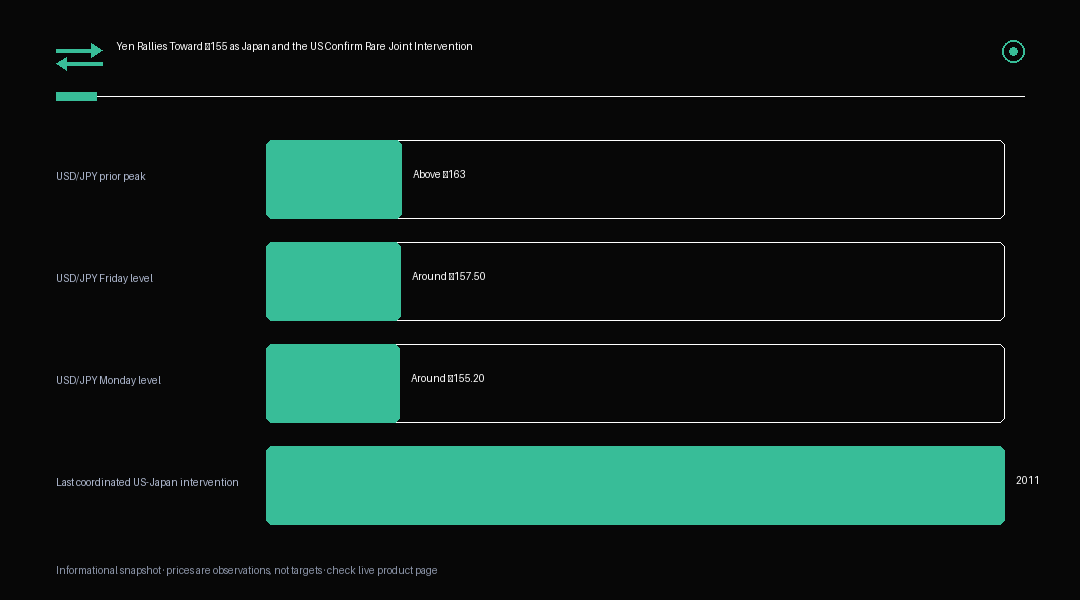
USD/JPY tumbled toward the ¥155 area to start the week after Japanese and US officials confirmed they had jointly intervened to support the yen, one of the more unusual currency operations markets have seen in years. The pair had traded above ¥163 only days earlier before sliding to around ¥157.50, and the confirmed intervention has now pushed it further, into the mid-¥155 region during early trading.
What makes this episode stand out is not just the size of the move but who was involved. Reports indicate this was the first coordinated US-Japan currency intervention since 2011, a rare instance of Washington stepping in directly alongside Tokyo rather than leaving Japan to defend its own currency. US Treasury officials characterized the action as a response to disorderly yen movements, and Japan's finance ministry used similar language, sticking to the official position that intervention targets excessive volatility rather than any specific exchange rate target.
The mechanics of the operation matter for traders trying to gauge what comes next. Reports said the New York Fed carried out Treasury-side foreign exchange operations through major banks, working alongside Japanese authorities as they bought yen. European Central Bank officials were reportedly informed of the transaction as well, underscoring how unusual it was for a G7 partner to be looped in on a bilateral currency operation of this kind.
Japan's own intervention playbook typically starts quietly. The finance ministry, acting through the Bank of Japan, will often begin with what is known as a rate check, where officials ask dealers for current pricing and trading volumes without necessarily acting on it. That step functions as a warning shot. When warnings fail to cool the move, the ministry can instruct the BOJ to step into the market directly, generally by selling dollars and buying yen. This time, that domestic playbook was reinforced by direct American participation, giving the operation considerably more firepower than a unilateral Japanese effort would have carried.
Finance Minister Satsuki Katayama reiterated over the weekend that Japan would not hesitate to conduct further coordinated interventions and remained in close contact with the US Treasury on currency matters. That statement effectively puts the broader ¥160-to-¥164 region on notice: a zone that had already been treated by many desks as an area where Tokyo grows uncomfortable is now a stretch where traders should expect both governments to be watching closely, not just Japan alone.
It's worth stressing what this move does and does not accomplish. The intervention has pulled USD/JPY down by roughly eight to nine yen from last week's peak, a meaningful swing in a short window. But interventions are, by design, a tool for smoothing disorderly price action rather than a mechanism for rewriting the underlying drivers of the pair. Japan's policy rate remains far below prevailing US rates, and that interest-rate gap is the primary force that has kept the yen structurally weak for an extended period. Coordinated buying can shock the market and force short-yen positioning to unwind quickly, but it does not by itself close that gap.
That distinction matters for how this episode is likely to evolve. Historically, unilateral Japanese intervention has tended to produce sharp, short-lived rallies that fade once the immediate shock passes and traders refocus on rate differentials. A joint US-Japan operation is a stronger signal precisely because it suggests both governments see the currency move as a shared problem worth spending real capital on, which may extend the psychological impact even if it does not change the fundamental math overnight.
For now, the practical takeaway is that the ¥160-to-¥164 region carries elevated intervention risk should the pair attempt to retrace higher, while a slide toward ¥155 and below opens the door to further two-way volatility as markets test how committed both governments are to defending these levels. Desks that were aggressively short yen heading into last week are likely reassessing position sizing given the newly demonstrated willingness of Washington to participate directly.
Traders watching this pair into the rest of the week should keep an eye on any follow-up commentary from Japanese officials, further signals from the US Treasury about the durability of the coordinated stance, and incoming US economic data that could reinforce or undercut the interest-rate gap driving the broader trend. Until the rate differential narrows in a durable way, rallies driven by intervention are likely to be treated by many participants as tactical opportunities rather than a fundamental turn in the pair's multi-year trend.
The episode is also likely to ripple beyond USD/JPY itself. Sharp, intervention-linked yen moves have historically spilled into other yen crosses, and desks will be watching for comparable volatility in EUR/JPY and GBP/JPY even though neither the euro nor sterling has a direct catalyst of its own tied to this move. A stronger yen across the board can also prompt an unwind of carry-trade positioning that had built up while the currency sat near multi-decade lows, a dynamic that tends to show up first in higher-beta currency pairs and risk assets funded in yen before feeding back into the dollar-yen pair directly.
It is also worth remembering how this fits into Japan's broader intervention history. Tokyo has intervened repeatedly over the past several years whenever the yen's slide accelerated past levels officials consider disorderly, typically buying back some ground before fundamentals reasserted themselves. What differentiates this episode is the direct US participation, which signals that Washington now views a disorderly yen as a shared financial-stability concern rather than purely a Japanese domestic matter. That shift in tone, more than the specific yen level defended, may be the detail that most changes how the market prices intervention risk going forward.
Trading Insight
The ¥160-to-¥164 region should now be treated as a zone of elevated intervention risk rather than a routine resistance band, given that both Tokyo and Washington have just demonstrated a willingness to act together to defend the yen there. Traders leaning short yen into a retest of that area should size positions with the knowledge that further coordinated buying remains explicitly on the table, per Finance Minister Katayama's own comments. On the other side, dips toward ¥155 and below may still attract dollar buyers if US yields hold firm, since intervention alone rarely reverses a pair's medium-term trend without a matching shift in the underlying rate differential. The most durable directional signal will likely come from any change in that US-Japan rate gap rather than from guessing the timing of the next intervention.