


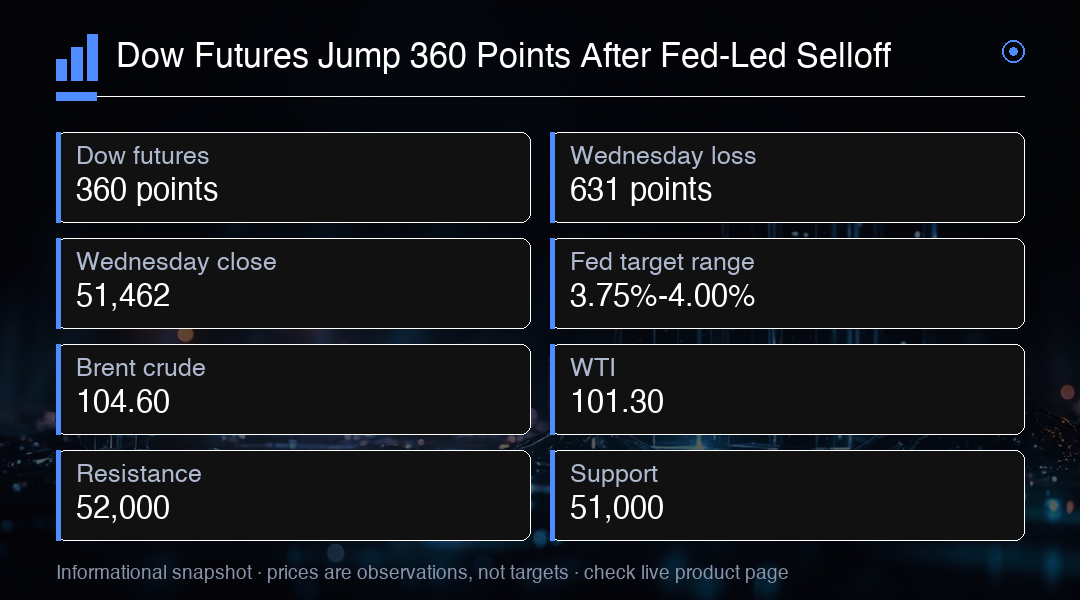
Dow futures rose roughly 360 points Thursday after the index tumbled 631 points, or 1.2%, to 51,462 Wednesday. The S&P 500 lost 0.45%, while the Nasdaq finished almost unchanged as technology shares proved more resilient than industrial, financial and energy stocks. The Dow's underperformance partly reflects its unusual construction. Unlike the market-value-weighted S&P 500, the Dow is price-weighted. That means companies with higher share prices exert greater influence regardless of their overall size. A difficult session for several expensive components can therefore produce an impressively dramatic point total. Futures are recovering around 60% of Wednesday's loss while S&P 500 and Nasdaq futures gained roughly 0.6% alongside the Dow, suggesting the improvement is broad rather than another tech-only rescue mission.
The Federal Reserve raised rates by 25 basis points to 3.75%-4.00% and indicated another increase is likely this year. Policymakers also project no reduction in all of 2027. Stocks initially rose before reversing as investors accepted that the Fed's "short" hiking cycle could still leave borrowing costs elevated for considerably longer. Relief arrived from oil. Brent fell another 1.2% toward 104.60, while WTI dropped to 101.30. Saudi Arabia offered additional crude through ship-to-ship transfers near Oman, easing some fears. Lower crude benefits the Dow's manufacturers, retailers and consumer-facing companies by reducing transport and input costs.
Japanese stocks advanced Thursday, with the Nikkei gaining around 1%. Pharmaceutical and machinery companies led the move: Eisai rose 2.4% and Mitsubishi Heavy Industries added 3.2%. The Bank of England is expected to hold rates at 3.75% today despite UK inflation accelerating to 3.1%. Traders will look for guidance on a possible November increase, particularly after higher energy costs revived inflation concerns across Europe. The Bank of Japan is expected to raise its rate from 1% to 1.25% Friday, the highest in 31 years. Since the move is heavily priced, Governor Kazuo Ueda's guidance will likely be the big surprise.
The dollar index climbed to 100.40, its highest in seven weeks, as traders assigned roughly a 90% probability to another Fed increase this year. EUR/USD fell below 1.15, sterling weakened ahead of the BoE and USD/JPY topped 156 despite expectations for Japanese tightening. Gold recovered above 4,300 after its post-Fed decline. Bullion is balancing a stronger dollar and higher policy rates against geopolitical risk, fiscal concerns and easing long-term yields. Bitcoin held near 76,400, showing moderate resilience after the Fed and the Clarity Act setback. The immediate test is whether BTC can reclaim 77,000-78,000 while cash and government bonds offer more competitive returns.
For Dow traders, the key question is whether the recovery can sustain itself. The Fed's hawkish stance suggests that borrowing costs could remain elevated for longer, which would normally be a headwind for equities. However, the retreat in oil prices is providing some relief, particularly for manufacturers and consumer-facing companies. The options market is pricing in elevated volatility around the upcoming BOJ and BoE decisions, suggesting traders are bracing for potentially significant price swings. The put-call skew indicates that investors are hedging for downside risk, but there is also significant interest in upside calls.
Looking ahead, the key levels to watch for the Dow are Tuesday's low near 51,462 and the psychological 52,000 level. A sustained move above 52,000 could open the door to a retest of the all-time highs near 53,000. On the downside, the 51,000 level is the first psychological support, followed by the 50-day moving average near 50,500. The interplay between Fed policy, oil prices, and global central bank decisions will continue to drive the Dow in the weeks ahead. Position sizing and risk management become crucial in this environment.
The earnings season is approaching, and investors will be looking for signs that companies can maintain their profit margins in the face of rising input costs. The energy sector has been a bright spot, with oil prices above 100 dollars per barrel boosting the profits of energy producers. However, higher energy costs are a headwind for other sectors, particularly airlines, transportation companies, and manufacturers. The consumer discretionary sector is also under pressure, as higher interest rates and elevated inflation weigh on consumer spending.
The Federal Reserve's balance sheet reduction is another factor that could influence equity markets. As the Fed continues to shrink its holdings of Treasury securities and mortgage-backed securities, liquidity is being removed from the financial system. This could put upward pressure on long-term interest rates and make it more expensive for companies to borrow. The pace of balance sheet reduction will be closely watched by investors, as any acceleration could spook markets. For now, the immediate focus is on the Fed's rate decision and the guidance that accompanies it.
The Federal Reserve's dot plot will be closely watched for clues about the path of policy in 2027. If the median dot shows only one more hike this year, that could be taken as a dovish signal. If it shows two or more, that could spook equity markets. The yield curve is also worth watching: if the 2s10s curve steepens after the decision, that could signal growing confidence in the economic outlook. Key levels for the Dow are 52,000 resistance and 51,000 support. A break above 52,000 could open the door to 53,000, while a break below 51,000 could expose 50,500.
From a sector rotation perspective, the recent shift toward energy and away from technology is notable. If oil prices remain elevated, energy stocks could continue to outperform. However, if oil prices retreat further, technology stocks could regain leadership. The earnings season will be critical for the tech sector, with investors looking for evidence that the massive capex investments are generating returns. Any disappointment could trigger another round of selling in semiconductor names, which would weigh on the Nasdaq and potentially the broader market.
Trading Insight
The Dow's near-term direction hinges on whether the recovery can sustain itself amid the Fed's hawkish stance and retreating oil prices. A sustained move above 52,000 could open the door to all-time highs near 53,000, while a break below 51,000 could expose the 50-day moving average near 50,500. The options market is pricing in elevated volatility around upcoming central bank decisions.