


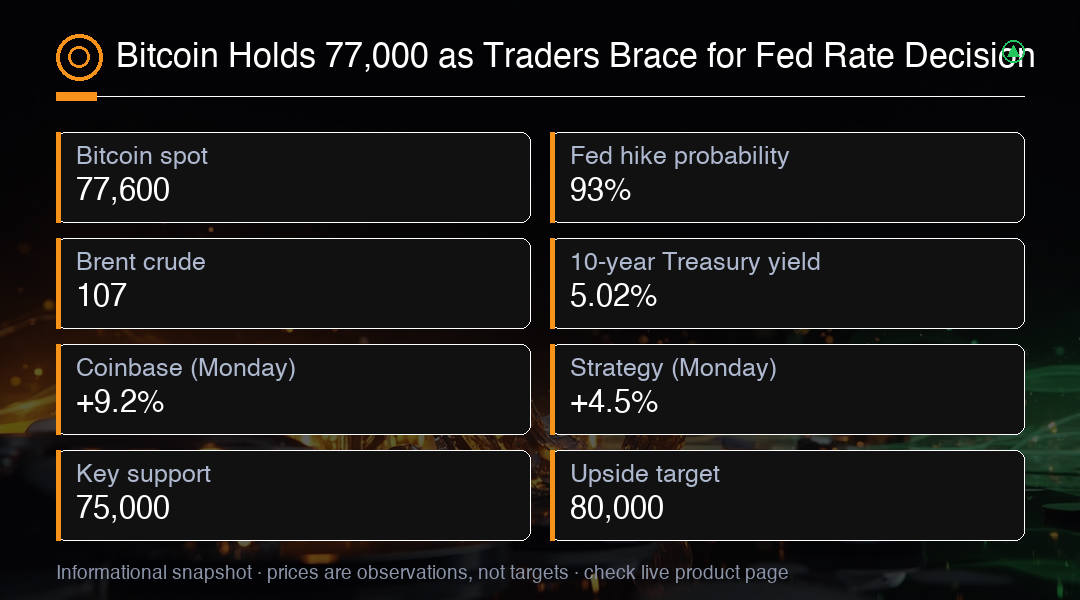
Bitcoin is weathering a stronger dollar while traders are baking in a rate hike from the Fed. Bitcoin traded near 77600 Tuesday after briefly approaching 79500. Holding above 77000 looks like an achievement because the dollar is near a two-week high and the 10-year Treasury yield just crossed 5% : conditions that normally make speculative, non-yielding assets less attractive. The resilience also contrasts with weakness in technology stocks, where concern about slower AI development weighed on the Nasdaq and semiconductor shares. Bitcoin still trades like a risk asset over longer periods, but its refusal to follow tech lower suggests crypto-specific demand is providing support. The structure of the market has changed since the spot ETF approvals, with institutional flow now playing a larger role in daily price action.
Markets assign roughly a 93% probability to a Federal Reserve rate increase Wednesday, following stronger-than-expected employment and inflation data. Since a quarter-point hike is largely priced in, Bitcoin's bigger reaction may come from the Fed's guidance on whether additional tightening is likely. Brent crude near 107 has complicated the outlook. Expensive energy can support Bitcoin's long-term scarcity narrative, but it also lifts inflation, Treasury yields and rate expectations. A one-and-done message from the Fed could weaken the dollar and help BTC retest 80000. A signal that several hikes remain possible would threaten the 77000 floor, followed by the psychologically important 75000 area. The interplay between energy prices and crypto has become increasingly important as Bitcoin mining continues to grow.
Coinbase climbed 9.2% Monday, while Bitcoin-heavy Strategy gained 4.5%. Both outperformed the original coin because crypto equities behave like leveraged expressions of the underlying market. Rising token prices can improve trading revenue, balance-sheet values and investor sentiment all at once. Washington is another near-term catalyst. The Senate is preparing to vote on the Clarity Act, which seeks to establish clearer jurisdiction and operating rules for digital assets. Passage could lower regulatory uncertainty, although disputes over ethics provisions, state enforcement and stablecoin rewards remain unresolved. The regulatory landscape for crypto has been a major source of uncertainty for years, and any clarity could unlock significant institutional capital.
For traders, the key takeaway is that Bitcoin's near-term direction hinges on the Fed's forward guidance. A dovish hike could spark a rally toward 80000, while a hawkish stance may trigger a pullback to 75000. The Clarity Act vote adds a regulatory wildcard that could shift sentiment independently of macro forces. Bitcoin's correlation with traditional risk assets remains elevated, but its unique supply dynamics and growing institutional adoption continue to set it apart from conventional markets. The options market is pricing in elevated volatility around the Fed decision, suggesting traders are bracing for significant price swings in either direction. Institutional inflows into Bitcoin ETFs have remained steady, providing a floor under the price despite macro headwinds. The hash rate continues to climb, indicating strong network security and miner confidence in the long-term value proposition. Historically, Bitcoin has tended to weaken in the weeks leading up to a Fed tightening cycle but recover once the market prices in a pause or pivot. The current cycle is unique because it follows a period of unprecedented monetary expansion, making the tightening path particularly uncertain.
Looking ahead, the key levels to watch are 75000 on the downside and 80000 on the upside. A break below 75000 could trigger a deeper correction toward 72000, while a move above 80000 could open the door to a retest of all-time highs. The Fed's dot plot and economic projections will be just as important as the rate decision itself. Traders should also keep an eye on the Bitcoin options market, where implied volatility has been rising ahead of the event. The put-call skew suggests that investors are hedging for downside risk, but there is also significant interest in upside calls. This creates a setup for a potentially violent move in either direction once the uncertainty is resolved.
Another factor supporting Bitcoin is the ongoing reduction in exchange reserves, which has been trending lower for several months. This suggests that investors are moving coins to long-term storage rather than keeping them available for trading, effectively reducing the circulating supply. The halving in April reduced the new supply entering the market, and the combination of steady demand and falling supply creates a favorable technical setup for the medium term.
The correlation between Bitcoin and the S&P 500 has been declining in recent weeks, which could be a positive sign for investors looking for diversification in their portfolios. Bitcoin's fixed supply and decentralized nature make it an attractive hedge against inflation and currency debasement, particularly in an environment where central banks are still navigating the balance between fighting inflation and supporting growth. The upcoming halving and the potential approval of additional spot ETFs could provide additional tailwinds in the months ahead.
From a risk management perspective, traders should position their exposure carefully heading into the Fed decision. The elevated options premiums suggest that the market is pricing in a significant move, but the direction remains highly uncertain. Stop-loss orders below 77000 could help limit downside risk, while keeping some dry powder available to buy any dips could be a prudent strategy for longer-term investors.
In conclusion, Bitcoin's near-term trajectory hinges on the Fed's forward guidance and the broader macro environment. Traders should monitor the 77000 support and 80000 resistance levels closely.
Trading Insight
For traders, the key takeaway is that Bitcoin's near-term direction hinges on the Fed's forward guidance. A dovish hike could spark a rally toward 80000, while a hawkish stance may trigger a pullback to 75000. The Clarity Act vote adds a regulatory wildcard that could shift sentiment independently of macro forces. Bitcoin's correlation with traditional risk assets remains elevated, but its unique supply dynamics and growing institutional adoption continue to set it apart. The options market is pricing in elevated volatility, suggesting traders are bracing for significant price swings. Institutional inflows into Bitcoin ETFs have remained steady, providing a floor under the price despite macro headwinds.