


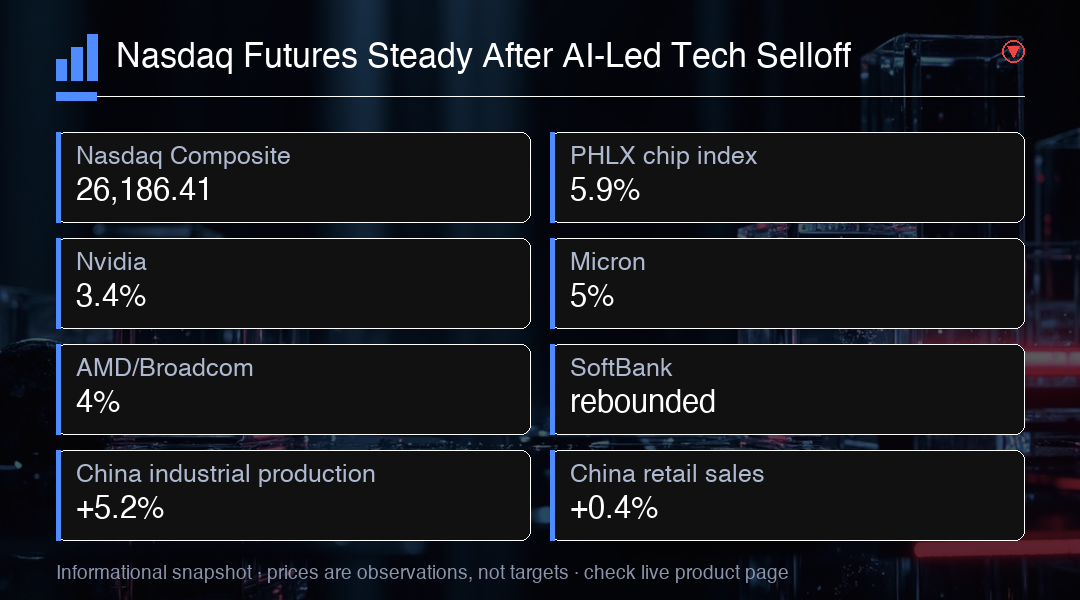
Nasdaq Composite futures were little changed Tuesday after the index fell 0.6%, settling at 26186.41 in the previous session. Investors were assessing whether Monday's selloff was an overdue reset or the start of a deeper reassessment of the AI investment cycle. The pressure began after Anthropic CEO Dario Amodei urged developers to slow improvements in frontier models so safety research could catch up. Amodei's argument is that the rapid pace of AI advancement is outstripping the ability of safety researchers to keep up, creating potential risks that could derail the entire industry if left unchecked. This is not the first time that AI safety concerns have rattled the market, but the timing is particularly sensitive given the massive capital expenditures that have been committed to AI infrastructure.
OpenAI's Sam Altman and xAI's Elon Musk backed the broader argument, raising questions about how quickly infrastructure demand can continue expanding. Semiconductors took the largest hit. The PHLX chip index dropped 5.9%, reducing its 2026 gain to 57%. Nvidia fell 3.4%, Micron lost more than 5% and both AMD and Broadcom declined over 4%. The selloff reflects a growing recognition that the AI build-out may not proceed at the breakneck pace investors had been pricing in for months. The AI build-out has been driven by massive capital expenditures from hyperscale cloud providers, but questions are emerging about whether the returns on these investments will meet expectations. Some analysts are beginning to question whether the AI capex cycle is approaching a peak, which could have significant implications for the broader tech sector.
The reaction became global overnight, although Asian markets avoided another indiscriminate rout. The MSCI Asia-Pacific index outside Japan slipped 0.1%, South Korea's Kospi lost 0.3% and the Nikkei reversed early weakness to edge 0.2% higher. Chip performance was mixed rather than uniformly negative. Samsung Electronics slipped 0.2%, while Japanese memory-chip producer Kioxia gained 3.3%. The divergence in chip performance suggests that the market is discriminating between companies with strong AI exposure and those with more diversified revenue streams.
SoftBank also rebounded strongly as investors weighed its OpenAI exposure against the prospect that the ChatGPT maker will postpone its public listing until at least 2027. China offered another complicated signal. Industrial production rose a better-than-expected 5.2% in August, but retail sales increased only 0.4% and fixed-asset investment fell 7.2%. The mixed data from China adds another layer of uncertainty for tech companies with significant exposure to the Chinese market. Apple, in particular, has been facing increasing competition from Chinese smartphone makers, which could weigh on its revenue growth in the coming quarters.
For traders, the key question is whether the AI trade is entering a new phase of slower growth or merely pausing before the next leg higher. The Fed's rate decision adds another layer of uncertainty. Higher rates increase the discount rate on future tech earnings, which can weigh on valuations even if the underlying growth story remains intact. The semiconductor selloff may have been overdone, but the fundamental question about AI development pace remains unresolved. The options market is pricing in elevated volatility, suggesting traders are bracing for continued swings. The AI trade is at a crossroads, with safety concerns and tighter financial conditions creating a more complex backdrop. Historically, sharp rotations in tech tend to resolve once earnings season confirms whether the fundamental growth story remains intact. The next earnings season will be critical for the AI narrative, with investors looking for evidence that the massive capex investments are generating returns.
The earnings outlook for the tech sector remains robust, with analysts expecting double-digit growth in the coming quarters. However, these expectations are heavily dependent on continued strength in AI-related spending. Any signs of a slowdown in AI capex could lead to significant downward revisions to earnings estimates, which would put additional pressure on already elevated valuations. The forward P/E ratio for the Nasdaq remains above historical averages, leaving little room for disappointment.
The performance of tech stocks in the coming weeks will likely depend on a combination of factors, including the Fed's rate decision, earnings results from major companies, and any developments in the AI safety debate. Nvidia, in particular, will be in the spotlight when it reports earnings next month, as investors look for signs that the AI spending spree is continuing. Any disappointment could trigger another round of selling in the semiconductor sector.
For long-term investors, the current selloff could present a buying opportunity in quality tech names. Companies with strong balance sheets, diversified revenue streams, and leading positions in their respective markets are likely to weather the storm better than those that are more speculative. However, timing the bottom is always difficult, and investors should be prepared for further volatility in the near term.
Microsoft and Meta are among the tech giants that have been investing heavily in AI infrastructure, and their capital expenditure plans will be closely watched for signs of any slowdown. These companies have deep pockets and strong cash flows, which should allow them to weather the current storm better than smaller players. However, if the AI capex cycle does peak, it could have significant implications for the broader tech sector, which has been driven by AI-related optimism for much of 2026.
Trading Insight
For traders, the key question is whether the AI trade is entering a new phase of slower growth or merely pausing before the next leg higher. The Fed's rate decision adds another layer of uncertainty. Higher rates increase the discount rate on future tech earnings, which can weigh on valuations even if the underlying growth story remains intact. The semiconductor selloff may have been overdone, but the fundamental question about AI development pace remains unresolved. The options market is pricing in elevated volatility, suggesting traders are bracing for continued swings. The AI trade is at a crossroads, with safety concerns and tighter financial conditions creating a more complex backdrop.