


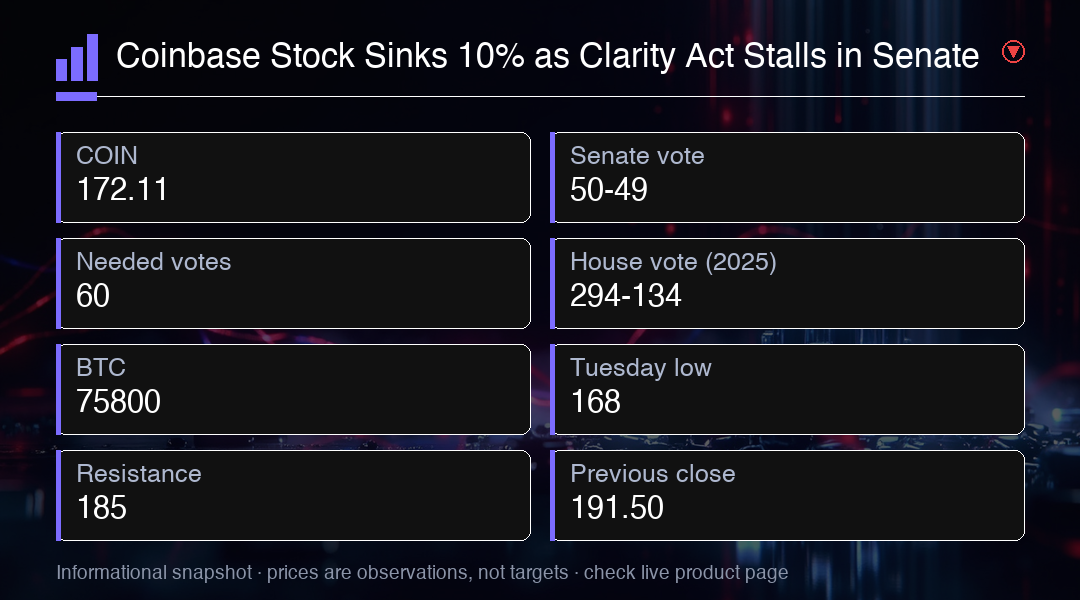
Coinbase shares plunged 10.1% to 172.11 Tuesday after the Senate rejected a procedural motion to advance the Clarity Act. The measure received a 50-49 majority but needed 60 votes, leaving the crypto industry ten senators short of the legal certainty it has pursued for years. The legislation would have divided oversight between the Securities and Exchange Commission and Commodity Futures Trading Commission, while establishing rules for issuing, trading and selling digital assets. The House passed an earlier version 294-134 in July 2025, including support from 78 Democrats. That bipartisan coalition did not survive the Senate, where every Democrat and four Republicans opposed advancement. Congress is preparing to leave Washington before November's midterm elections, making another attempt this year highly unlikely.
Democratic resistance centered on whether the bill's ethics restrictions went far enough to prevent elected officials from benefiting from crypto policy. Republicans added conflict-of-interest provisions and more than 100 revisions, but the final compromise still failed to unlock sufficient support. Banks raised a different objection: stablecoin rewards. They argue that allowing crypto companies to offer attractive returns on dollar-backed tokens could pull deposits from traditional banks, reducing the funds available for lending. Coinbase considers rewards an important part of making stablecoins useful, so this was hardly a decorative disagreement. The bill also addressed consumer protection, illicit finance, software developers and state enforcement authority. Combining all those questions into one package created an impressive legislative traffic jam.
Bitcoin fell some 2.4% toward 75800 following the vote, but Coinbase dropped much harder because it represents a leveraged bet on US crypto adoption. Clearer rules could encourage more token listings, institutional trading, custody activity and stablecoin use : each a potential source of revenue for the exchange. Without legislation, the SEC and CFTC can continue writing rules under existing authority. The problem is durability: agency regulations may be challenged in court or reversed by a future administration. The failed vote does not reverse institutional adoption already under way. Banks, asset managers and payment companies have invested heavily in custody, tokenization, ETFs and blockchain settlement.
Lawmakers leave Washington this month and the midterms could alter control of Congress. Even if negotiations restart, ethics restrictions and stablecoin rewards will remain the central bargaining points. It does, however, slow the arrival of a common rulebook and leaves smaller companies less able to absorb legal uncertainty than Coinbase. The broader crypto market reacted swiftly to the news. Ethereum fell 3.2% and Solana dropped 4.1%, reflecting the broader risk-off sentiment. The total crypto market capitalization declined by approximately 2.8% in the hours following the vote, erasing roughly $45 billion in value. This underscores the extent to which regulatory developments continue to influence the crypto market.
For Coinbase, the regulatory uncertainty is a double-edged sword. On one hand, the absence of clear rules creates headwinds for institutional adoption and makes it harder for the exchange to plan long-term investments. On the other hand, the lack of legislation also means that the SEC and CFTC cannot easily impose new restrictions without congressional backing. This creates a legal gray area that has persisted for years and shows no signs of resolution. Looking ahead, the key levels to watch are Tuesday's low near 168 on the downside and resistance around 185 and the previous close near 191.50 on the upside.
The longer-term implications of the Clarity Act's failure extend beyond Coinbase. The entire crypto industry had been banking on regulatory clarity to unlock the next wave of institutional capital. Without a clear rulebook, many institutional investors will remain on the sidelines, waiting for certainty before committing significant capital. This could slow the pace of innovation and adoption in the US crypto market, potentially ceding ground to more favorable regulatory jurisdictions like Singapore, Switzerland, and the United Arab Emirates. For now, the industry must continue to operate under the existing patchwork of state and federal regulations, which creates both opportunities and challenges.
The regulatory uncertainty is not limited to the Clarity Act. The SEC and CFTC have been actively enforcing existing rules, and several crypto companies have faced enforcement actions in recent months. Without clear legislative guidance, this regulatory by enforcement approach is likely to continue, creating a challenging operating environment for crypto businesses. The lack of clarity also makes it difficult for banks to engage with crypto companies, which limits the industry's ability to access traditional financial services.
Despite the regulatory headwinds, Coinbase has been diversifying its revenue streams. The company has been expanding its international operations and has been investing in new products and services. Its custody business, in particular, has been growing as more institutional investors seek secure storage solutions for their digital assets. The company's staking services have also been generating steady revenue, although this could face regulatory scrutiny in the future. Looking ahead, the key levels to watch are Tuesday's low near 168 and resistance around 185 and the previous close near 191.50.
The regulatory uncertainty is not limited to the Clarity Act. The SEC and CFTC have been actively enforcing existing rules, and several crypto companies have faced enforcement actions in recent months. Without clear legislative guidance, this regulatory by enforcement approach is likely to continue, creating a challenging operating environment for crypto businesses. The lack of clarity also makes it difficult for banks to engage with crypto companies, which limits the industry's ability to access traditional financial services.
Despite the regulatory headwinds, Coinbase has been diversifying its revenue streams. The company has been expanding its international operations and has been investing in new products and services. Its custody business, in particular, has been growing as more institutional investors seek secure storage solutions for their digital assets. The company's staking services have also been generating steady revenue, although this could face regulatory scrutiny in the future.
Trading Insight
The Clarity Act's failure is a significant setback for Coinbase and the broader crypto industry. Without regulatory clarity, institutional adoption could slow, and smaller companies will struggle to absorb the legal uncertainty. Key levels to watch are Tuesday's low near 168 and resistance around 185. The broader crypto market also felt the impact, with Bitcoin falling toward 75800 and total market cap declining 2.8%.