


Tom Lee thinks the S&P 500 could finish above 8,000 in 2026, even if the route includes a sharp correction. From the index's August 3 close at 7,600.50, the threshold was only about 5.3% away—but the small headline distance hides a demanding earnings and valuation test.
The useful question is not whether to trust one strategist. It is whether profits, interest rates and market breadth keep validating the arithmetic behind the target.
Key takeaways
- From 7,600.50, 8,000 required roughly 5.3% upside.
- The bull case needs earnings growth to carry most of the move.
- A 10% correction can coexist with an 8,000 destination, but it raises the rebound required.
What did Tom Lee's S&P 500 call actually say?
Lee's reported path was more volatile than the 8,000 headline suggests. In an August 3 CNBC appearance summarized by two social-market accounts, the Fundstrat co-founder described a move toward 7,800 in August, kept a possible 10% correction on the table, and still saw a year-end finish above 8,000.
That sequence separates destination from path. A market can reach a bullish year-end target after a deep drawdown, but anyone positioned for a straight climb may experience a very different outcome from someone watching the same final level.
How much work would 8,000 require?
At the August 3 close, the target was close enough to be plausible but not automatic. The Associated Press reported that the S&P 500 rose 1.5% to 7,600.50, just below its 7,609.78 record close. The same session put 7,800 about 2.6% higher and 8,000 about 5.3% higher.
The drawdown arithmetic is more revealing. A 10% decline from 7,800 would land near 7,020. Recovering from there to 8,000 would require a rebound of roughly 14.0%. That 7,020 marker is an illustration—not a claim that Lee specified the correction's exact starting point.
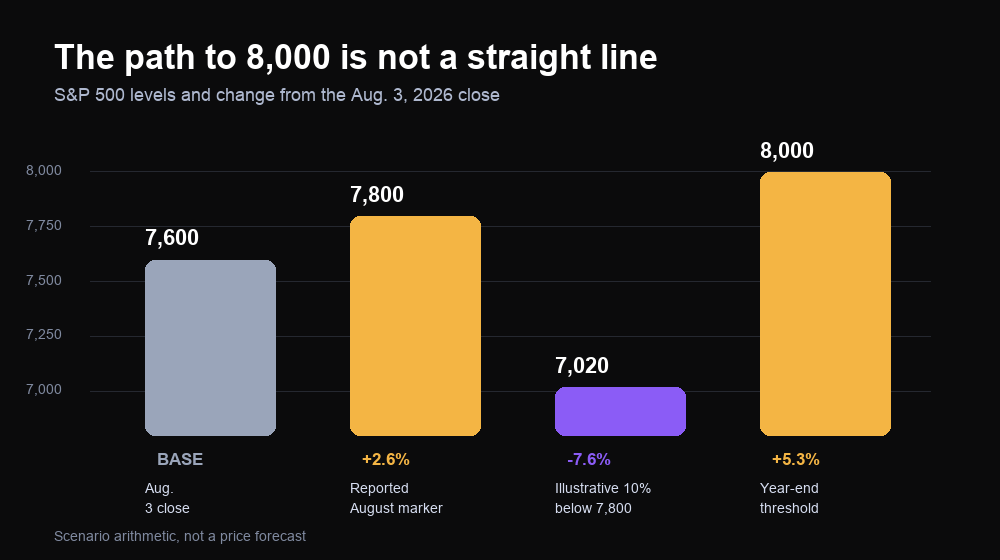
The percentages use the August 3 close as the base. The drawdown bar is scenario arithmetic, not a predicted low.
What earnings and valuation would support 8,000?
An 8,000 index level becomes easier to defend if earnings rise while the valuation multiple stays stable. Goldman Sachs Research raised its 2026 year-end target to 8,000 in May, forecasting S&P 500 earnings per share of $340 for 2026 and $385 for 2027. It expected the forward multiple to remain around 21 times, with AI-infrastructure beneficiaries producing roughly half of 2026 earnings growth.
The valuation identity is simple: index level = earnings × multiple. At $385 of forward EPS, 8,000 implies about 20.8 times earnings. At $340, it implies about 23.5 times. The market therefore needs either the higher earnings base to become credible, a richer multiple, or some combination of both.
| Forward EPS | Valuation | Implied S&P 500 | What it says |
|---|---|---|---|
| $360 | 20.0× | 7,200 | Earnings or valuation fall short |
| $385 | 20.0× | 7,700 | Strong profits, no premium expansion |
| $385 | 20.8× | ~8,000 | Goldman-style forward framework |
| $400 | 20.0× | 8,000 | Higher earnings do the work |
Why could a 10% correction still fit the bull case?
A correction would challenge positioning, not necessarily the full-year earnings thesis. Lee's sequence assumes that forced selling or a risk shock can hit prices faster than analysts cut profit estimates. If earnings revisions keep rising after the selloff, lower prices can reset the multiple and create room for a recovery.
The August 3 session showed how quickly the macro pressure can reverse. AP reported Brent crude down 4.7% to $83.77 and the 10-year Treasury yield down to 4.68% from 4.75% on Friday. The S&P 500 rallied near its record, while the Nasdaq Composite gained 2.1%. Lower oil and yields can support valuation; another inflation shock can do the opposite.
What could break the 8,000 case?
The forecast weakens if earnings estimates fall while yields or oil stay high. That combination attacks both sides of the equation: lower profits reduce the earnings base, and higher discount rates compress the multiple investors will pay.
Goldman also flagged narrow market breadth, strong momentum and uncertainty around the durability of AI-related profits. Those risks matter because a cap-weighted index can look healthy while a small group carries most of the advance. A broader rally would make 8,000 more durable; repeated record attempts led only by a few mega-caps would make it more fragile.
Targets themselves deserve a discount. FactSet found that bottom-up analyst targets overestimated the final S&P 500 level by an average 5.9% over 2005–2024. Forecasts are useful assumption maps, not settlement prices.
What should traders monitor now?
Track revisions, rates and breadth—not the target in isolation.
| Signal | Supports 8,000 | Weakens 8,000 |
|---|---|---|
| Forward EPS | 2027 estimates hold near $385 or rise | Broad cuts outside one sector |
| 10-year yield | Stable or easing | Persistent rise that compresses multiples |
| Oil / inflation | Energy pressure cools | Renewed oil shock lifts inflation risk |
| Market breadth | More sectors confirm new highs | A few mega-caps carry the index |
| Price path | Pullbacks hold with earnings intact | 7,800 rejection plus falling estimates |
For another view of how concentrated technology leadership can change the index signal, see the MC Markets analysis of the Nasdaq chip selloff and AI valuations.
Final thoughts
The S&P 500 does not need a perfect macro backdrop to finish above 8,000. It does need the earnings story to survive volatility and the valuation investors pay for those earnings to remain defensible. Lee's call is most useful when treated as a live equation: update the profit estimate, the multiple and the path risk, and the headline target becomes testable.