


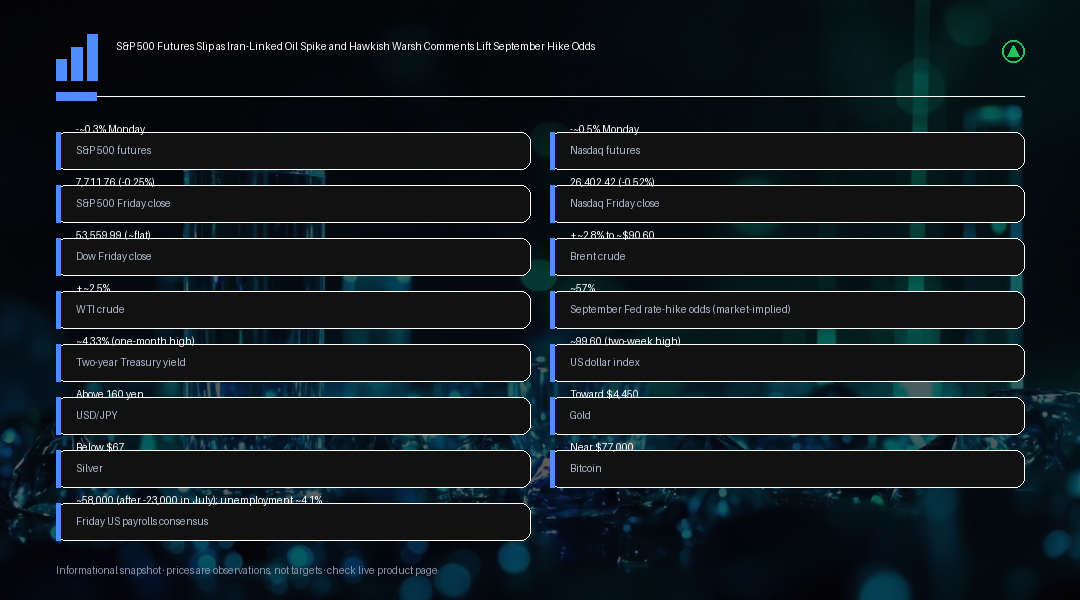
US equity futures started the new week on the back foot. S&P 500 futures slipped around 0.3% Monday and Nasdaq contracts dropped roughly 0.5%, while European futures softened and Asian equities also traded lower, as renewed fighting between US and Iranian forces pushed oil prices higher and kept Treasury yields elevated heading into a data-heavy week.
The pullback follows a lower finish on Wall Street Friday, when Fed Chair Kevin Warsh used his Jackson Hole address to reiterate the central bank's commitment to fighting inflation. The S&P 500 fell 0.25% to close at 7,711.76, the Nasdaq lost 0.52% to 26,402.42 and the Dow Jones Industrial Average finished nearly flat at 53,559.99. Even with Friday's dip, all three major indexes still finished the week higher, powered by Nvidia's blockbuster forecast and strong earnings from Salesforce, CrowdStrike and Okta that kept the broader AI trade intact.
The bigger overnight move came from the energy market. Brent crude rose roughly 2.8% toward $90.60 a barrel and WTI gained about 2.5% after US forces struck Iranian missile launchers on Larak Island, with reports of Iranian retaliation against American forces in the region. Those retaliation reports, along with separate claims about damage to Iran's Kharg Island oil terminal, have not yet been independently confirmed by official military channels and should be treated as developing rather than settled facts; Kharg is significant because it handles the bulk of Iran's crude exports, so any verified damage there would raise the risk of an actual physical supply disruption rather than just a temporary geopolitical risk premium.
Higher oil prices complicate the inflation picture at a moment when the market is already nervous about the Fed's next move. Costlier crude filters through to transportation, manufacturing and consumer prices, and it also pressures growth-stock valuations indirectly through the bond market: persistent inflation supports higher yields, and higher yields reduce the present value of companies whose largest profits are still expected years into the future, a dynamic that weighs disproportionately on the same mega-cap technology names that drove last week's rally.
Warsh's Jackson Hole remarks were the other half of Monday's story. He told the audience that policymakers still have work to do unless inflation moves convincingly toward the Fed's 2% target, language that stopped short of announcing a rate increase but was still hawkish enough to move rate-futures pricing. Markets responded by lifting the market-implied probability of a September increase to roughly 57%, a reading that should be understood as derivatives pricing rather than a Fed commitment, since that number can and does shift as new data arrives through the week.
The two-year Treasury yield, which tracks near-term Fed expectations closely, climbed toward 4.33%, a level some reports describe as its highest in a month, while the dollar index held near a two-week high around 99.60. USD/JPY pushed above 160 yen in sympathy, reviving talk of fresh currency intervention from Tokyo and Washington after Japan's record defense of the yen earlier in the summer.
The rates and dollar move also weighed on non-yielding and alternative assets. Gold slipped toward $4,450 an ounce and silver retreated below $67, while Bitcoin traded near $77,000, as higher yields raised the opportunity cost of holding assets that produce no income of their own. The move lower across metals and crypto is broadly consistent with a market that is, for now, taking Warsh's hawkish tone and the oil-driven inflation scare seriously rather than shrugging them off.
Breadth considerations from last week's rally are also worth keeping in mind heading into this new bout of volatility. The prior week's gains were concentrated in a small number of mega-cap technology names following Nvidia's guidance and the software sector's earnings beats, which means the index-level strength may be less broadly supported than the headline numbers suggest, leaving the market more exposed if sentiment toward the largest constituents sours alongside rising yields.
Friday's US employment report remains the week's main scheduled test for both the equity and bond markets. Economists are looking for payrolls to rebound by roughly 58,000 jobs after July's surprise decline of 23,000, with unemployment expected to hold near 4.1%. A stronger-than-expected print would tend to reinforce September hike pricing and could pressure equities further through the yield channel, while a softer report could ease rate-hike bets and offer risk assets some relief, particularly in the rate-sensitive technology sector that led last week's advance.
Taken together, Monday's session illustrates how quickly a geopolitical shock and a hawkish central-bank speech can combine to reverse a market's tone within a single trading day. Traders heading into the rest of the week should watch three threads at once: whether the Iran-related oil premium proves durable or fades as retaliation claims are confirmed or walked back, whether Friday's payrolls data validates or challenges the newly hawkish Fed pricing, and whether the historically narrow leadership behind last week's rally can hold up if any of those risks intensify.
Trading Insight
For index traders, the immediate question is whether Monday's pullback is a shallow, one-session risk-off move or the start of a more meaningful rotation out of the mega-cap-led leadership that carried the market higher last week. A close that holds the recent range would suggest dip-buyers remain in control, while a break that accelerates through Friday's Nasdaq levels would point to a genuine reassessment of how much further the AI-driven rally can run against a backdrop of rising yields. The Iran-linked oil headlines deserve particular caution: unconfirmed reports of retaliation and terminal damage can move markets sharply in either direction once verified or walked back, so position sizing around this specific catalyst should stay conservative until official confirmation emerges. Rate-sensitive growth names are the most exposed to any further move higher in the two-year Treasury yield, given how concentrated last week's advance was in a handful of large technology stocks. MC Markets does not cite exact source levels without independent market-data verification, so confirm live index levels, yields and the economic calendar directly before acting on anything discussed here. As always, the roughly 57% September hike probability is a snapshot of current market pricing, not a certainty, and Friday's jobs report is the single scheduled event most likely to move it meaningfully in either direction.