


Gold fell to $4,113.38 per ounce on Thursday, down 1.19% from the previous day, extending a pullback that has seen the precious metal shed 4.21% over the past month. The decline came despite a weaker dollar, a combination that would normally be expected to support prices, suggesting that other factors are weighing on market sentiment. Trading volumes were elevated throughout the session as both speculative and institutional participants repositioned their holdings in response to shifting macroeconomic expectations. The move lower marks the sixth consecutive session in which gold has closed below its short-term moving average, reinforcing the bearish near-term outlook among technical traders.
The drop follows a Treasury Department announcement that it would at least double its buyback of notes and bonds in the upcoming financial quarter. The move is designed to contain soaring yields on longer-dated securities, following Secretary Bessent's call for higher limits on the Federal Reserve's FIMA facility. Officials argue that the expanded repurchase program will improve liquidity conditions in the Treasury market and reduce volatility that has plagued fixed income trading since the summer. However, market participants remain skeptical about the long-term effectiveness of such intervention.
Lower borrowing costs typically reduce the opportunity cost for markets to hold precious metals, which carry no coupons. However, the gold market focused instead on the implications of increased government intervention in bond markets, which some traders view as a form of financial suppression that could eventually erode confidence in the dollar. This narrative has gained traction among precious metals investors who argue that artificially capped yields mask the true inflationary pressures building within the economy. The concern is that suppressing rates through extraordinary measures creates a distorted pricing environment that ultimately benefits hard assets over financial assets.
The looming increase in deficit spending combined with expectations that the US government is actively suppressing borrowing costs has strengthened calls that precious metals are ideal protection against downside risks to the dollar's purchasing power. Gold remains up 35% year over year, though it is down 2.3% compared to the same time last year. The divergence between these two timeframes highlights the volatility that has characterized gold trading throughout 2026, as the metal has swung between record highs and sharp corrections with unusual frequency.
Gold reached an all-time high of $5,608.35 in January 2026 before the current correction began. The metal has since retreated 26.6% from that peak, though it remains historically elevated. Key support is now seen at $4,050, a level that drew buying interest in early October. The pace of the decline has accelerated in recent weeks, with gold losing ground on ten of the past twelve trading sessions as bullish sentiment has steadily eroded across both retail and institutional investor bases.
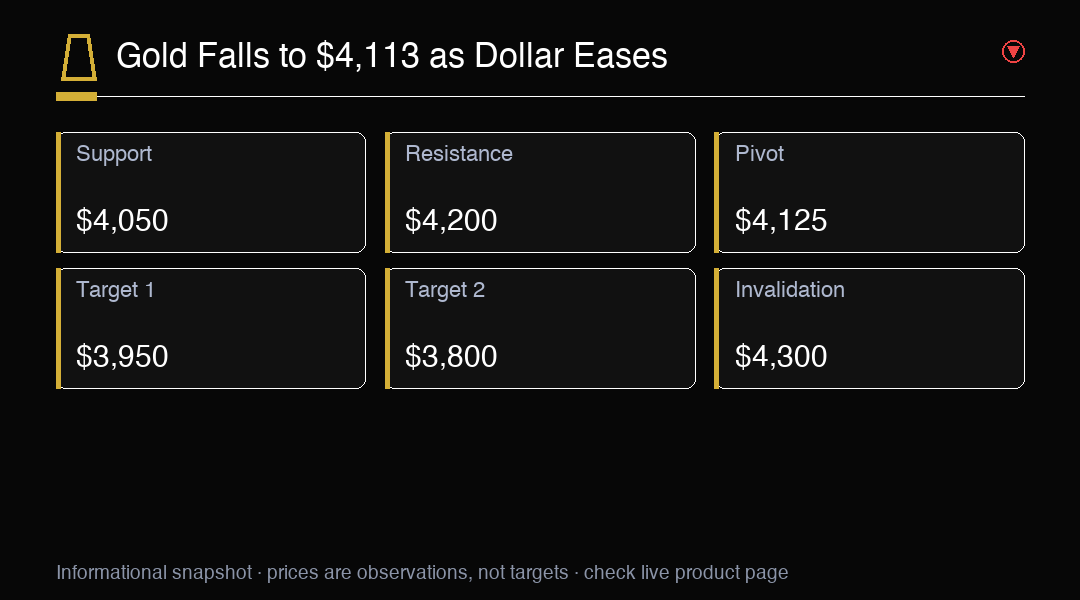
From a technical perspective, gold is testing a support zone between $4,050 and $4,100. A decisive break below $4,050 could open the door to a retest of $3,950, the July low. Conversely, a reclaim of $4,200 would signal stabilization and a potential return to the recent uptrend. The relative strength index has fallen to 32, approaching oversold territory, which historically has preceded short-term rallies in gold prices. However, momentum indicators remain firmly bearish, suggesting that any bounce is likely to be sold into until a clear trend reversal signal emerges.
Silver also came under pressure, falling 2.1% to $48.50 per ounce. The gold-silver ratio rose to 84.8, its highest level in six months, suggesting silver is underperforming gold during the current bout of risk aversion. Silver's dual role as both a precious metal and an industrial commodity makes it particularly sensitive to shifts in global growth expectations, and the recent weakness in manufacturing data has weighed heavily on the metal. Historically, a rising gold-silver ratio during periods of economic uncertainty has signaled that investors are seeking the relative safety of gold over the more cyclically exposed silver.
Analysts note that gold's recent weakness is somewhat counterintuitive given the macro environment. Rising government deficits, elevated geopolitical tensions and central bank buying should all be supportive. However, the metal's strong performance in 2026 may have left it vulnerable to profit-taking after such a dramatic run higher. Some institutional funds have reportedly reduced their allocations to precious metals following the sharp correction from the January peak, rotating instead into equities and fixed income instruments that offer more attractive yield profiles in the current rate environment.
The options market shows increased demand for put protection in gold, with implied volatility rising to 18.5%, up from 15.2% last week. Traders are paying more for downside insurance, reflecting concerns about further declines. However, call skew remains positive, suggesting some investors are positioning for a rebound. The volume of put options struck at the $4,000 level has increased threefold over the past week, indicating that a significant portion of the market is hedging against a break below the psychologically important round number.
Central bank buying remains a key support for gold. The World Gold Council reported that central banks added 32 tonnes to reserves in the third quarter, with China, India and Turkey leading the purchases. This follows record buying in 2024 and 2025. Emerging market central banks continue to diversify their reserves away from the dollar, driven by geopolitical considerations and a desire to reduce exposure to any single currency. This structural demand floor is one reason many analysts remain constructive on gold's medium-term outlook despite the current price weakness.
Looking ahead, Thursday's PPI report could influence gold prices. If inflation data comes in cooler than expected, it could ease rate pressure and lift precious metals. Conversely, another hot reading could push gold below $4,050 and toward the $3,950 level. The Federal Reserve's policy path remains the single most important driver of gold direction, and any signals regarding the pace of future rate decisions will be closely scrutinized by precious metals traders. Additionally, upcoming speeches from several Fed officials could provide further clarity on the central bank's thinking.
Overall, gold remains in a broad range between $3,950 and $4,300 established over the past two months. The Fed's policy path and the government's bond market intervention will likely determine whether gold breaks lower or stabilizes in the coming weeks. Until a clear directional catalyst emerges, traders should expect continued volatility with sharp intraday swings in both directions. Risk management remains paramount in the current environment, and position sizing should carefully reflect the elevated uncertainty that currently characterizes the precious metals market.
Trading Insight
Gold is testing $4,050 support amid Treasury intervention and dollar uncertainty. Watch Thursday's PPI data. Range remains $3,950 to $4,300.