


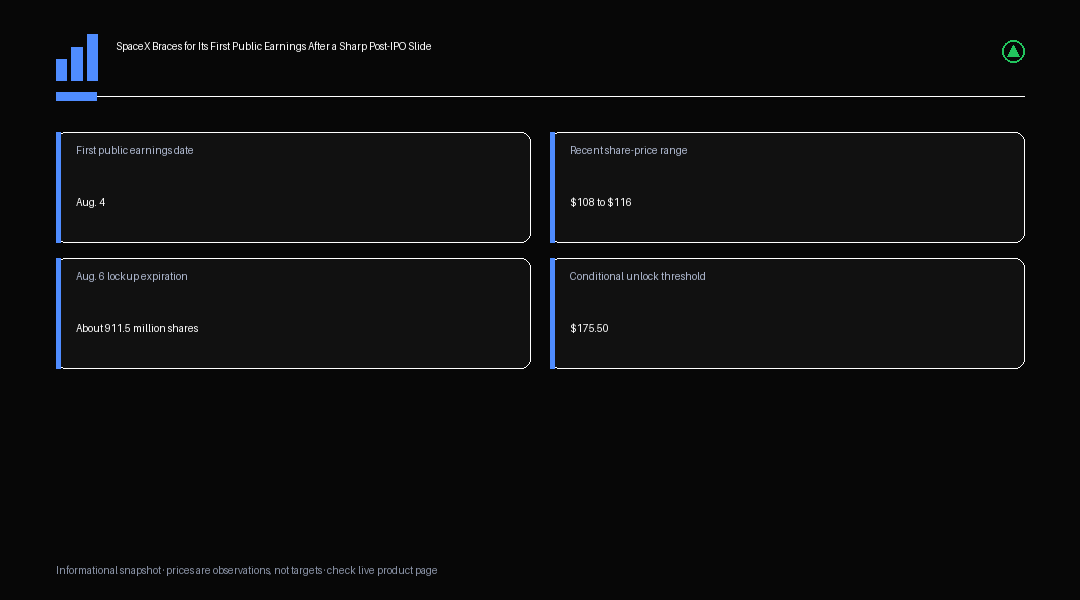
SpaceX is set to report its first quarterly results as a public company on Aug. 4, a milestone earnings print with essentially no historical comparison to lean on. The rocket and satellite company's shares have fallen sharply since their June peak, recently trading in the $108 to $116 range, well below the $135 level at which the company priced its record-setting initial public offering.
That drawdown has become the central question hanging over the report. Depending on the exact reference point used, coverage of the stock's decline from its June highs has ranged from roughly 37% to 44%, a meaningful reset from the exuberance that surrounded the IPO. Investors now have to decide whether that reset has created an attractive entry point or whether it simply reflects a more realistic reassessment of a business that is still working out how profitable its various units can become.
Adding to the complexity is a lockup expiration landing just two days after earnings. Around 911.5 million previously restricted shares become eligible for trading on Aug. 6, a substantial increase in the pool of shares that could theoretically hit the market. A further tranche of roughly 455.8 million shares could also become eligible if the stock trades at or above $175.50 in at least five of the ten trading days before the report, a threshold that looks like a stretch given where shares have recently changed hands. Eligibility to sell does not guarantee that early investors will actually do so, but the timing means the market will be digesting both an unprecedented earnings print and a potential supply overhang in the same week.
SpaceX's business is generally understood to span three broad areas: its core Space operations, which include the Falcon launch franchise and ongoing Starship development; Connectivity, built around the Starlink satellite internet network; and a growing AI investment effort. Investors watching the report will want detail on how each of these areas is performing and, in particular, how much capital is being funneled into AI infrastructure relative to the returns that spending is generating so far. Given how much investor attention has focused on this specific point, any commentary distinguishing near-term AI spending from the underlying Falcon and Starlink businesses will likely draw close scrutiny.
Starship remains a central storyline in its own right. The vehicle has continued flight testing through the summer, and Wall Street will be watching for updates on the pace of upcoming tests, progress toward routine commercial operations, and the scale of ongoing investment in production infrastructure. The bigger long-term narrative, launching low-cost computing capacity into orbit to take advantage of abundant solar power, remains speculative at this stage, but any concrete update on that ambition would be a notable data point for a stock whose valuation has always priced in more than just rockets and satellite dishes.
It is worth being cautious about pinning too much on a single valuation figure. Some market snapshots in late July put SpaceX's market capitalization at roughly $1.4 trillion, but that figure is based on the currently publicly traded float rather than a comprehensive enterprise valuation, and it should be read as a rough gauge rather than a precise number. Given how thin the trading history is, and how sensitive the share count is to the pending lockup expiration, valuation multiples derived from the current share price carry more noise than usual.
Because this is SpaceX's first public earnings report, there is no prior quarter's market reaction to anchor expectations. That absence of history cuts both ways. It means there is no obvious playbook for how shares typically respond to a beat or a miss, which can amplify volatility in either direction as algorithmic and discretionary traders alike search for a reference point in real time. It also means framing this event as a simple 'buy the dip' opportunity is inherently speculative rather than something supported by a track record.
For traders, the setup this week combines three distinct catalysts: the earnings print itself, commentary on AI capital spending and its near-term returns, and a lockup expiration that could reshape available float within days of the report. Each of those elements could move the stock independently, and the interaction between them is likely to be the real story once the numbers are out.
There is also a broader read-through worth keeping in mind. SpaceX's IPO was one of the largest and most closely watched listings in recent memory, and how this first earnings report lands will shape sentiment toward other high-profile, pre-revenue-stage or early-revenue-stage growth names that have leaned heavily on AI infrastructure narratives to support elevated valuations. A clean report that reassures investors about capital discipline could help stabilize sentiment across that broader cohort, while a messy print layered on top of the unlock-driven supply overhang could reinforce the more cautious mood that has already pulled the stock well below its June highs.
Options markets and short-dated volatility pricing around the earnings date are likely to reflect just how binary this event feels to professional traders given the absence of any historical reaction data. That should keep implied volatility elevated into Tuesday's print, and traders considering directional exposure around the event may want to weigh position size accordingly, since the combination of a maiden earnings report and a large looming share unlock is the kind of setup that can produce outsized moves in either direction regardless of how good or bad the underlying numbers ultimately are.
Trading Insight
This week's setup in SpaceX shares is unusually layered for a single stock, with the first public earnings print landing just two days before a large share-lockup expiration. Given the stock's roughly 37% to 44% pullback from its June highs, traders framing this as a straightforward dip-buying opportunity should recognize there is no historical earnings reaction to lean on for context, which raises the risk of outsized moves in either direction. The Aug. 6 unlock of roughly 911.5 million shares is a known event that can pressure the float regardless of how the earnings are received, while the additional 455.8 million-share tranche only becomes relevant if the stock rallies to $175.50 into the report, a level well above recent trading. Position sizing around this event should account for elevated volatility from both the earnings surprise and the incoming supply, rather than treating the pullback alone as a clean valuation signal.