

Memory stocks are rallying together because investors are again pricing tight supply, AI data-center demand and unusually strong pricing power across the memory chain. MC Markets' 2 September Topic Radar snapshot highlighted Sandisk up 5.5%, Micron up 2.7% and SK Hynix up 2.2%. The synchronized move is more informative than a single-stock bounce, but it is not proof that the cycle can no longer turn.
The useful question is not whether Sandisk can reach a headline target such as $1,700. A target is an opinion. The stronger test is whether breadth, earnings quality and demand visibility continue to reinforce one another after the first burst of buying.
Key takeaways
- SNDK, MU and SKHY rising together points to a sector thesis rather than one company headline.
- Latest results show pricing—not shipment volume alone—has driven much of the earnings acceleration.
- A durable rally needs customer demand and semiconductor breadth to hold when momentum cools.
What does a synchronized memory-stock rally actually prove?
It shows that investors are buying a shared supply-and-demand story, but it does not show that every company has the same exposure or risk. Micron is a major DRAM and high-bandwidth-memory supplier alongside NAND products. Sandisk is more directly tied to NAND flash and storage. SK Hynix spans DRAM, HBM and NAND. Their stocks can rise together when the market expects AI infrastructure to absorb more memory and storage than producers can quickly supply.
Breadth matters because a move led by only one company can reflect earnings, an analyst note or positioning in that name. A move across US and Korean memory stocks suggests investors are repricing the industry. Even then, timing matters: intraday percentages can change before the close, and a synchronized bounce after a steep selloff can still be short covering rather than a durable trend.
This is why the 5.5%, 2.7% and 2.2% figures are best read as the approved social snapshot that triggered the topic—not as permanent reference levels. The next layer is whether company-reported economics justify the enthusiasm.
Why are Sandisk and Micron benefiting through different products?
Sandisk is benefiting from an improvement in NAND and data-center storage economics, while Micron captures demand across DRAM, HBM and NAND. That difference makes the rally broader, not redundant: AI servers need fast compute memory as well as increasingly large pools of persistent storage.
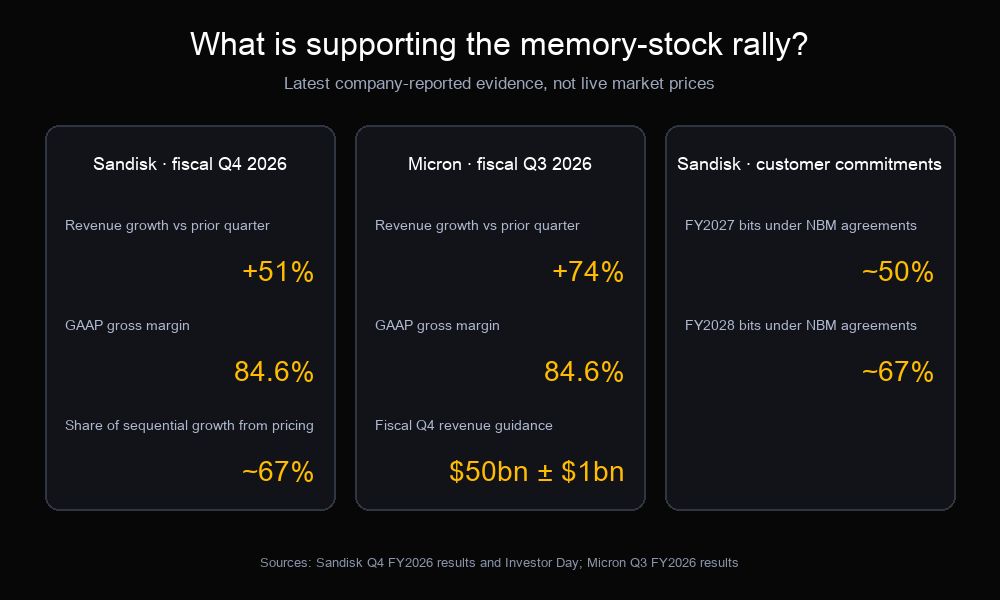
Sandisk reported fiscal fourth-quarter 2026 revenue of $8.965 billion, up 51% from the prior quarter. Datacenter revenue reached $2.977 billion, up 103% sequentially, and GAAP gross margin was 84.6%. The company said roughly one-third of sequential revenue growth came from higher volume and two-thirds from higher pricing. That split is essential: demand is expanding, but scarcity and pricing are doing more of the near-term earnings work.
Micron reported fiscal third-quarter revenue of $41.456 billion, up about 74% sequentially and 346% from the year-earlier quarter. GAAP gross margin was also 84.6%, while operating cash flow reached $25.39 billion. Micron guided fiscal fourth-quarter revenue to $50 billion, plus or minus $1 billion, and said HBM4 was already in high-volume shipments for a lead customer's platform.
Those results explain why the market can treat memory as an AI-infrastructure bottleneck rather than a low-value component. They do not eliminate cyclicality. High prices encourage capacity investment, customers seek alternatives, and demand can disappoint before new supply arrives.
Why does pricing power matter more than a price target?
Pricing power determines whether strong demand becomes durable earnings; a stock-price target only expresses one valuation view. Sandisk's disclosure that about two-thirds of its sequential growth came from pricing is a cleaner clue than a round-number target. It shows why revenue and margins can accelerate faster than physical shipments.
The same fact creates the central risk. If contract or spot memory prices cool while volume growth stays modest, earnings expectations can fall quickly. That is the old memory-cycle problem: profits look strongest near the point when investors begin asking whether scarcity has peaked.
Customer agreements can reduce that volatility without removing it. At its August Investor Day, Sandisk said its New Business Model agreements represented about 50% of expected bits in fiscal 2027 and about two-thirds in fiscal 2028. Those are company expectations, not realized sales, but they give traders a concrete durability measure: contracted volume and pricing structures should support visibility if customers continue taking the agreed supply.
Micron's multi-year strategic customer agreements point in the same direction. The important follow-up is not a new target price. It is whether guidance, cash flow and customer commitments stay intact as capacity spending rises.
How can traders test whether the rally is durable?
Use three layers in order: breadth, the earnings engine and durability. No single layer is enough on its own.
| Layer | Evidence now | What strengthens it | What weakens it |
|---|---|---|---|
| Breadth | SNDK, MU and SKHY moved higher in the Topic Radar snapshot | Memory names, chip indices and NAS100 participate together | One stock carries the move while the group fades |
| Earnings engine | Record revenue and 84.6% GAAP margins at both reported companies | Guidance holds as shipment growth improves | Pricing rolls over before volume can offset it |
| Durability | Multi-year customer agreements and constrained advanced supply | Commitments convert into revenue and cash flow | Order delays, weaker AI spending or faster capacity additions |
The table separates observed company results from future confirmation. Intraday stock moves and company guidance can change.
There is no need to force all three stocks into one technical setup. Sandisk can respond more to enterprise NAND and storage pricing; Micron can respond more to HBM and DRAM; SK Hynix can move with both HBM leadership and Korean market conditions. The shared signal is strongest when different exposures point in the same direction.
What does the rally mean for NAS100 and crypto traders?
For NAS100 traders, memory breadth is a test of whether AI leadership is widening beyond the largest platform and GPU names. Micron and Sandisk are not substitutes for the Nasdaq 100, but their earnings and price action can reveal whether infrastructure spending is flowing through the wider semiconductor chain. The previous Micron $1,000 test showed how quickly a single threshold can reverse; the newer signal is whether the group moves together.
For crypto traders, the connection is indirect. Both crypto and high-growth technology can benefit when liquidity and risk appetite improve, but memory-company results are not a Bitcoin signal. A broad chip rally that also appears in NAS100 is more useful than an isolated stock move because it says something about global technology risk appetite. The NVIDIA-to-memory read-through offers a separate event-driven framework.
Final thoughts
The memory rally has a stronger foundation than a target-price headline: multiple stocks are participating, reported margins are exceptional, and customer agreements are extending visibility. Its vulnerability is equally clear. Pricing has done much of the work, and memory remains a capital-intensive industry where supply and demand can change the story quickly. Treat $1,700 as a question the market is asking; treat breadth, pricing and contracted demand as the evidence that can answer it.