


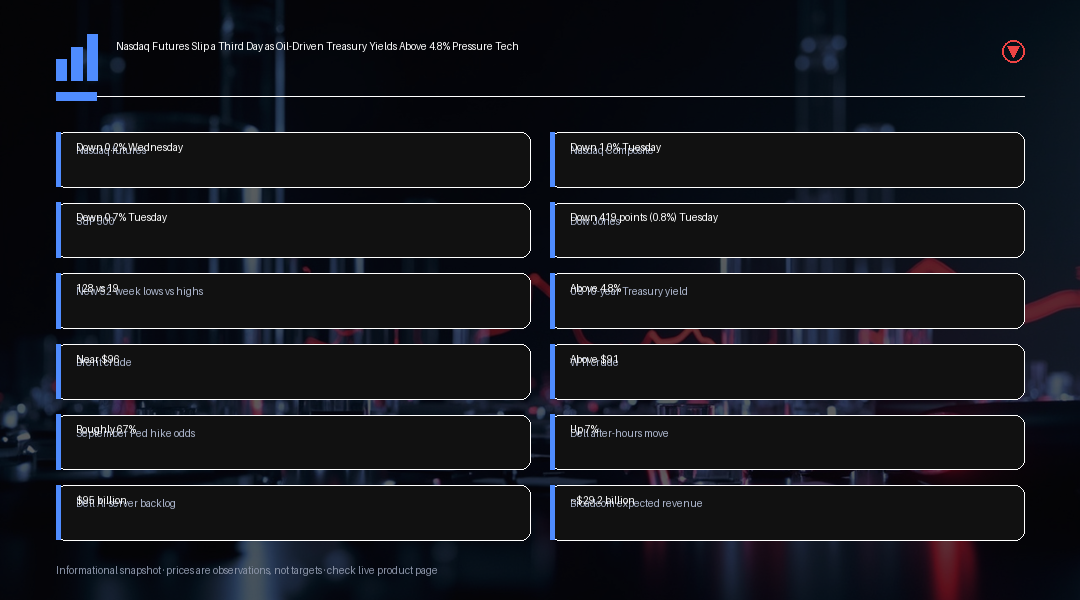
Nasdaq futures slipped roughly 0.2% Wednesday morning after the Composite index fell 1.0% Tuesday, extending a losing streak that has now reached three consecutive sessions across all three major US benchmarks. The S&P 500 lost 0.7% and the Dow Jones Industrial Average dropped 419 points, or 0.8%, on Tuesday. Market breadth on the Nasdaq was notably weak during the decline, with 128 stocks touching new 52-week lows against only 19 hitting new highs, a sign that the selling pressure has been broad rather than confined to a handful of high-profile names. Nvidia fell 1.5% and AMD dropped 2.4% as investors trimmed exposure to some of the market's most expensive growth stocks.
The catalyst behind the move is a familiar one this week: oil. Brent crude jumped Tuesday and pushed toward $96 a barrel on Wednesday, while WTI crossed $91, after fresh US strikes on Iranian positions triggered missile and drone retaliation against American bases and attacks on commercial tankers raised concern about shipping through the Strait of Hormuz. Oil has now gained roughly 8% over two sessions, and that kind of move filters quickly into inflation expectations, which in turn raises the odds that the Federal Reserve holds rates higher for longer or even resumes tightening.
That dynamic showed up directly in the bond market, where the US ten-year Treasury yield climbed above 4.8% Wednesday, its highest level since late 2023, after closing near 4.79% Tuesday. Higher yields increase borrowing costs across the economy and make bonds more attractive relative to stocks, while also reducing the present value of the distant future earnings that growth and technology companies are priced on. That combination is particularly uncomfortable for Nasdaq-listed names whose valuations depend heavily on profits expected several years down the road rather than current cash flow.
Derivatives-implied pricing now points to roughly a 67% probability of a quarter-point Federal Reserve rate increase in September, up from around 40% just a week earlier. That shift followed hawkish commentary from Fed officials, including Chair Kevin Warsh, who has signaled the central bank would still have more work to do if inflation fails to move convincingly back toward its 2% target. Traders should treat this as market-implied pricing that can move quickly with fresh data rather than a confirmed Fed decision.
The selling pressure was not limited to the United States. Asian markets absorbed the next wave Wednesday, with South Korea's chip-heavy Kospi falling roughly 3%, Japan's Nikkei dropping around 2.6%, and the broader Asia-Pacific index losing about 1.5%. Japanese government bond yields also extended their advance, with benchmark yields hovering near 3% and adding to the sense that the yield-driven pressure on equity valuations is a global story this week, not just a Wall Street one.
The one clear bright spot came from Dell, which jumped roughly 7% in after-hours trading after posting record quarterly revenue of about $47 billion and adjusted earnings of $7.04 per share, well above expectations. Management raised its annual revenue guidance to $192 billion, an increase of $25 billion, while AI-server bookings exceeded $130 billion over the past year and the AI-server backlog reached a record $95 billion. That result suggests demand for AI infrastructure spending remains intact even as broader growth-stock valuations come under pressure from rising yields, an important distinction for traders trying to separate a genuine slowdown in AI capital spending from a more general repricing of long-duration growth assets.
Attention now turns to Wednesday's ADP private payrolls report, an early read ahead of Friday's more closely watched official jobs data, along with Broadcom's earnings after Wednesday's closing bell, with revenue expected near $29.2 billion and adjusted earnings around $3.23 per share. A stronger-than-expected jobs report would likely reinforce the case for a September rate hike and add further pressure to yields and growth stocks, while a softer print could ease some of the tension that has driven the past three sessions of losses. The dollar index has held near a two-week high toward 99.8, gold has slipped below its 200-day moving average, and Bitcoin has weakened modestly, all consistent with a market that is currently pricing in tighter monetary policy rather than anticipating near-term relief.
It is worth putting this three-day slide in the context of what came before it. All three major US benchmarks still finished August with gains, meaning the current pullback has so far erased only a portion of the prior month's advance rather than signaling a full change in trend. That distinction matters for traders deciding how aggressively to react: a normal, healthy pullback within an ongoing uptrend looks very different from the early stage of a more sustained reversal, and the coming week's combination of jobs data, Fed commentary and large technology earnings should go a long way toward clarifying which scenario is currently playing out.
The weak market breadth figures, with far more stocks hitting new 52-week lows than new highs, are also worth watching closely in the sessions ahead. Broad-based weakness of that kind can either be an early warning sign of a deeper correction or, if it reverses quickly once yields stabilize, a signal that the selling was concentrated in rate-sensitive names rather than reflecting a broader deterioration in the economic outlook. Traders should watch whether breadth improves alongside any relief in Treasury yields, since a recovery led only by the largest technology names while smaller stocks continue making fresh lows would be a less convincing signal than a broad-based rebound across the index.
Trading Insight
With all three major indexes now down for three straight sessions, traders should watch the US 10-year Treasury yield as the key swing factor for Nasdaq direction this week. A move meaningfully above 4.8% would likely keep pressure on richly valued growth and semiconductor names, while any pullback in yields, particularly if Wednesday's ADP report or Friday's payrolls data come in soft, could spark a relief rally in the same names that have led the recent decline. Dell's strong AI-server results are a useful reminder that underlying AI infrastructure demand has not weakened even as index-level sentiment has soured, so dispersion between individual AI-linked names and the broader index could widen in the sessions ahead. Broadcom's results after Wednesday's close add another near-term catalyst worth watching for confirmation of that theme.