


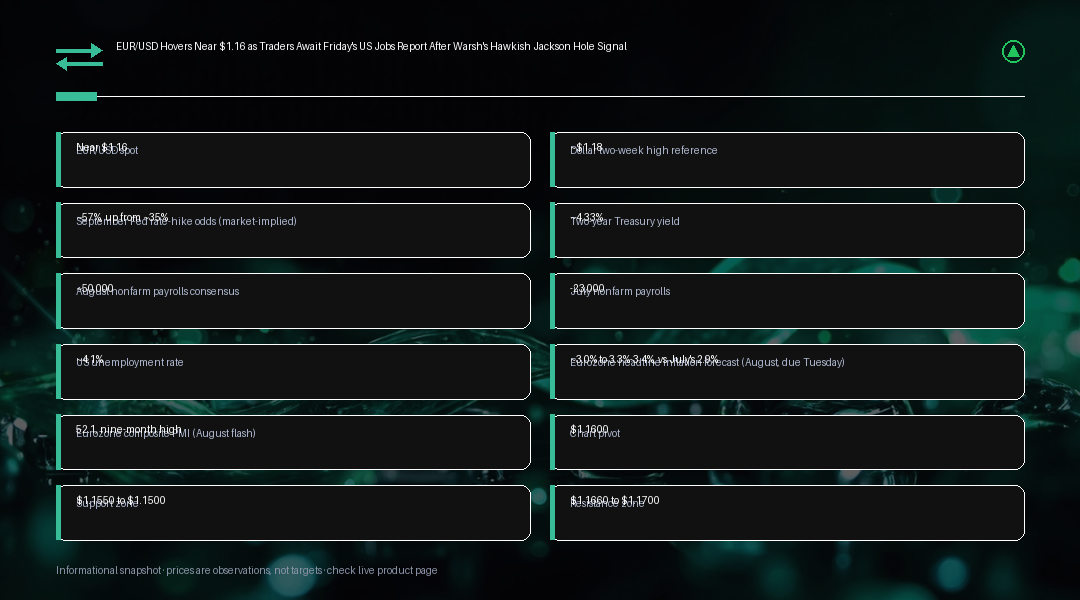
EUR/USD traded near $1.16 on Monday, holding just below the round-number level after the US dollar climbed toward a two-week high from around $1.18 the previous week. The single currency is still tracking toward a second consecutive monthly advance, but its upward momentum has clearly cooled since Federal Reserve Chair Kevin Warsh used his keynote address at the Jackson Hole symposium to remind markets that further policy tightening remains firmly on the table.
Warsh told the Jackson Hole audience that policymakers still "have work to do" unless underlying inflation moves convincingly back toward the Fed's 2% target. Importantly, the speech stopped short of announcing a rate increase or laying out a specific timetable; it was a warning rather than a policy decision, and traders should treat it as such rather than as a done deal. Even so, interest-rate futures moved quickly to reprice the odds of a September hike, pushing the market-implied probability to roughly 57%, up sharply from about 35% in the days before Warsh spoke. That is a market read on the speech, not a Fed commitment, and the number will keep shifting as fresh data lands through the week.
The repricing showed up immediately in the bond market. Two-year Treasury yields, which are unusually sensitive to near-term Fed expectations, rose toward 4.33%, widening the yield advantage that dollar assets hold over the euro. That yield gap is arguably EUR/USD's more immediate problem than any single data point: the eurozone can keep producing encouraging growth and inflation numbers, but the pair still has to compete with a central bank on the other side of the Atlantic that is once again signalling it may pay investors more to hold its currency.
That sets up Friday's US employment report as the week's decisive event. August nonfarm payrolls are due at 8:30 a.m. ET, with consensus estimates clustering around 50,000 new jobs and unemployment expected to hold near 4.1%, following July's surprise loss of 23,000 positions. A stronger-than-expected report, particularly one with firm wage and hours-worked components, would tend to reinforce Warsh's hawkish framing and could push EUR/USD deeper below $1.16. A softer reading would work in the opposite direction, undermining September hike expectations, pulling Treasury yields lower and giving the pair a cleaner path back toward its recent highs.
Traders do not have to wait until Friday for clues. US job openings data lands Tuesday, while private-sector employment indicators, weekly unemployment claims and revised productivity figures are scheduled to arrive later in the week, each offering an incremental read on labour-market momentum ahead of the headline payrolls print. Because Friday's report is best understood as the week's main scheduled test rather than a release that mechanically dictates the September decision on its own, these earlier data points matter for calibrating expectations before the main event.
The other side of the pair has its own catalyst. Eurozone flash inflation data is due Tuesday, and current survey estimates point to a pickup in the headline rate from July's confirmed 2.9% reading, with forecasts spread across a range of roughly 3.0% to as high as 3.3%-3.4% depending on the survey. A print toward the upper end of that range would strengthen the case for a European Central Bank rate increase in September, potentially offsetting some of the dollar support generated by Warsh's remarks, though it would not by itself guarantee an ECB move.
There is also a genuine growth story building in the background. August's preliminary composite Purchasing Managers' Index rose to 52.1 from 52.0, a nine-month high, with manufacturing orders and renewed export demand doing most of the work. Final manufacturing and services PMI readings due this week will test whether that improvement is durable across the wider economy or concentrated in a handful of favourable sectors.
On the chart, $1.1600 is acting as the immediate pivot for the pair, with a first layer of support positioned around $1.1550 and a deeper floor near $1.1500. On the upside, resistance is clustered in the $1.1660 to $1.1700 zone. These are best treated as indicative technical reference points drawn from the current chart rather than fixed, universally agreed levels, since they can shift quickly once Friday's jobs data and Tuesday's eurozone releases are in hand.
Putting the pieces together, the week's path for EUR/USD looks conditional rather than directional. A soft US jobs report paired with a firm eurozone inflation print would build the strongest case for a break back above the pivot and toward resistance, since it would simultaneously cool Fed hike bets and firm up ECB expectations. A strong payrolls number, by contrast, would leave euro bulls negotiating with both the Federal Reserve and the bond market at the same time, a combination that has typically kept the pair capped in the recent range.
For active traders, the key discipline this week is separating what has already happened from what is still a forecast. Warsh's speech and July's payroll shortfall are confirmed events; August payrolls, eurozone inflation and any subsequent policy decisions from either central bank remain scenarios until the data actually prints. Positioning around headline probabilities, such as the roughly 57% market-implied odds of a September hike, should account for the fact that this kind of pricing can move meaningfully within a single trading session as new information arrives.
Trading Insight
For EUR/USD traders, the setup this week is less about picking a single directional bet and more about sequencing two competing data risks. Friday's US jobs report carries the heavier weight because it feeds directly into September Fed pricing, but Tuesday's eurozone inflation print arrives first and could reset the tone heading into the back half of the week. A disciplined approach means waiting for confirmation from at least one of the two releases rather than pre-positioning heavily around the pivot at $1.1600. Traders leaning short into strong US data should watch the $1.1550 and $1.1500 support band for signs of exhaustion, since a level that fails to hold on a closing basis would suggest the move has further to run. Those looking for a bounce on a softer payrolls print should treat $1.1660-$1.1700 as the first real test of renewed euro strength, not a guaranteed target. MC Markets does not cite exact source levels without independent market-data verification, so traders should confirm live pricing and economic-calendar timing directly before acting on any of the levels discussed here. Above all, remember that the roughly 57% September hike probability is a snapshot of futures pricing, not a Federal Reserve commitment, and it will keep moving as new data arrives through the week.