


Social threads are framing a simple story: the old 85% Bitcoin and Ethereum rule for crypto ETFs is dead, so a wave of new products on roughly 15 non-security tokens — including Bitcoin Cash (BCH) — should follow. The useful map is not a single cancelled statute. It is an eligibility ladder: September 2025 generic listing standards opened a faster path beyond case-by-case BTC/ETH reviews; research screens already list a set of tokens with CFTC futures history; and a separate April 2026 85/15 multi-asset proposal (still not final in spring 2026 coverage) shapes how mixed trusts can be built — without guaranteeing any one launch date.
For live core-crypto pricing while that structure evolves, see the BTC product page and the ETH product page.
Key takeaways
- Sep 2025 generic listing standards replaced the slowest part of the old product-by-product gate — not a free pass for every token.
- The retail “85% BTC/ETH rule is dead” line mixes that shift with a later multi-asset 85/15 design proposal (eligible NAV floor), which was still under review in May 2026 explainers.
- Watch the eligibility ladder and product structure: anchors (BTC/ETH) stay central; alts need futures/surveillance routes and real listings — not headlines alone.
What was the old Bitcoin and Ethereum ETF gate?
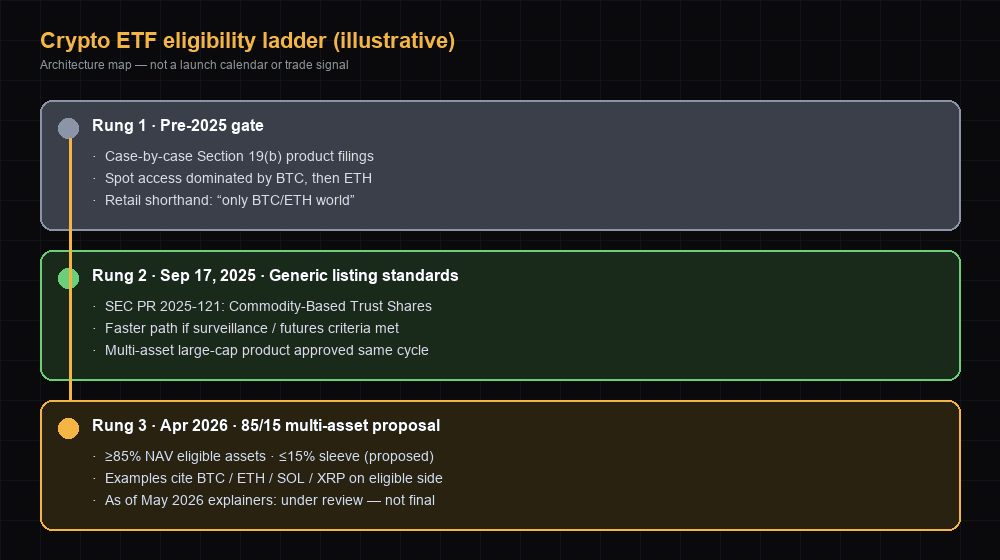
For years, U.S. spot crypto exchange-traded access was effectively a BTC-then-ETH story built on case-by-case exchange filings. Each product typically needed a separate Section 19(b) review path. That model could work for a handful of flagship trusts; it did not scale once issuers lined up Solana, XRP, multi-token baskets, and other structures.
Retail shorthand often compressed that history into an “85% BTC and ETH rule” — as if every fund had to be almost entirely bitcoin and ether. In practice, the binding constraint was less a single public “85% statute” than a slow, product-specific approval culture in which only BTC and ETH had cleared the full spot path. When social posts say that rule “appears dead,” they are usually reacting to the post-2025 listing architecture, not to one repealed paragraph.
What did the SEC actually change?
On September 17, 2025, the U.S. Securities and Exchange Commission approved generic listing standards for Commodity-Based Trust Shares on three national securities exchanges, according to SEC press release 2025-121. Qualifying products that meet those standards can be listed and traded without a separate product-by-product Section 19(b) proposed rule change to the Commission — the step that had dominated the old calendar.
Same-day coverage from Reuters and Investopedia framed the vote as removing a last major hurdle for a wider set of spot crypto products, with early narratives pointing to Solana, XRP, and Dogecoin-class filings among the first wave. In the same standards cycle, the Commission also approved listing and trading of the Grayscale Digital Large Cap Fund, a multi-asset digital large-cap product — proof that the architecture was no longer single-asset BTC or ETH only.
A second pillar arrived on March 17, 2026, when the SEC issued an interpretation (press release 2026-30) clarifying how federal securities laws apply to certain crypto assets and transactions. The Commission’s framing, as summarized in contemporaneous CRS material, is that most crypto assets are not themselves securities, with a taxonomy that treats digital commodities such as Bitcoin, Ether, XRP, and Solana as distinct from digital securities. That taxonomy is not an ETF stamp of approval for every ticker — but it is the policy backdrop social posts mean when they talk about “non-security cryptos” next in line for products.
Which tokens sit in the fast lane?
Eligibility is a market-structure test, not a marketing calendar. Under the generic standards summaries used by legal desks (and restated in Commissioner Peirce’s September 17, 2025 statement on commodity-based ETPs), a commodity generally needs a surveillance path: trading on an Intermarket Surveillance Group (ISG) market, a CFTC-regulated futures contract trading for at least six months, or sufficient exposure through an already-listed ETF (often described as a 40% NAV route).
Galaxy Research’s August 28, 2025 note “Fast-Tracking Digital Asset ETFs” screened the top market-cap set (excluding BTC and ETH, which already had spot products) and identified ten tokens that met its expedited-listing criteria: DOGE, BCH, LTC, LINK, XLM, AVAX, SHIB, DOT, SOL, and HBAR, with ADA and XRP described as near-term. That screen is research, not a regulator’s launch order — but it is exactly why BCH-focused threads claim “Bitcoin Cash is next.”
| Bucket | Examples (research / policy framing) | Trader read |
|---|---|---|
| Established spot anchors | BTC, ETH | Still the liquid institutional core even as the product set widens |
| Galaxy expedited screen (ex-BTC/ETH) | DOGE, BCH, LTC, LINK, XLM, AVAX, SHIB, DOT, SOL, HBAR | Futures / surveillance history supports a faster listing path — not a guaranteed launch date |
| Near-term in same research cycle | ADA, XRP (as described by Galaxy) | Watch futures seasoning and filing progress, not social certainty |
| Multi-asset index path | Grayscale Digital Large Cap (Sep 2025 cycle) | Proves baskets can list under the new architecture |
| 85/15 multi-asset design (proposal) | Filing examples cite BTC, ETH, SOL, XRP as eligible-side anchors | Portfolio construction rule for mixed trusts — not an altcoin free pass |
Eligibility screens move as futures markets season and filings update. Live core quotes: BTC · ETH.
What is the 85/15 proposal really about?
The April 2026 “85% rule” that resurfaced in spring headlines is mainly a multi-asset design threshold — not a re-litigation of whether only bitcoin and ether may exist as products. According to BeInCrypto’s May 1, 2026 guide summarizing the NYSE Arca filing (Rule 8.201-E for Commodity-Based Trust Shares), the proposed framework would require at least 85% of a trust’s net asset value to sit in already-eligible assets, while up to 15% could sit in a non-eligible sleeve. Yahoo Finance and AOL filing summaries dated April 28–29, 2026 place the public comment window around the same late-April cycle.
BeInCrypto’s read of the Federal Register examples is concrete: a trust with roughly 95% allocated across bitcoin, ether, Solana, and XRP plus a small sleeve of other digital assets would clear the proposed threshold; a structure that looks “mostly bitcoin” but loads large OTC call-option notionals can fail (their walk-through cites about 71% eligible). That is product engineering, not a binary “alts banned / alts free.”
Critical status check: as of the May 1, 2026 explainer, the 85/15 framework was still a proposed exchange rule change under SEC review — not a final Commission rule and not a product approval. Treating it as proof that “fifteen new ETFs print next week” over-reads both the filing and the social title.
What should crypto traders watch next?
Watch structure and relative bids, not a single victory headline.
Scenario A — multi-token path extends. More single-asset or basket products that meet generic standards list; filings progress on SOL/XRP/BCH-class names; multi-asset trusts use BTC/ETH (and other eligible anchors) to keep the eligible side dominant if 85/15 or similar design rules advance. In that tape, alt beta can lead short windows when a listing catalyst is real — while BTC and ETH remain the depth anchors for risk-on crypto beta.
Scenario B — path narrows or stays slow. The multi-asset proposal stalls, sleeves stay tight, or novel structures (heavy derivatives, thin surveillance history) keep failing eligibility math. BTC and ETH retain the bulk of regulated product AUM and the cleaner institutional narrative; alts trade more on native crypto liquidity than on “ETF next” hope.
Scenario A fails quickly if “approved standards” chatter is not followed by actual listings and secondary-market volume. Scenario B fails quickly if a cluster of non-BTC/ETH products lists cleanly and pulls measurable flows without breaking the surveillance story. In both cases, treat social certainty as a sentiment gauge — then verify against the eligibility ladder and the product that actually trades.
Final thoughts
The old world really was narrow: spot access was a long BTC-and-ETH tunnel. The new world is wider — generic listing standards, a clearer non-security taxonomy, research screens that put BCH and peers on a faster structural path, and a separate multi-asset 85/15 design debate. None of that is a free calendar of guaranteed launches. The durable habit for traders is the same as on any other structural story: separate architecture from approval from flows, keep BTC and ETH as the liquid reference, and update the map when listings — not headlines — change.