


Brent holding near $95 while government-bond yields ease is not a contradiction. It says the oil market still carries a supply-risk premium, while the rates market has stopped extending the inflation shock for the moment. The next durable move depends less on one diplomatic comment than on whether physical flows, crude benchmarks and yields begin confirming the same story.
That distinction matters across portfolios. Oil near $95 can pressure inflation-sensitive assets, but a softer yield backdrop can give equities and crypto breathing room. Traders therefore need to read the combination, not treat crude or bonds as a standalone signal.
Key takeaways
- Brent remained close to $95 even after the first burst of escalation risk was absorbed.
- A two-basis-point easing in the 10-year yield is relief, not confirmation that the energy shock has ended.
- Physical shipping, oil prices and inflation-sensitive rates form a stronger signal than negotiation headlines alone.
Why did Brent hold near $95?
Brent held near $95 because the market still priced a meaningful chance of further Middle East supply disruption. According to the Associated Press, Brent rose 4.6% to settle at $94.65 on September 1 as renewed US strikes on Iran lifted inflation concerns. It then settled at $95.63 on September 2 and $95.52 on September 3.
The daily changes became smaller, but the level stayed elevated. Reuters reported Brent at $95.78 and WTI at $91.64 at 1:00 p.m. ET on September 3. Renewed military escalation supported prices, while signals of possible negotiations and higher Iraqi exports limited the gain. That is a market balancing a real chokepoint risk against partial supply offsets—not one that has resolved the risk.
The Strait of Hormuz explains why the premium can persist. The U.S. Energy Information Administration estimated that 20 million barrels a day moved through the strait in 2024, roughly 20% of global petroleum liquids consumption. Alternative routes can absorb only part of that flow, so even a low-probability disruption can carry a large price consequence.
Why can oil stay high while bond yields cool?
Yields can ease after a sharp sell-off without reversing the inflation message from oil. The 10-year US Treasury yield moved from 4.79% at the September 1 close to 4.78% on September 2 and 4.77% on September 3, according to the Associated Press. Over the same three closes, Brent moved from $94.65 to $95.52.
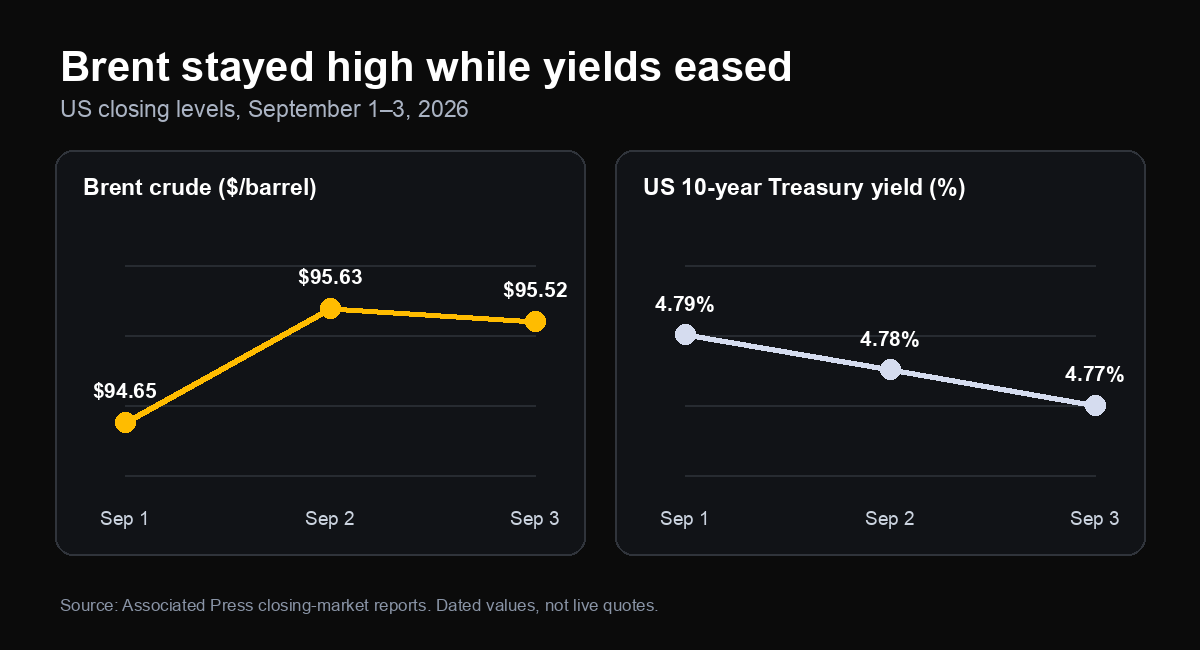
This is a small sample, not a statistical relationship. Still, it captures the session logic: the bond market took a breather as the latest oil jump stopped accelerating. Softer employment data and demand for bonds can pull yields lower even while crude retains a geopolitical premium.
The broader mechanism remains intact. Research from the Federal Reserve Bank of San Francisco explains that a supply-driven oil shock can weaken economic activity while lifting inflation pressure. Stocks may fall as the growth outlook softens, while bond yields can rise as investors demand compensation for inflation. A one-session decline in yields changes the intensity of that pressure, not the mechanism itself.
Do negotiation comments remove the supply premium?
No—comments matter immediately, but only physical evidence can prove that the supply risk is receding. Moneycontrol reported that President Donald Trump said he was not trying to force Iran back to negotiations while Brent traded around $95. The statement can change perceived escalation odds, yet it does not by itself confirm safer shipping, higher cargo volumes or restored regional output.
For traders, the sequence matters. First comes the headline, then the crude-price response, and finally the physical confirmation. If vessel traffic improves consistently and Brent gives back the premium, diplomacy is reaching the barrel. If transit remains constrained and Brent stays firm, the market is treating the comment as rhetoric rather than resolution.
The fundamental baseline also deserves context. In its August outlook, completed before the latest escalation, the EIA forecast Brent to average about $85 in the third quarter of 2026 and expected most regional production to approach pre-conflict averages in early 2027. Brent near $95 is therefore trading above that baseline, which makes evidence of normalization—or its absence—especially important.
What does this mix mean for equities and crypto?
Cooling yields can support risk assets, but high oil keeps a macro cost in the background. On September 3, the Associated Press reported that the major US indexes gained at least 1% as the 10-year yield slipped to 4.77%, even though Brent settled at $95.52. Technology shares benefited because lower yields reduce some pressure on long-duration valuations.
That relief is conditional. If Brent rises because supply is impaired and yields resume climbing, growth-heavy equities can face both higher input costs and a higher discount rate. If oil stays elevated but yields remain contained, the market may treat the shock as manageable, allowing earnings and company-specific news to dominate.
Crypto sits in the same cross-current. Bitcoin and other liquid crypto assets can benefit when yields and the dollar cool, but they can weaken when an oil shock revives inflation fears and tightens financial conditions. There is no fixed inverse relationship between Bitcoin and Brent. The cleaner read is whether oil, yields, the dollar and equity breadth are moving together.
What would confirm the next market regime?
The strongest signal comes from agreement across physical supply, crude prices and rates. One market can move on positioning; three aligned markets are harder to dismiss.
| Evidence | Risk premium persists | Pressure starts to ease |
|---|---|---|
| Physical flows | Transit or output remains constrained | Cargo movement improves across several sessions |
| Brent | Holds the elevated range after headlines fade | Gives back the premium as supply access improves |
| Bond market | Long yields resume rising with inflation concern | Yields stay contained despite firm crude |
| Equities | Broad market weakens and rate-sensitive growth lags | Breadth improves beyond a narrow technology rally |
| Crypto and dollar | Dollar firms and liquidity-sensitive assets weaken | Dollar cools while crypto participation broadens |
These are confirmation conditions, not price targets. Market levels can change throughout the session.
Final thoughts
Brent at $95 is best read as an unresolved premium, not a forecast carved in stone. The oil market is still paying for the possibility of disrupted supply; the bond market is asking whether that possibility will become persistent inflation.
Cooling yields make the immediate backdrop less hostile for risk assets, but they do not close the Strait of Hormuz story. Watch what moves after the headlines: barrels, benchmark prices and the cost of money. Their agreement will say more about the next regime than any single opening-bell narrative. More cross-asset context is available in MC Markets Insights.