


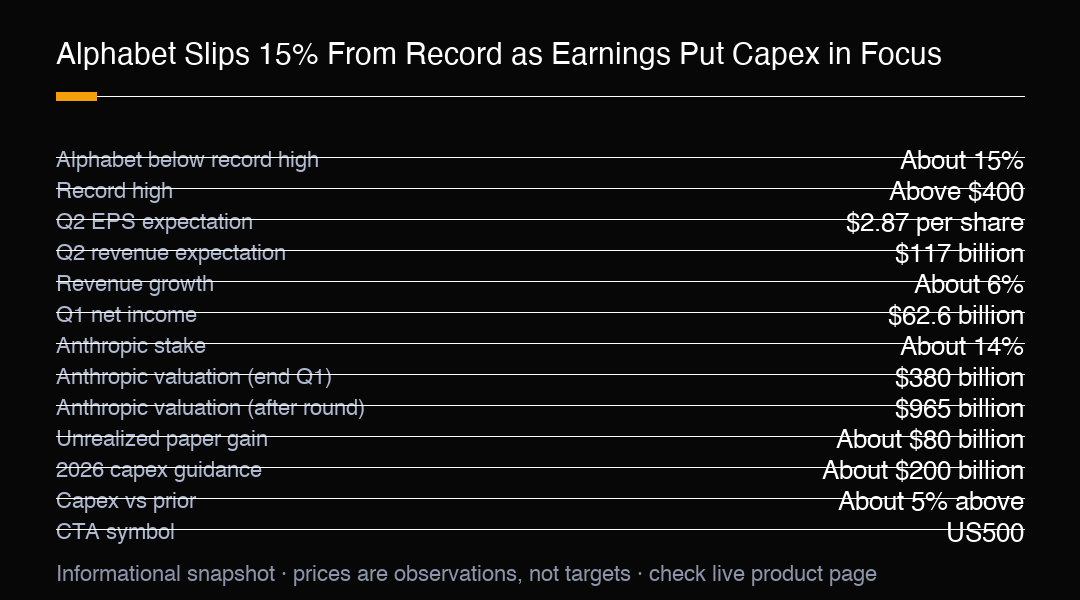
Alphabet heads into one of the busiest earnings weeks of the season in an unusual spot: shares were little changed in premarket trading Monday but still sat roughly 15% below the record high they set above $400. The pullback has turned Wednesday's report into a referendum on how much the market is willing to pay for an AI-led story that has already re-rated sharply higher.
The setup is classic mega-cap tension. On one hand, Wall Street expects earnings of $2.87 per share on $117 billion in revenue, up about 6% from a year ago. On the other, expectations for the largest technology names rarely stop at 'meeting estimates.' A company this size can post a solid quarter and still disappoint if the guidance does not keep pace with the valuation.
What makes Alphabet different from a normal earnings trade is the composition of its profit. The company posted a record $62.6 billion in net income in the first quarter, but nearly half of that came from unrealized gains on investments in Anthropic and SpaceX rather than its core advertising and cloud businesses. The ownership stake of roughly 14% in Anthropic is the wedge: its valuation was $380 billion at the end of the first quarter and was revalued at $965 billion after a fresh funding round, translating into an estimated $80 billion paper gain for Alphabet.
Those gains matter for the reported numbers, but they are not cash. Unrealized means Alphabet has not actually sold anything; the higher valuation lifts the accounting value of the stake and boosts earnings without bringing money through the door. For traders, the risk is that a strong headline number is flattered by marks that can move in either direction with private-market sentiment.
That is why capital expenditure has become the real story. With AI demand accelerating, memory prices climbing, and Alphabet having recently raised fresh capital, analysts expect management could lift its 2026 capex guidance to roughly $200 billion, about 5% above prior expectations. In today's AI race, spending has become almost as important as profit, just inverted: the biggest number investors watch is not how much Google earns but how much it is willing to spend to stay ahead.
The capex debate cuts both ways. Heavy spending signals conviction in AI demand and can defend market share against rivals building at the same pace. But it also pressures free cash flow and raises the bar for returns, especially when a chunk of recent earnings quality came from paper gains rather than operations. A guide-up can be read as confidence or as a warning that the cost of staying competitive is rising faster than revenue.
The comparison with peers is unavoidable. Alphabet headlines the week alongside Tesla, while IBM returns to the spotlight after preliminary results triggered one of the biggest single-day collapses in its history. That clustering means one weak print can spill into the others, because the market is pricing these names as a connected AI mega-cap complex rather than separately. Breadth will matter: if the selling stays concentrated in a few names, indexes can hold; if it spreads, the index has further to correct.
For index traders, the cleanest read is that Alphabet's 15% distance from its record is a repricing of expectation, not a verdict on the business. The $2.87 EPS and $117 billion revenue consensus set the bar, while the $200 billion capex guide is the number that will decide whether the re-rating continues or pauses. US500 traders can use the 6% revenue growth and the capex shift as a lens on whether mega-cap technology can still justify its weight.
Event clustering is the practical risk. Earnings, macro data, and overseas headlines can all land outside US trading hours and reprice the index fast. Rather than reading one overnight move as the full story, traders should wait for follow-through across sectors before drawing conclusions about direction, because a single earnings surprise can be absorbed or amplified depending on what else is happening.
Positioning into the print matters as much as the price. A market that enters a shock with crowded longs tends to fall faster, because leverage has to be unwound before any recovery can begin. Alphabet's recent range suggests a more balanced book, but the size of the name means any de-risking from index funds and quants can be outsized relative to the fundamental news.
The useful framework is to separate the durable story from the noisy one. The durable story is AI demand, cloud growth, and a balance sheet strong enough to fund a $200 billion build. The noisy story is the quarter-to-quarter swing in paper gains and the knee-jerk reaction to guidance language. Traders who conflate the two tend to over-trade the print and under-trade the trend.
Risk control should account for the gap between expectation and outcome. A guide-up in capex paired with soft cloud commentary could pressure the stock even on an in-line beat, while a disciplined spend plan with strong AI momentum could rebuild confidence quickly. Either way, the 15% gap from the record shows the market has already removed some complacency, which can make the reaction less violent than it would have been at the highs.
The tactical setup is to let the print and the call do the work. Rather than predicting the number, traders can define risk around the post-earnings range and react to whether management's capex message supports or undermines the AI thesis. A hold of the $400 area on a constructive guide would say buyers remain; a clean loss of it would confirm the re-rating has further to run.
MC Markets traders can use US500 to express a view on this cross-asset setup, tracking mega-cap earnings, AI capex guidance, and incoming index volatility without taking on single-name risk. Alphabet's 15% slip from its record and the coming $200 billion capex debate put the AI complex in focus, and this week's results will show whether the market's favorite winners can still justify their weight. This is market commentary, not personal financial advice.
Trading Insight
Alphabet sat roughly 15% below its record high above $400 ahead of Wednesday's earnings, with Wall Street looking for $2.87 per share on $117 billion in revenue, up about 6%. Q1 net income of $62.6 billion was flattered by an estimated $80 billion unrealized gain on its ~14% Anthropic stake, whose valuation was $380 billion at the end of Q1 and was revalued at $965 billion. The real test is 2026 capex guidance near $200 billion, about 5% above prior expectations. This is market commentary, not personal financial advice.