


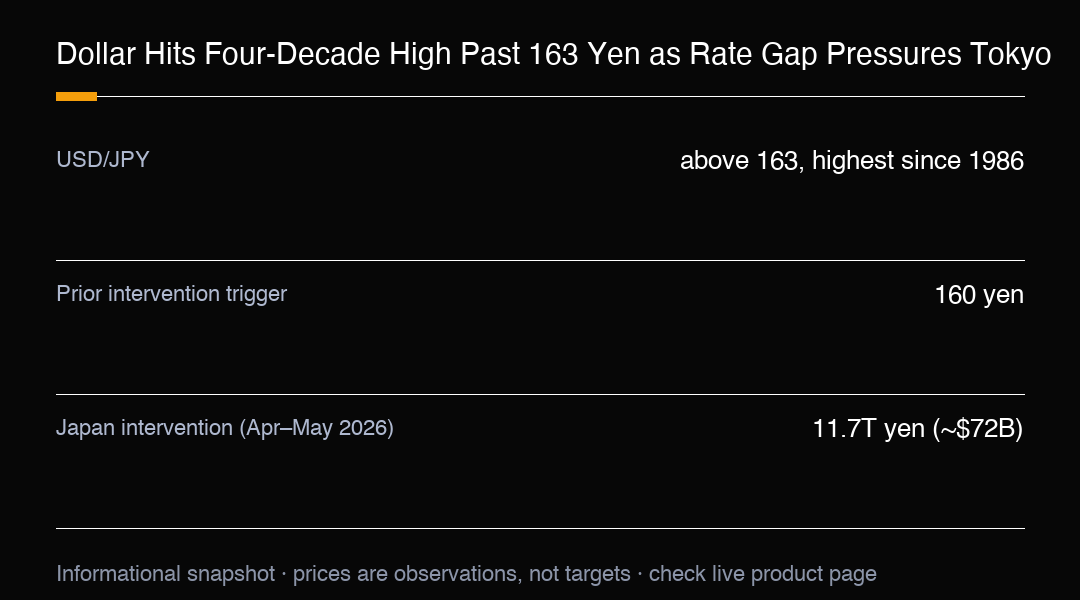
The dollar pushed to a fresh four-decade high against the yen on Tuesday, with the US currency crossing above 163 yen for the first time since 1986. The move extends a years-long climb driven by higher US interest rates, stronger Treasury yields, and a wave of investors favoring dollar assets during periods of global uncertainty.
For Japan, the breach of 163 is more than a number. It sits well beyond the 160 level that previously drew official intervention from Tokyo, and it revives the question of whether policymakers will step in again. The open question is not whether Japan can act, but when, and surprise action has historically been the preferred tool.
Tokyo has already shown its hand once this year. Authorities spent roughly 11.7 trillion yen, about 72 billion dollars, between late April and late May 2026 to slow the slide. Intervention can take the edge off downward momentum, but it rarely reverses a trend built on fundamentals, and the wide rate gap between the US and Japan still favors the dollar.
That gap is the engine of the move. With US yields elevated and the Bank of Japan moving slowly, holding the yen offers little carry, while holding dollars pays. As long as that spread persists, every modest rebound in the yen looks like a selling opportunity to traders, which caps any recovery effort.
The policy divergence is structural, not cosmetic. The US central bank has kept rates restrictive to fight sticky inflation, while Japanese policymakers have only gingerly normalized after years of ultra-loose settings. Until that gap narrows materially, the arithmetic of the trade points the same direction it has for most of the past two years.
Finance Minister Satsuki Katayama has warned in recent weeks that the government stands ready to act. Yet officials tend to favor surprise over repeated public threats, leaving the timing of any move genuinely uncertain. Markets are pricing in the possibility of intervention without knowing the trigger.
The latest leg higher for the dollar came as renewed tensions in the Middle East lifted oil prices and Treasury yields. Both developments strengthen the US currency while pressuring Japan, which imports almost all of its energy. A weaker yen also pushes up import costs, adding to pressure on households and businesses already dealing with elevated inflation.
Energy is the hidden transmission channel here. When crude rises, Japan's import bill swells precisely as its currency weakens, a double squeeze on a net energy importer. The cost feeds directly into petrol, utilities and manufactured goods, and from there into the broader inflation picture that the Bank of Japan is watching closely.
New lows in the currency quickly become a domestic political issue, not just a trading opportunity. Higher import bills feed directly into the cost of living, and that raises the stakes for any government weighing whether to defend the exchange rate. The politics can move as fast as the charts.
The political math is uncomfortable for Tokyo. Voters feel currency weakness at the supermarket and the pump long before they feel any benefit to exporters, so sustained weakness erodes approval ratings. That gives policymakers an incentive to be seen acting, even when the fundamentals argue that any defense will be costly and temporary.
For now the trend is intact and the drivers are unchanged. Until the rate gap narrows or Tokyo commits to a sustained defense, the path of least resistance points higher for the dollar. The only real wildcard is a surprise intervention that reminds the market how forcefully Japan can act when the yen moves too far, too fast.
History suggests intervention works best as a shock, not a schedule. A single large, unexpected operation can reset positioning and buy time, but it does not rewrite the rate differential that caused the move. Traders know this, which is why each failed defense in the past has eventually been met with fresh selling, and why the next one will be judged on whether it changes the narrative, not just the level.
The cross-market read is that this is no longer just a Japan story. A dollar at multi-decade highs against the yen pressures other Asian currencies to appreciate or face their own competitiveness squeezes, and it feeds dollar strength that ripples through commodities and emerging-market debt. What starts as a bilateral rate gap becomes a global pricing force.
That is why the level matters even to investors with no direct exposure to the pair. A stronger dollar makes raw materials priced in the currency more expensive for everyone else, complicates central banks elsewhere, and tightens financial conditions more broadly. The 163 yen line is a marker for a broader shift in how the world is priced, not just a quote on a screen.
For now, the most likely path is a slow grind rather than a clean break. Expect more verbal warnings from Tokyo, occasional actual intervention, and a dollar that keeps finding a bid on every dip as long as the rate gap holds. The pair has become a live test of how far a structural divergence can run before policy pushes back hard enough to matter.
Until something changes the arithmetic, the path of least resistance stays higher. Traders will keep selling yen rallies, Tokyo will keep warning, and the dollar will keep pressing the boundary of what policymakers will tolerate. The 163 line is not a ceiling so much as a flare marking where the tension between markets and policy is most intense.
The lesson of the past two years is that currency wars are won slowly and lost quickly. Japan has the reserves to act and the incentive to be seen defending the yen, but not the rate backdrop to win a sustained fight. That asymmetry is why the dollar keeps pressing higher and why every intervention, when it comes, is treated as a pause rather than a turning point.
For traders positioned around the pair, the cleanest expression of the view is to respect the trend until Tokyo proves otherwise. The fundamentals reward patience on the dollar side, and only a decisive, sustained defense would justify betting the other way. Until then, 163 is a waypoint, not a wall.
Trading Insight
The dollar broke above 163 yen, its highest since 1986, as the US-Japan rate gap keeps favoring the greenback. Tokyo has intervened before this year, so surprise action remains the key risk to the trend.