


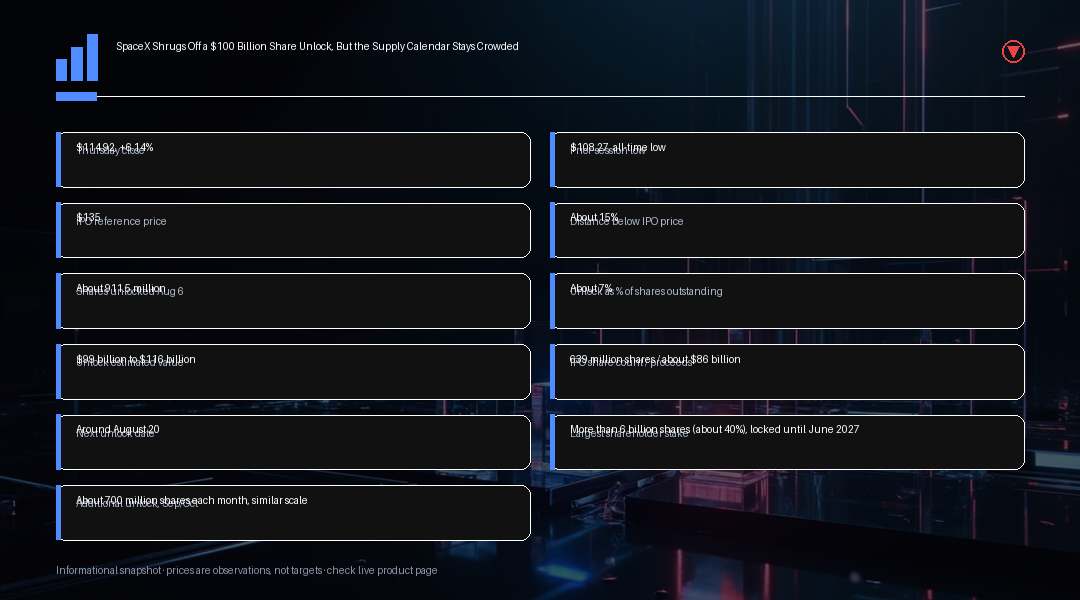
SpaceX shares climbed 6.1% to $114.92, brushing off what many traders had feared would be a disorderly selling wave as the company's first major post-IPO lockup expired and roughly 911.5 million previously restricted shares became eligible for trading. The bounce came a session after the stock suffered its second-worst day on record, sliding nearly 14% to an all-time low of $108.27 as investors weighed heavy AI-related capital spending against lockup anxiety heading into the unlock date.
A lockup period is a standard IPO mechanism that prevents company insiders, employees and early investors from selling their shares for a set window after a stock begins trading. Its expiration does not force anyone to sell; it simply removes the restriction and allows those holders to decide for themselves whether to take profits, hold for the long term, or wait for a better price. Markets often brace for lockup expirations because they can sharply increase the number of shares available for public trading, known as the float, and a larger float can create selling pressure if a meaningful share of holders decide to cash out at the same time.
In this case, the unlocked block represented roughly 7% of SpaceX's outstanding shares. Independent market estimates of its dollar value varied, with figures ranging from roughly $99 billion to as high as $116 billion depending on the reference price and timing used, comfortably supporting the more than $100 billion framing that circulated across trading desks on the day. For context, that single unlock tranche is larger than the 639 million shares originally sold in SpaceX's landmark IPO, an offering that raised about $86 billion at a $135 per-share price. Thursday's close still leaves the stock roughly 15% below that IPO price, meaning investors who bought at the debut remain underwater even after the rebound.
Rather than a rush to the exits, options-market activity into the unlock suggested a different story. Institutional traders had been building bullish call positions ahead of Thursday's bell, a signal that at least some sophisticated money was betting the stock could hold up, or even rally, once the supply overhang became a known and priced-in event rather than a feared unknown. That kind of positioning helps explain why a headline event long flagged as a risk ultimately coincided with a gain rather than a rout.
The calm should not be mistaken for the story being over. SpaceX's unlock calendar remains crowded well beyond this week. Additional tranches of roughly 319 million shares are scheduled to become eligible around August 20, followed by further releases of a similar scale in September and October. Beyond those near-term dates, the broader unlock schedule continues to build through the rest of the year, with the cumulative share of freely tradable stock expected to keep rising into December. Each additional release adds to the pool of shares that could, in theory, reach the market, even if history from this week suggests demand can absorb supply increases without a disorderly reaction.
One especially large piece of the ownership structure remains off the table for now. SpaceX's largest shareholder, who holds more than 6 billion shares, or roughly 40% of the company, remains locked until June 2027. That keeps the single biggest potential source of future supply out of the market for nearly another year, giving both bulls and bears a long runway before that particular event risk needs to be priced.
For traders, the practical takeaway is that Thursday's session passed an important test without triggering the selling stampede many had positioned for, but the underlying supply dynamic has not disappeared, it has only been deferred into a series of smaller, scheduled events. Each subsequent unlock date becomes a fresh opportunity to gauge whether demand can keep pace with an expanding float. A repeat of Thursday's calm would reinforce confidence that the market has already absorbed the bulk of the near-term overhang concern; a weaker reaction around the August 20 or September dates would suggest the market's patience has limits.
Volatility around SpaceX shares is likely to stay elevated regardless of the near-term outcome. The stock has swung between an all-time low and a double-digit percentage rebound within a span of two sessions, a reminder that newly listed, high-profile names with large pools of restricted stock can move sharply in either direction as ownership structures evolve. Traders should size positions with that swing potential in mind, particularly around each scheduled unlock date through the rest of the year.
The broader lesson for traders extends beyond SpaceX itself. Newly public companies with unusually large, thinly floated share structures tend to produce exactly this kind of two-sided event: a headline that sounds unambiguously bearish, a stock that reacts calmly or even positively, and a market left debating whether the calm reflects genuine absorbed demand or simply a delayed reaction that could still show up around the next scheduled unlock. Comparable large-cap technology listings in recent years have shown both patterns at different points in their unlock calendars, which is why a single quiet session should be treated as informative but not conclusive.
Liquidity conditions around each unlock date also deserve attention. A larger float generally narrows bid-ask spreads and can make a stock easier to trade in size, which is a genuine structural benefit for both institutional and retail participants regardless of near-term price direction. That liquidity improvement is a separate consideration from the directional selling-pressure question, and traders should avoid conflating the two: a stock can become easier to trade even in a session where the price move itself is muted or negative.
MC Markets does not cite exact source levels without independent market-data verification. Traders should confirm current pricing, unlock dates and share counts through their own market-data feeds before acting on any of the figures discussed above.
Trading Insight
The immediate lockup-expiry test passed without a disorderly selloff, but the calendar still includes further unlock tranches around August 20, in September and in October, each of which is a fresh event risk for volatility. Watch whether the stock can hold above the $108 all-time-low area on any renewed weakness, and whether it can make progress back toward the $135 IPO price as a longer-term reference level. A repeat of this week's resilience into the next unlock date would support a constructive read; a sharp reversal on rising volume around a future unlock would suggest the float increase is finally outpacing demand. With the largest single shareholder's stake locked until June 2027, the nearest-term supply risk remains concentrated in the smaller, scheduled 2026 tranches rather than a single dominant overhang.