


China's best-known robot maker delivered one of the year's most spectacular stock market debuts. One month later, it is a very different story, and the reversal says as much about investor psychology as it does about the robots themselves.
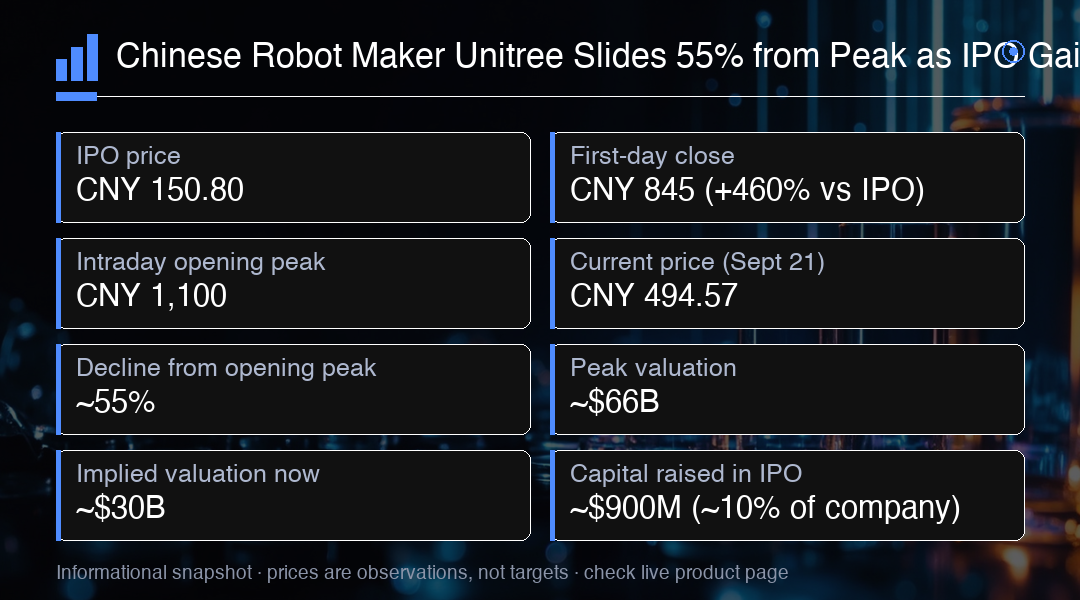
Unitree Robotics shares surged more than fivefold during their Shanghai debut in August. The stock finished its first session at 845 yuan, 460% above its 150.80-yuan IPO price, after initially trading as high as 1,100 yuan intraday. The excitement briefly valued the company at approximately $66 billion, a staggering figure for a robotics manufacturer only a few years removed from being a research-lab curiosity.
That valuation did not last. Shares have since fallen 55% from their peak, and roughly $30 billion in market value has replaced the $66 billion peak. Tens of billions of dollars in paper value have evaporated as the initial listing euphoria has given way to a harder set of questions about what Unitree's robots are actually doing for paying customers.
The IPO itself was not small. Unitree sold approximately 10% of the company and raised around $900 million in the process. Founder Wang Xingxing retained a stake of roughly 20%, while Tencent, Alibaba and DeepSeek were among the prominent backers who bought in ahead of the listing. That roster of investors is part of why the debut drew so much attention in the first place: this was not a speculative micro-cap, but a company with serious institutional and strategic backing.
Unlike many robotics hopefuls chasing a story rather than a balance sheet, Unitree is already profitable, and its humanoid and quadruped machines have become genuinely famous for what they can do on camera: running, dancing, and performing martial arts routines that circulate widely online. The problem is that viral demonstrations and dependable commercial deployment are two very different businesses. Sales have so far been concentrated among universities and research institutions making one-off purchases, with comparatively few robots operating inside real commercial environments on a recurring basis.
That is the gap investors are now focused on closing. The market wants evidence of repeat orders, factory-floor deployment at scale, and recurring service revenue, the less telegenic numbers that ultimately determine whether a humanoid-robot company deserves a valuation built for a category-defining technology platform rather than an impressive lab demo. Until that evidence shows up in a meaningful way, every disappointing data point gives the stock another reason to reprice lower.
Regulators have added to the pressure. Chinese authorities have reportedly used informal 'window guidance' to slow the pace of approvals for humanoid-robot IPOs, and some market participants now describe that listing pipeline as effectively frozen, even though there is no formal ban in place. At least six companies, including Deep Robotics, X Square Robot and AGIBOT, have reportedly been preparing their own listings, and Unitree's post-IPO stumble is exactly the kind of cautionary tale regulators may want the market to digest before letting more of them through.
None of this means Beijing has soured on robotics as an industry. China considers 'embodied intelligence,' AI systems that can perceive and act in the physical world, a strategic priority, and the broader policy support for the sector has not disappeared. What appears to be cooling is specifically the pace of speculative capital-markets enthusiasm around humanoid-robot listings, which is a narrower and more manageable target for regulators than the underlying technology race itself.
Unitree also faces pressure from outside China. The United States has prohibited imports of future foreign-made humanoid and quadruped robot models, a category that includes Unitree's products, closing off a market that would otherwise have been a natural growth avenue. The Pentagon has separately added the company to a list of Chinese military-linked businesses, a designation Unitree disputes by noting that its robots are intended for civilian applications. Whatever the merits of that dispute, the practical effect is another layer of friction for a company trying to prove out a commercial growth story on a global stage.
What would actually move the needle for Unitree's valuation from here is not another viral video, but boring, repeatable commercial metrics: signed multi-unit orders from factories or logistics operators, service and maintenance contracts that recur quarter after quarter, and disclosed unit economics that show the robots generate a return for the businesses buying them. Until those numbers start showing up in filings or investor updates, the market is likely to keep treating every headline, positive or negative, as a reason to swing the stock rather than to re-rate it durably in either direction.
That volatility cuts both ways for traders. A stock that can rally fivefold in a single session and then shed 55% of its value within a month is not a name to size like a blue-chip index holding. Position sizing that accounts for the possibility of another sharp swing in either direction, and a clear plan for where a trade is wrong, matters more here than in almost any other corner of the market right now.
For traders, the setup now is less about the excitement of a hot IPO and more about a straightforward test of support. The stock is in a clear downtrend from its post-listing peak, and the psychologically important halfway point between the IPO price and the opening peak is emerging as a key level. A break below that zone would raise the risk of a slide back toward the original 150.80-yuan IPO price, effectively erasing the entire post-listing rally. Conversely, any stabilization above current levels, ideally paired with concrete commercial deployment news, would go some way toward rebuilding the bull case that briefly justified a $66 billion valuation.
The broader lesson extends beyond one stock. Humanoid robotics remains one of the most closely watched themes in global markets precisely because the long-term addressable market is enormous if the technology delivers on its promise. But Unitree's first month as a public company is a reminder that the gap between an impressive demo and a durable commercial business can be wide, and that gap is exactly where the next leg of this stock's story, and the broader humanoid-robot IPO wave behind it, will be decided.
Trade the momentum in AI and robotics-linked markets with MC Markets, and access the charting and risk-management tools to navigate high-volatility names as this sector's next chapter unfolds.
Trading Insight
Unitree remains a high-risk, high-reward trade following its post-IPO collapse. The stock is in a clear downtrend from its post-listing peak, with shares trading around 494.57 yuan as of September 21 (roughly 55% below the 1,100-yuan opening peak) and the midpoint between the IPO price and the opening high acting as a key support zone. A break below this level raises the risk of a slide back toward the original IPO price of 150.80 yuan. A stabilization above current levels, particularly alongside concrete commercial-deployment news, would support a near-term bounce, though the broader regulatory and sentiment backdrop for humanoid-robot listings remains cautious.