


Bitcoin has clawed its way back above $81,000, brushing aside a rough patch that briefly dragged BTCUSD under $76,000 last week. The bounce is real, and it has put the world's largest cryptocurrency within striking distance of its highest level since early September. The next leg higher, though, runs straight into a wall that has already turned bulls away twice.
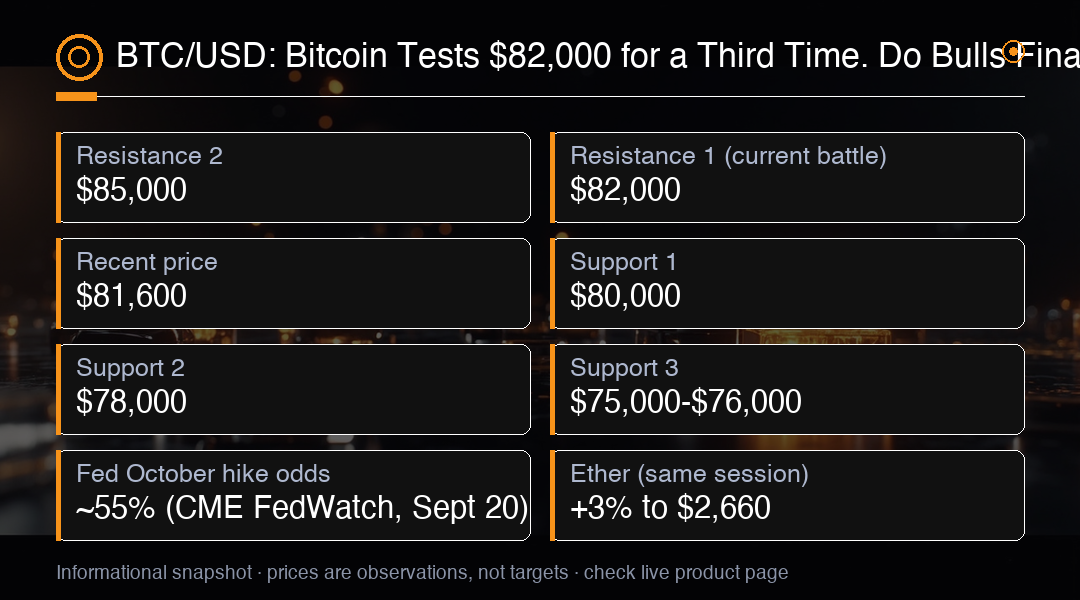
BTCUSD climbed roughly 1.5% on Monday morning, pushing toward $81,600 and briefly nudging the $82,000 level before easing back. That level is not a random round number. It rejected Bitcoin in early September, when price reached about $82,160 before reversing, and it also capped an advance back in mid-May. Two failed attempts at the same ceiling tend to get traders' attention, and this is now shaping up as a third test.
The setup is straightforward, even if the outcome is not. A daily close above $82,000, ideally followed by a successful retest of the level as new support, would go a long way toward confirming a genuine breakout. Anything short of that, another intraday poke above the line that fades back underneath it by the close, would leave the market staring at a possible triple rejection, and triple rejections tend to embolden the sellers who have been right twice already.
Context matters here, because this recovery did not happen in a friendly news environment. The bounce followed a genuinely rough week for crypto bulls: the Federal Reserve raised its target range by 25 basis points to 3.75%-4.00% on September 16, and the US Senate failed to advance the Clarity Act, the crypto market-structure legislation that traders had been hoping would clear a major regulatory hurdle. Bitcoin's initial reaction was to slip below $76,000, which is exactly what you would expect. The fact that it recovered from there just as quickly suggests a lot of that bad news was already priced in before it was officially confirmed.
Higher rates remain the more durable headwind. CME FedWatch pricing cited in weekly-outlook reporting on September 20 implied roughly a 55% probability of another Federal Reserve rate increase in October, a market-implied figure that can shift quickly as new data arrives, and Treasury yields have stayed elevated alongside a dollar index sitting near the 100 mark. Bitcoin pays no yield, so every basis point added to risk-free returns raises the bar it has to clear to keep attracting fresh capital. That is not a new dynamic, but it is one worth remembering every time BTC tries to break out against a backdrop of higher-for-longer rate expectations.
What makes this attempt a little more credible than a pure short-covering bounce is that the strength is not isolated to Bitcoin alone. Ether rose more than 3% toward $2,660 on Monday, actually outperforming BTC on the day, while US equity futures and Asian technology shares also pushed higher. When risk appetite improves broadly rather than in one asset alone, breakout attempts tend to have more staying power, because the move is being driven by more than just traders squeezing out of short positions.
The levels above and below $82,000 are where the next chapter of this story gets written. A confirmed break higher opens the door to the psychological $85,000 level, and because sellers have already turned Bitcoin away twice at $82,000, a genuine breakout could also trigger stop-loss buying from traders who had positioned for a third rejection. That kind of forced buying can accelerate a move quickly once it starts.
On the downside, $80,000 is the level bulls need to hold onto first. Losing it would undercut the current breakout attempt and open the door toward roughly $78,000. Below that, the $75,000-$76,000 region is the more important line in the sand, since it marks both last week's reversal zone and the starting point of the current recovery. A slide back into that band would suggest the bounce has run out of road rather than merely paused.
This is also a busy week for the kind of macro data that tends to push Bitcoin around indirectly, through its effect on Treasury yields and the dollar. Wednesday brings preliminary US manufacturing and services PMIs for September, and Thursday adds jobless claims and durable-goods orders to the mix. Any of those prints has the potential to shift rate expectations one way or the other, and Bitcoin has shown all year that it pays close attention to that channel even when the headlines are ostensibly about something else.
The other major date on the calendar is Thursday's meeting between Donald Trump and Xi Jinping, which touches on trade, technology controls and broader geopolitical risk appetite, the kind of backdrop that can move all risk assets together, crypto included. Layered on top of that is the ever-present possibility that US crypto legislation makes fresh headlines, for better or worse, which could temporarily matter more to BTC price action than the traditional macro calendar.
Zoom out and this is Bitcoin's third serious attempt at the $82,000 level within roughly four months, following the mid-May test and the early-September rejection. Repeated failures at the same technical level are not automatically bearish; they often simply mean the market needs more time, and more participation, to absorb the supply sitting at that price. What tends to matter most when a level finally breaks after multiple tests is follow-through: a high-volume close above $82,000 that holds for more than a session or two carries far more weight than a brief intraday spike that fades by the close.
For traders positioning around this level in either direction, sizing and stop placement matter more than usual given how cleanly the market has respected $82,000 on the upside and the $75,000-$76,000 zone on the downside. A tight stop just below $82,000 on a long breakout attempt, or just above it on a short fade of a failed breakout, keeps risk defined against a level the market has already shown it respects, rather than against an arbitrary percentage move.
Putting it together, Bitcoin's short-term bias leans neutral to cautiously constructive above the $80,000 support shelf, with $82,000 remaining the level that decides the next several thousand dollars of range. A decisive close above it, confirmed by a retest holding as support, would open the path toward $85,000. A third rejection at the same ceiling, on the other hand, would raise the odds of a slide back toward the $75,000-$76,000 zone that has already proven its relevance once this month.
Ready to position for Bitcoin's next move? Trade BTCUSDC with MC Markets and access real-time pricing, charting and risk-management tools built for exactly this kind of level-to-level battle.
Trading Insight
Bitcoin's short-term bias is neutral to cautiously bullish above the $80,000 support shelf. A decisive daily close above $82,000, confirmed by a retest holding as support, would open the door toward the psychological $85,000 level. A third rejection at $82,000 would increase the risk of a pullback toward the $75,000-$76,000 zone, with $78,000 as an interim level to watch on the way down. CME FedWatch pricing (as of September 20) implied roughly a 55% probability of a further Fed rate hike in October, which remains the key macro headwind for a non-yielding asset like Bitcoin.