


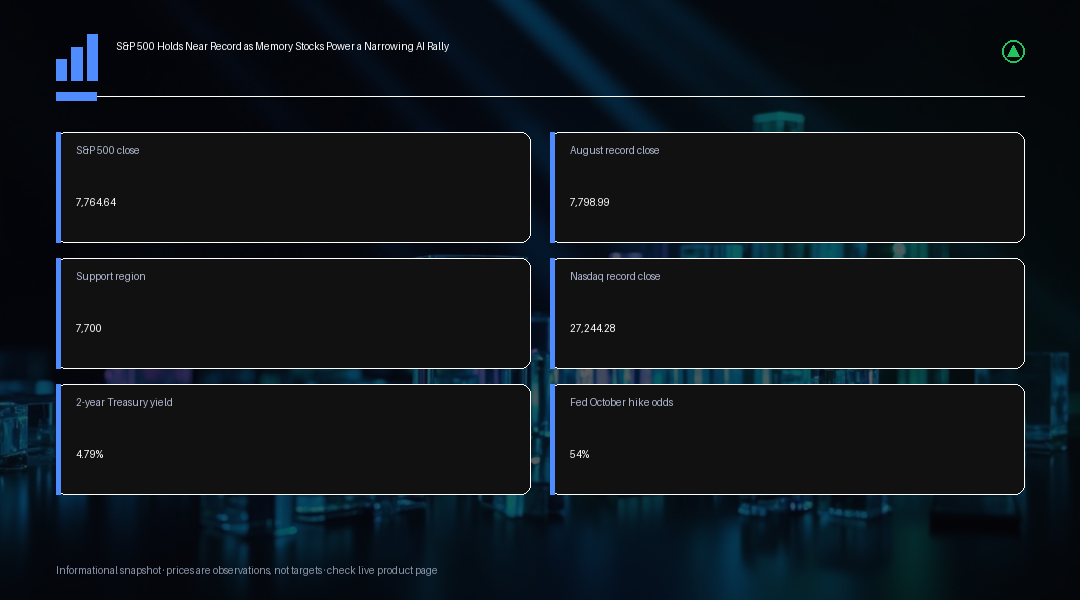
The S&P 500 closed at 7,764.64, essentially unchanged on the session and roughly 0.44 percent below its record close of 7,798.99 set in mid-August. The Nasdaq Composite told a stronger story, adding 0.45 percent to reach a second consecutive record close, while the Dow Jones Industrial Average slipped 0.36 percent. Futures for both major benchmarks were steady heading into the next session, suggesting the market was digesting rather than reversing the prior day's move.
Beneath the surface, breadth told a more divided story than the headline index level suggested. Six of the S&P 500's eleven sectors declined on the day, with financials down about 1.7 percent as JPMorgan and Wells Fargo each lost more than 3 percent. Trading volume reached 17.9 billion shares, comfortably above the twenty-day average of 16.3 billion, indicating that the rotation beneath the flat headline number was anything but casual. The index's immediate technical test remains the record area just above current levels, with the 7,700 region acting as the first meaningful support buffer beneath the market.
The clearest source of strength came from memory and storage names, where Micron rallied roughly 5 percent and SanDisk gained close to 7 percent as part of a semiconductor advance that has now extended for six consecutive sessions. The move reflects growing investor conviction that AI infrastructure buildout will keep driving demand for processors and memory capacity, though that remains a forward-looking thesis rather than a confirmed near-term earnings outcome. The same AI theme cut the other way for consumer-facing platforms: Charles Schwab fell more than 6 percent, Airbnb declined roughly 3 percent, and Uber and Lyft each slipped more than 1 percent as investors weighed whether AI agents could eventually handle tasks, from brokerage transactions to travel bookings, that currently flow through established platforms.
That question is set to be tested directly this week. Meta Connect opens with Mark Zuckerberg's keynote scheduled for 7 p.m. Eastern time, and options markets are pricing an implied move of roughly 4.5 percent in Meta shares in either direction by the end of the week, an options-implied range rather than a directional forecast. Traders are looking for evidence that strong download figures for Meta's Muse AI agent can convert into retention, subscriptions and advertising revenue, a translation that would lend more credibility to the broader AI-monetization narrative currently supporting parts of the tech complex.
The advance was not confined to US markets. Asian equities extended a sixth consecutive day of gains, with South Korea's Kospi climbing about 1.2 percent and Taiwan adding roughly 0.9 percent as Samsung and SK Hynix each rose more than 2 percent. Energy markets eased as Brent crude settled near $99 a barrel after Saudi Arabia restarted operations on a key pipeline, while the ten-year Treasury yield stayed below 5 percent even as the two-year yield climbed to about 4.79 percent, its highest level since mid-2024. Futures markets are pricing roughly a 54 percent probability of another Federal Reserve rate hike in October, a market-implied estimate that will move as new data arrives rather than a settled policy outcome.
Gold eased toward $4,340 an ounce as higher short-term yields and a firmer dollar offset some of its usual safe-haven appeal, while Bitcoin held near $86,700, comfortably above the $82,000 zone that had capped prior rally attempts earlier in the year. The next major cross-market catalyst arrives later this week with a planned meeting between President Trump and Chinese President Xi Jinping in Washington, with trade, tariffs, AI policy, supply chains and the situation in Iran all reportedly on the agenda. An extended trade truce would likely support both equities and industrial metals, while renewed friction could quickly test the market's current calm.
The narrowing pattern in this rally is not new, but it is worth taking seriously as a risk signal rather than dismissing it purely as sector rotation. Six consecutive advancing sessions in semiconductors, set against declines in financials and several consumer-facing platforms, means a shrinking share of the index is doing the work of pushing the benchmark toward its record. Historically, narrow leadership of this kind has not by itself been a reliable timing signal for a top, but it does tend to raise volatility around single-stock catalysts, which is exactly the dynamic playing out this week with Meta Connect and the Trump-Xi meeting both concentrated in a short window. Traders who treat narrow leadership as an automatic reversal signal often exit strong positions too early, while those who ignore it entirely can be caught off guard when a single sector's fatigue eventually spreads into the broader tape, so the more useful approach is to monitor breadth as a supporting indicator rather than trading it in isolation.
For traders sizing exposure to the broader index rather than individual names, the practical takeaway is to treat the 7,700 support region and the 7,798.99 record as the two boundaries of the near-term range, while recognizing that a break in either direction is more likely to be driven by one of this week's event catalysts than by a gradual grind. Elevated two-year yields alongside a still-below-5-percent ten-year suggest the front end of the curve is doing more of the repricing work right now, which is consistent with a market that is treating the October Fed decision as a live risk rather than a foregone conclusion. Discipline around position sizing matters more than conviction about direction in an environment like this one, since the range boundaries are already well defined and the primary source of uncertainty this week is the timing of a catalyst rather than its ultimate direction.
Trading Insight
The setup argues for watching participation rather than the index level alone: a breakout above the record area that draws in broader sector strength, rather than one more narrow tech and memory-led push, would carry more technical weight. The 7,700 region remains the key support buffer beneath current levels, and a break below it alongside renewed weakness in financials and consumer platforms would suggest the divergence between winners and losers in the AI trade is starting to weigh on the broader tape. Event risk is elevated this week between the Meta Connect keynote and the Trump-Xi meeting, both of which carry the potential for outsized moves in specific sectors and in risk sentiment more broadly, so position sizing should account for the likelihood of sharp, event-driven swings.