


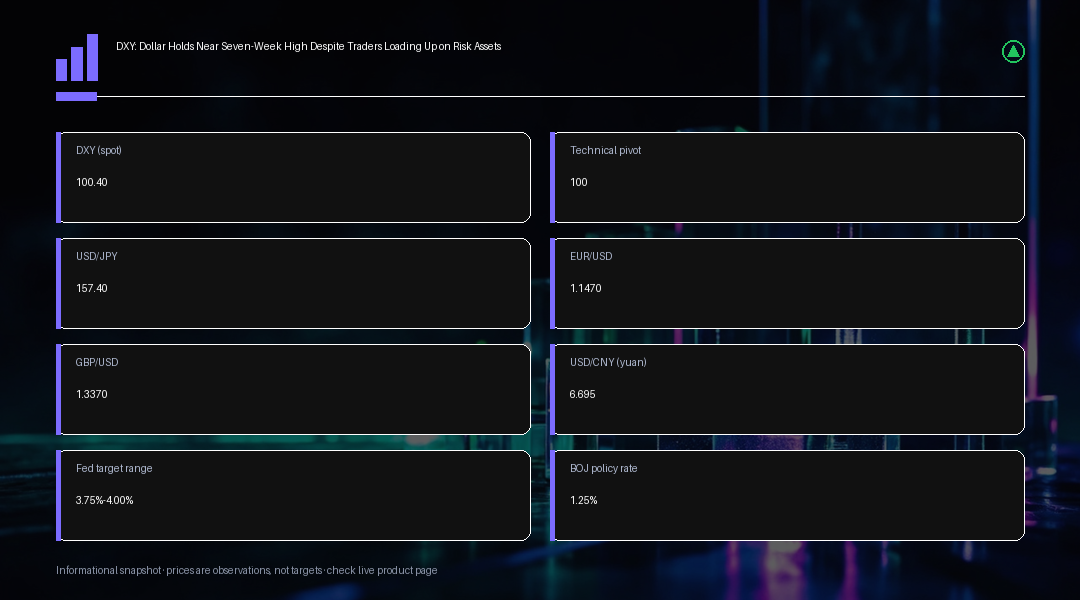
The US Dollar Index held close to its highest level in seven weeks on Tuesday, trading around 100.4, even as a broad risk-on mood pushed the Nasdaq Composite to a record close and lifted equities across Asia. Market-data providers put the index closer to 100.43, essentially firm to modestly higher on the session, underscoring how sticky the dollar's bid has become even when risk appetite would normally argue for a lighter defensive-currency stance.
Usually, a rally in technology shares, a firmer Bitcoin and softer oil prices would be read as a signal that saps demand for the dollar as a haven. This time, traders are instead focused on the yield advantage still on offer in US assets. The Federal Reserve raised its target range by 25 basis points to 3.75%-4.00% earlier this month, and although policymakers signaled that the inflation fight is not fully resolved, futures markets remain close to an even split on whether another hike follows in October, with pricing clustering around 53% in some readings rather than settling into a clear one-sided consensus. That two-sided uncertainty is enough to keep short-dated dollar assets attractive relative to non-yielding alternatives, and it helps explain why the currency has held firm even as broader sentiment improves.
The clearest expression of that yield gap sits in USD/JPY, which traded near 157.40-157.50, not far from a three-week high. The Bank of Japan lifted its policy rate to 1.25% from 1.00% last week, but the decision passed on a 7-2 vote, with two board members dissenting, and the accompanying guidance did little to convince yen buyers that further tightening is imminent. Even after the hike, the policy-rate gap between Washington and Tokyo remains roughly 2.6 percentage points on a target-range basis, wide enough to keep yen-funded carry trades in business and to leave the currency more reactive to changes in that spread than to the hike itself.
Elsewhere in the G10 complex, EUR/USD held near $1.1470 and GBP/USD traded around $1.3370. Both currencies have avoided a deeper slide, but neither has mounted a serious challenge to the dollar's recent strength, in part because the European Central Bank and the Bank of England are managing their own inflation pressures without offering a clearer signal on the timing of their next moves. The net effect is a market comparing degrees of hawkishness across major central banks rather than pricing in outright policy divergence in either direction.
The one currency bucking the pattern is China's yuan, which strengthened to around 6.695 per dollar, its firmest level since January 2023. The move has coincided with a softer approach from the People's Bank of China toward currency appreciation ahead of this week's meeting between the US and Chinese leaders, suggesting the yuan's strength is at least partly policy-facilitated rather than a pure market verdict on the dollar's broader trajectory. That distinction matters for traders: a policy-guided move in one pair says less about the dollar's global standing than a broad-based decline would.
Attention now turns to this week's US flash PMI releases and a run of scheduled remarks from Federal Reserve officials, and market participants will be watching for commentary that firms up or dials back the odds of an October move. Firmer activity, employment or price data would tend to reinforce the dollar's yield advantage and support the case for holding near the seven-week high already established. Softer data, particularly any evidence that energy-driven inflation pressure is fading following the recent pullback in crude prices, could trim hike expectations and ease some of the pressure building on rival currencies.
From a technical standpoint, the 100 level remains the dollar index's immediate pivot. Holding above that mark would keep the recent breakout intact and leave the seven-week high within reach on any fresh catalyst. A sustained break back below 100 would be an early signal that softer energy prices and lower Treasury yields are starting to outweigh the Fed's still-hawkish messaging, putting the dollar's recent run of relative strength to its first real technical test since the current advance began.
The setup also carries implications beyond the FX market. A dollar that stays firm alongside easing oil prices tends to compress the case for gold and other non-yielding assets, since higher-for-longer US rate expectations raise the opportunity cost of holding them even when broader risk appetite is improving. Conversely, a decisive break of the dollar index below 100 would likely be read as a green light for further gains in risk assets generally, not just in equities, since it would signal that the market has stopped pricing meaningful odds of additional Fed tightening. That cross-asset read is part of why this week's flash PMI releases and Fed commentary carry outsized importance relative to a typical mid-week data run.
It is also worth separating what is confirmed from what remains market interpretation. The Fed's own communication described its inflation fight as ongoing rather than issuing an explicit warning in the way some coverage has framed it, and the idea that the dollar's yield advantage is 'winning' against risk sentiment is an interpretation of the price action rather than a stated policy objective from any central bank. Traders should treat the PBOC's apparent tolerance for yuan strength the same way: as an observed market outcome ahead of a high-profile diplomatic meeting, not as a formally announced currency policy shift that would necessarily persist afterward.
Trading Insight
For traders, the dollar's ability to hold firm alongside a record-setting Nasdaq is the standout feature of this setup, and it argues for treating DXY as event-driven rather than trend-following in the days ahead. As long as October hike odds stay close to a coin flip, dips toward the 100 level are more likely to attract buyers than to break down outright, particularly against the yen, where the roughly 2.6-percentage-point policy gap still favors carry positioning. A confirmed close below 100 would be the first technical signal that the balance is shifting, and it would put the focus back on whether falling oil prices and softer Treasury yields can do more of the work that a still-undecided Fed has not yet done. Flash PMI data and scheduled Fed commentary this week are the most likely near-term triggers for a shift in either direction, and traders should treat the yuan's PBOC-linked strength as a distinct, policy-driven story rather than evidence of broader dollar weakness that would apply to other major pairs.