


Sandisk fell about 10% in the August 6 market-open window even after reporting record quarterly results. Yet the broader technology tape did not break: SpaceX absorbed a major share unlock, and the Nasdaq Composite ended almost flat while oil and Treasury yields rose.
The useful conclusion is that this was a dispersion test, not yet a confirmed NAS100 selloff. Traders needed four signals to line up — earnings weakness spreading beyond one stock, unlocked supply overwhelming SpaceX demand, oil and yields extending higher, and the index losing relative strength.
Key takeaways
- Sandisk's opening drop was violent, but its record quarter made the reaction more about expectations than collapsing demand.
- More than 911 million SpaceX shares became eligible for sale; the stock still closed 6.1% higher.
- Oil and yields were the broader risk channel, but the Nasdaq's 0.1% decline showed limited index confirmation.
Did Sandisk's 10% drop signal a broader tech selloff?
No — not on August 6 alone. Sandisk was a sharp constituent-level shock, but the Nasdaq Composite closed down only 0.1%. The S&P 500 lost 0.2%, while the Dow fell 0.9%, according to Associated Press market-close data. That hierarchy did not show technology leading an indiscriminate retreat.
A single large loser can matter to sentiment without defining the index. The stronger breadth signal would have been synchronized weakness across memory, semiconductors, software and other duration-sensitive leaders, followed by NAS100 failing to recover its opening range. The closing tape did not provide all of those confirmations.
Why did Sandisk fall after a record quarter?
The price reaction suggests expectations had moved faster than the already-strong reported numbers. Sandisk said fiscal fourth-quarter revenue reached $8.97 billion, up 51% sequentially, with GAAP net income of $6.90 billion. It also guided fiscal first-quarter 2027 revenue to $10.30–$10.80 billion and expanded its share-repurchase authorization.
Those figures describe a powerful operating quarter, not a sudden business contraction. The roughly 10% opening decline therefore highlights a familiar earnings dynamic: a stock can sell off when positioning, valuation or the market's unstated expectations are more demanding than the headline beat. For index traders, the next question is whether peers confirm the reaction. Without that breadth, SNDK is evidence of stock-specific repricing rather than proof of a technology-wide demand break.
What did the SpaceX share unlock actually show?
It showed that eligible supply is not the same as completed selling. More than 911 million shares held by employees and early investors became eligible for sale on August 6 — more than double the shares initially offered to the public. The event increased potential supply, but it did not force every eligible holder to sell.
Price absorption mattered more than the headline number. Associated Press reported that SpaceX closed 6.1% higher at $114.92 after dropping nearly 14% the previous day. That reversal does not remove future unlock risk, but it shows why traders should watch the market's response to supply rather than assume the calendar event determines direction.
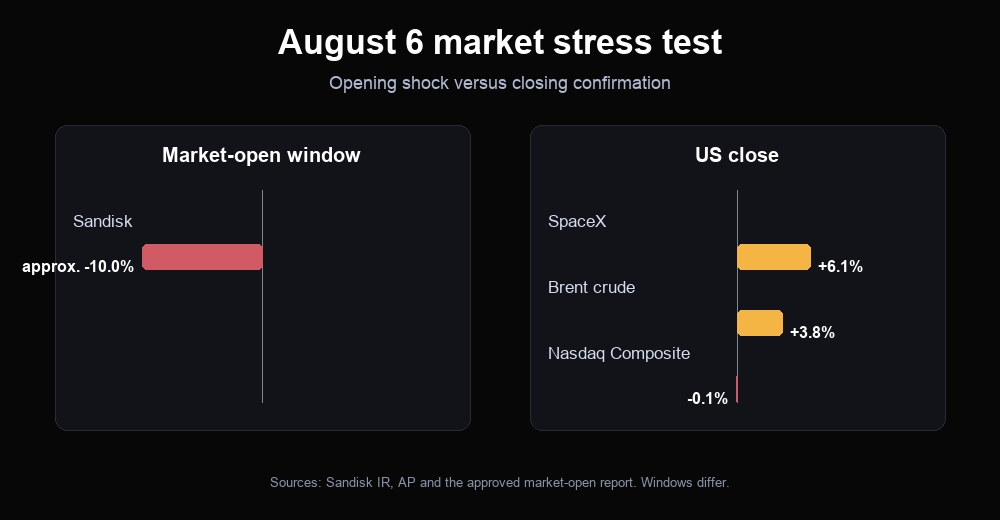
The Sandisk figure is an approximate market-open observation; the SpaceX, Brent and Nasdaq figures are US closing reads. The separate windows are intentional.
Why did oil and yields matter more for NAS100?
Oil and Treasury yields supplied the macro transmission channel that could turn isolated earnings volatility into broader valuation pressure. Brent crude rose 3.8% to $82.49 as uncertainty around the US–Iran conflict and the Strait of Hormuz persisted. The US 10-year Treasury yield rose to 4.67% from 4.63%.
Higher energy costs can reinforce inflation concerns, while higher yields raise the discount rate applied to future earnings. That combination typically matters more to growth-heavy indices than one beverage or health-insurance report. Oscar Health and Celsius added to the day's earnings dispersion, but their company-specific reactions only become an index signal when participation broadens.
This is why the live NAS100 market is the final confirmation layer. If oil and yields rise while NAS100 keeps outperforming, the macro pressure is being absorbed. If all three move against growth assets together, the probability of a broader risk-off session increases.
What would confirm a broader technology selloff?
Look for all four signals to align instead of treating any one headline as decisive.
| Signal | Contained reading | Broader risk reading |
|---|---|---|
| Earnings shock | SNDK weakness remains isolated | Memory and semiconductor peers confirm |
| Unlock supply | SpaceX holds above the post-unlock range | Repeated selling overwhelms rebounds |
| Macro pressure | Oil or the 10-year yield fades | Brent and yields extend higher together |
| Index breadth | NAS100 reclaims the opening range | Growth leaders weaken and rebounds fail |
The framework also has a clean invalidation. If oil cools, yields stop rising and technology breadth improves, the opening alarm remains a collection of single-stock events. If those pressures persist and NAS100 loses relative strength, the session has moved from dispersion toward broad de-risking.
Final thoughts
A dramatic earnings drop, a huge unlock and rising oil can sound like one bearish story before the open. August 6 showed why they should be tested separately. Sandisk repriced, SpaceX absorbed supply, and the Nasdaq stayed resilient despite a less friendly oil-and-rates backdrop. The index message changes only when those pieces begin confirming one another.