


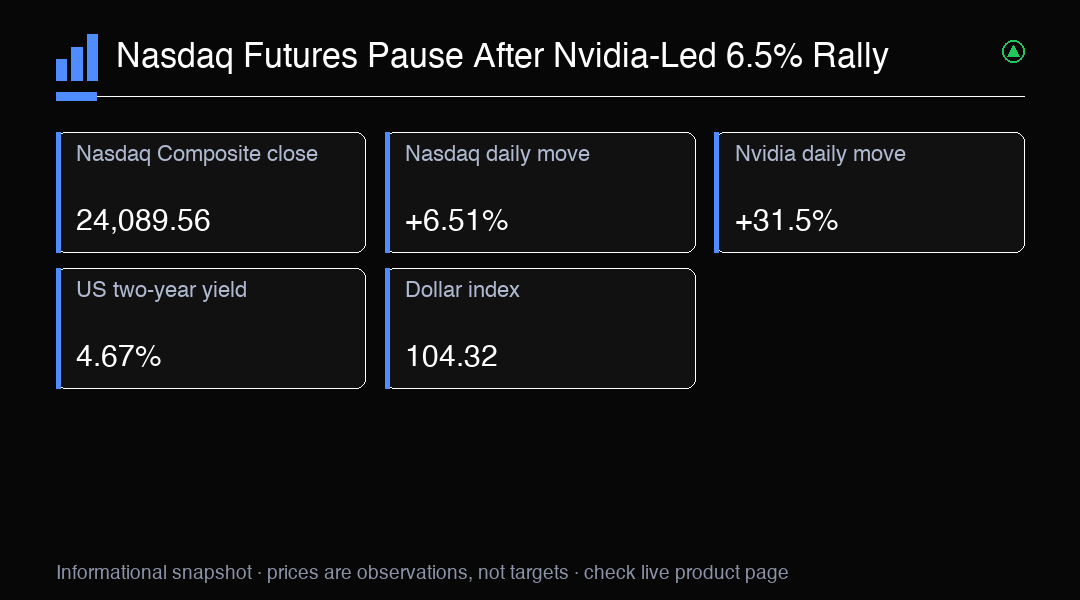
Nasdaq-100 futures slipped about 0.3% on Tuesday while S&P 500 futures were broadly flat, a quiet start after a sharp rebound in US stocks. On Monday, the Nasdaq Composite jumped 6.51% to 24,089.56, the S&P 500 gained 4.73% and the Dow Jones Industrial Average rose 3.01%. It was the strongest session for all three benchmarks since April 2025. The early dip in Nasdaq-100 futures put the focus on whether buyers would return when regular trading resumed and whether the rebound would extend beyond the chipmakers and large technology stocks that led it.
Nvidia was at the center of Monday’s move. Its shares jumped 31.5%, the company’s largest one-day percentage gain since 2003, adding nearly $1 trillion in market value. The advance followed the board’s reinstatement of Jensen Huang as chief executive after reported US government intervention. The decision gave investors clarity about who would set strategy and oversee execution at a company central to the market’s expectations for artificial intelligence spending. The operating questions are longer term. Demand for Nvidia’s chips, customer spending plans and the margins the company earns on its products will all help determine how much of the higher valuation its business can support.
The gains spread well beyond Nvidia within technology. The semiconductor index rose 14%, while Meta added 6.6%, Alphabet gained 6.3% and Amazon climbed 3.5%. The chip gauge captured the scale of the move in semiconductors, and gains across other large technology-related stocks gave the rally a wider base. Some of those companies carry substantial weight in the Nasdaq benchmarks. When several of them rise together, they can lift the index even if performance across the rest of the list is uneven. The Dow’s advance showed that the recovery reached another major benchmark, with the strongest buying concentrated in the technology-heavy Nasdaq.
Monday’s close and Tuesday’s futures dip measure different parts of the market. The Composite covers a broad range of Nasdaq-listed stocks, while Nasdaq-100 futures are tied to an index of large nonfinancial companies. Monday’s Composite figure reflects a completed cash session. Tuesday’s futures reading shows how traders priced the narrower index early in the day. Futures can respond to overseas trading and company developments before the US opening bell. Once regular trading begins, the prices of the underlying shares give a fuller picture of which companies are driving the move and how widely buying or selling is spreading.
The rebound carried into Asian technology markets. Taiwan’s benchmark rose nearly 10%, with TSMC and Foxconn nearing their daily upward limits. Japan’s Nikkei gained as much as 5% and South Korea’s Kospi advanced around 6.5%. The strength in Taiwan brought different parts of the technology supply chain into view, from semiconductor fabrication to electronics assembly. Participation was uneven elsewhere. Mainland China’s CSI 300 edged higher and Hong Kong shares slipped about 0.4%, while European futures were subdued. Asian stock moves and European futures readings were taken during trading, giving an early view of where the rebound had reached.
Treasury yields remained elevated. The US two-year yield was near 4.67% and the 10-year yield was around 4.92%, while the dollar index ended Monday near 104.32. The two-year yield is sensitive to expectations for Federal Reserve policy. The 10-year also reflects longer-term expectations for growth and inflation and the premium investors demand for holding longer-dated debt. Higher yields can weigh on growth-stock valuations by reducing the present value of earnings expected further into the future. That gives the Nasdaq rally a second test alongside the strength of corporate earnings and demand for technology equipment.
Other markets showed a mixed picture. Early Tuesday, gold retreated from the $3,700 area toward $3,630, and Brent crude held near $89.50 after falling 3.5% on Monday. Bitcoin briefly approached $64,000 before paring its advance and trading near $60,600. The reversal in Bitcoin was another instance of early buying losing momentum, alongside the pause in Nasdaq-100 futures. The two can both respond to changes in investors’ appetite for risk, although trading in Bitcoin also reflects conditions specific to the cryptocurrency market.
US consumer-confidence data and Dell’s earnings were due Tuesday, putting two kinds of demand in view. Confidence offers a read on how households see their finances and the wider economy, which can shape spending. Dell’s results offer a closer look at business spending on computing, including the servers used for artificial intelligence. In that market, orders show what customers commit to buying, delivery schedules affect when sales can be recognized, and margins show how much of that revenue the seller retains after costs. A rise in equipment orders can matter to chip suppliers well before completed systems show up in a manufacturer’s sales.
The personal consumption expenditures price index was due Wednesday, bringing the focus back to interest rates. The index measures changes in the prices of goods and services consumed by households. Its release can change how investors price the Federal Reserve’s policy path. The response in Treasuries would help show how much the inflation reading shifted rate expectations and whether growth shares moved alongside those shifts. Thanksgiving’s Thursday market closure leaves a short window for markets to digest the inflation figures alongside Tuesday’s data and earnings.
After a move as large as Monday’s, the distribution of gains can tell investors more about participation than the headline index change. A count of advancing and declining Nasdaq stocks shows how many companies are moving in each direction. An equal-weighted reading gives each constituent the same influence and helps show whether the average member is keeping up with the largest names. A firm capitalization-weighted index alongside softer equal-weighted performance would point to a rally concentrated in heavyweights. Strength across both measures would indicate broader demand across the companies that make up the index.
Sector performance can also put Monday’s rally in perspective. Further advances in chipmakers and hardware companies would show continued strength across the supply chain that led the rebound. If chipmakers give back ground while investment flows into other sectors, the broader market can hold up even as the sector that drove the initial surge cools. Monday’s cash close provides a reference point for those comparisons through the week’s scheduled releases. The next test for the Nasdaq is whether the gains sparked by Nvidia’s leadership news can draw in more of the market as investors weigh demand and inflation.
Trading Insight
If the Nasdaq-100 holds its ground as short-term Treasury yields rise after the inflation release, a firm equal-weighted reading would show that the resilience extends beyond the largest companies.