

Coinbase introduced perpetual futures linked to Anthropic’s pre-IPO valuation for eligible customers in select markets. Separately, it said automated defenses stopped about $4.7 million in attempted scam transfers during a fraudulent livestream. These developments concern different parts of crypto-market infrastructure: a derivative creates a tradable reference to a private-company valuation, while transaction screening seeks to interrupt suspicious payments. The product gives eligible traders a way to express a view through a contract. The scam response describes a control applied to customer transfers. Each development has a separate purpose and risk profile.
The futures were offered through Coinbase Bermuda Ltd to eligible non-US customers in select markets; US users were excluded. The USDC-settled contract had no fixed expiration and allowed long or short exposure ahead of Anthropic’s expected Nasdaq debut under ANT on November 19. Those terms define access, settlement currency and position direction. They also distinguish the instrument from purchasing shares. An open-ended contract can stay active without a scheduled expiry, leaving the trader to manage exposure under the contract’s pricing, margin and liquidity conditions for as long as the position remains open.
Before a public listing, the contract used valuation-based index pricing rather than a direct one-for-one link to an Anthropic share. That makes the index methodology central to price discovery: the contract reflects its specified valuation reference, while a future listed share would trade in a separate market. Traders therefore take a view on how the index values Anthropic, not a claim on a share or a guaranteed preview of the eventual public price. The gap between a valuation reference and a later share price is part of the product’s structure, not evidence that either price is wrong. The derivative’s price can therefore be informative about demand for valuation exposure, but it cannot by itself establish a share-market clearing price. USDC settlement also keeps the position in the contract’s settlement form rather than delivering ownership in Anthropic.
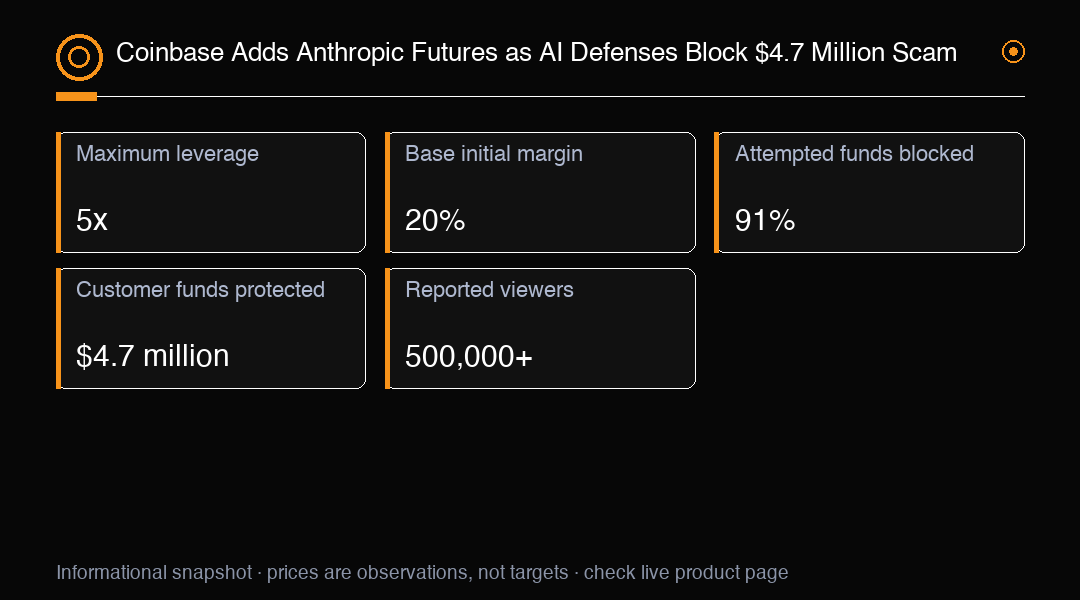
Coinbase set maximum leverage at 5x and base initial margin at 20%. Margin is the capital required to support a position, while leverage makes the position’s exposure larger than the margin posted. As a result, a move in the valuation index can have a magnified effect on account equity. If prices move against a position, the remaining margin can become insufficient under the contract’s rules, creating liquidation risk. The stated leverage and margin terms help explain why index moves, liquidity and position size need to be considered together rather than in isolation.
The contract provides no ownership interest, voting rights, shares or IPO allocation, and Coinbase said it was not affiliated with, sponsored by or endorsed by Anthropic. This matters to price interpretation: a trader cannot use the futures position to exercise corporate rights or secure participation in the listing. Exposure runs through the contract’s index and settlement terms. Interest in a prominent private company may attract attention to the instrument, but contract demand leaves the company’s valuation and any later share price to separate markets.
Coinbase warned that the contract may be less liquid and more volatile than standard perpetual futures. It identified thin liquidity, sharp moves around an IPO and the conversion process as potential sources of liquidation or auto-deleveraging risk. These conditions can reinforce one another: a fast repricing in a thin market may make it harder to maintain a position, while leverage leaves less room for an adverse move before margin pressure matters. The disclosures describe possible outcomes, not events already observed. An open-ended term leaves these risks intact and offers no guarantee of continuous liquidity.
The separate scam incident involved a fake YouTube livestream using an AI-generated Elon Musk deepfake to promote a fraudulent Tesla-themed cryptocurrency giveaway. It displayed wallet addresses and a QR code, and promised to double cryptocurrency sent by viewers. Coinbase said more than 500,000 people watched and hundreds of customers attempted transfers during roughly two hours. The mechanics of the pitch combined a recognizable public figure with a direct payment request. A polished video can make an imitation appear credible, while the promise of doubled funds remains a warning sign rather than proof of a legitimate promotion.
Coinbase said machine-learning transaction screening and an automated intervention agent blocked about 91% of the money customers attempted to send during the scam. It reported that $4.7 million was prevented from leaving customer accounts and reaching scammers. The percentage concerns attempted funds, not the number of transfer attempts. The reported sequence is meaningful: screening and intervention acted before the prevented money reached the recipients, interrupting the payment path at the account-transfer stage. The figure is Coinbase’s account of this incident and is specific to this campaign, not a general prevention rate across platforms.
The futures and the scam response illustrate different points where risk can enter or be contained. The derivative transmits market risk through index repricing, leverage, margin and liquidity. The giveaway transmits fraud risk through a persuasive message that directs viewers toward wallet transfers. In the first case, a position’s value can change as the contract’s reference changes; in the second, screening can stop a suspicious payment before it leaves an account. Treating these as separate mechanisms helps keep a new trading product from being confused with a broader claim about platform security.
For traders assessing the Anthropic-linked contract, the practical focus is the valuation-index methodology, available liquidity, margin requirements and the way the instrument behaves around a listing. The index is a reference for the derivative, not a shareholding claim; leverage can magnify losses as well as gains; and Coinbase’s stated warnings identify conditions that may raise liquidation or auto-deleveraging risk. Position sizing and the ability to withstand repricing therefore matter alongside a directional view. The disclosures provide no basis for assuming that the contract will track a later public share price closely.
For customers, the reported intervention shows how automated screening can address attempted transfers during a fast-moving campaign, while customers still need to examine payment requests. A livestream, familiar face, wallet address or QR code does not verify a giveaway. Customers can assess the transaction itself: whether it requests a wallet transfer, promises doubled funds and identifies a destination address. In this incident, the pitch asked viewers to send cryptocurrency under a doubling promise. For a broad crypto-market reference, BTCUSDC can provide separate market context; it is neither direct Coinbase or Anthropic exposure nor a hedge for the Anthropic-linked contract.
Trading Insight
Coinbase’s Anthropic-linked contract is a leveraged valuation-based derivative for eligible non-US customers in select markets, with liquidity and liquidation risks around a potential listing. BTCUSDC offers a broad crypto-market reference, not direct exposure or a hedge.