


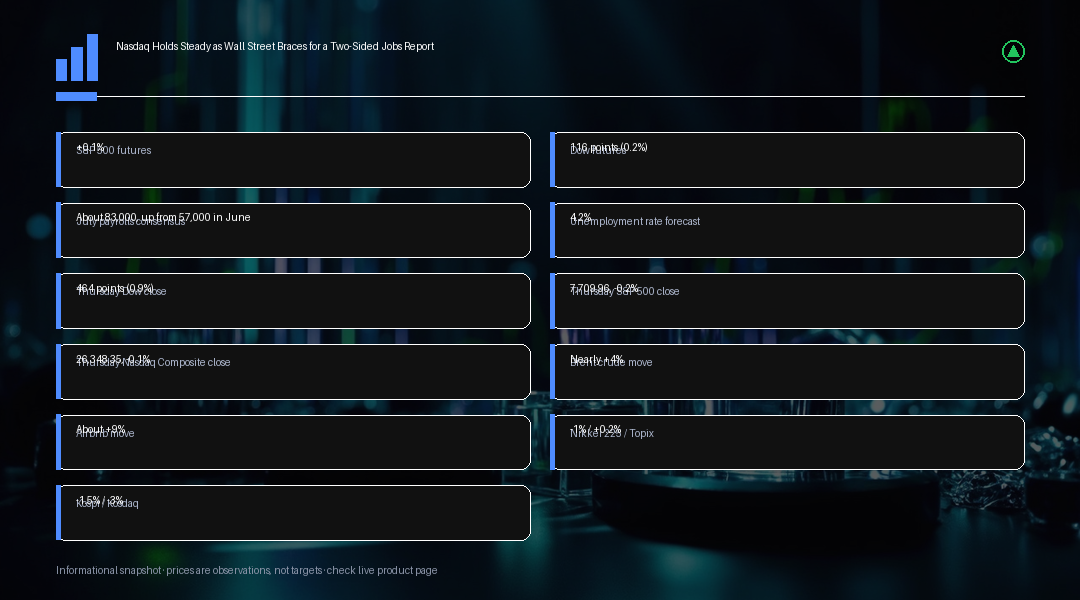
US stock index futures were mostly flat to modestly mixed early Friday as traders held back from placing major bets ahead of the closely watched July employment report. S&P 500 futures edged 0.1% higher while Dow futures slipped 116 points, or 0.2%, leaving Nasdaq futures essentially unchanged. Wall Street settled into its familiar pre-data posture: aggressively doing very little while waiting for a single number to set the tone for the session.
That number is the nonfarm payrolls report, which counts jobs added across most of the economy excluding farm work and a handful of smaller categories. Economists expected July payrolls to rise by roughly 83,000, a modest improvement from June's softer 57,000 gain, while the unemployment rate was expected to hold steady at 4.2%. Traders were also set to scrutinize wage growth and labor-force participation, the share of working-age people who are either employed or actively looking for work, since those details help reveal whether inflation pressure and labor availability are genuinely easing or merely stabilizing at an already-soft level.
The wait-and-see mood followed a bruising Thursday session in which rising oil prices and Treasury yields ended the Dow's five-session winning streak. The blue-chip index dropped 464 points, or 0.9%, while the S&P 500 slipped 0.2% to 7,709.96 and the Nasdaq Composite eased 0.1% to 26,348.35. Brent crude jumped nearly 4% as doubts resurfaced over a proposed agreement covering the Strait of Hormuz, a critical global shipping route. Higher energy prices tend to feed directly into inflation readings, while rising bond yields make richly valued growth stocks comparatively less attractive, a combination that weighed on sentiment across all three major benchmarks.
Despite Thursday's pullback, the broader market remained on track for a second consecutive weekly gain heading into the jobs data. Semiconductor and other technology names have shown a pattern of quickly rebounding after bouts of momentum unwinding earlier in the summer, when investors rapidly exited some of the year's biggest winners before rotating back in almost as quickly. That whipsaw pattern is a reminder that single-session moves in either direction should be read in the context of a market that has, on net, kept climbing through repeated bouts of short-term profit-taking.
Individual earnings reactions added texture to an otherwise cautious tape. Airbnb rallied roughly 9% after beating both profit and revenue expectations, helped by resilient travel demand. Cloudflare's shares surged after the network security company topped quarterly estimates and raised its forward outlook, with executives pointing to growing AI-agent-driven internet traffic as a key demand driver behind the beat. Those individual reactions underscore that even in a market waiting on a single macro data point, company-specific catalysts can still move stocks sharply in either direction.
Asian markets traded cautiously ahead of the US data release. Japan's Nikkei 225 fell around 1% while the broader Topix added 0.2%, a divergence that echoed the pattern seen on Wall Street, where technology-heavy benchmarks lagged more diversified ones. South Korea's Kospi declined 1.5%, and the smaller-company Kosdaq index dropped 3%, with regional chipmakers among the more heavily pressured names as investors positioned defensively before the US jobs figure.
The stakes around Friday's report cut in both directions. A softer-than-expected reading could reduce expectations for further Federal Reserve policy tightening and provide support for technology shares by reinforcing the idea that the labor market is cooling without falling off a cliff. A stronger-than-expected number could push Treasury yields higher and pressure growth-stock valuations by reviving concerns that the central bank has less room to ease. An especially weak print, well below the roughly 83,000 consensus, would risk reviving broader recession fears rather than being read as simply supportive for rate-sensitive assets.
For traders positioning into the report, the practical takeaway is that this is a genuine two-sided event. The market's flat-to-mixed futures posture reflects a lack of conviction about which outcome is more likely, not confidence that the report will be a non-event. Volatility around the release itself, and in the minutes that follow as algorithms and discretionary traders alike digest the headline number alongside wage growth and participation-rate details, is likely to exceed the muted moves seen in pre-market futures.
History offers a useful reference point for how markets tend to behave around major payrolls releases. Index-level moves in the hour immediately following the report are often several times larger than the moves seen in the overnight or pre-market session, since algorithmic trading systems react within seconds to the headline number while human traders and portfolio managers spend the following hours repositioning around the wage-growth and participation-rate details buried deeper in the release. That pattern argues for caution about reading too much into Friday's calm pre-market tape as a preview of how the actual session will unfold.
Cross-asset signals will also be worth tracking alongside the equity reaction. Treasury yields and the US dollar tend to move first and most directly in response to a payrolls surprise, and their reaction typically explains a large share of the subsequent move in growth-heavy indices like the Nasdaq. A payrolls number that pushes yields meaningfully higher, even if the headline print is only modestly above consensus, could still weigh on technology shares through the valuation channel described above, independent of whether the labor-market story itself is read as good or bad news for the economy.
MC Markets does not cite exact source levels without independent market-data verification. Traders should confirm current index levels, futures pricing and the actual released jobs figures through their own market-data feeds before acting on any of the figures discussed above.
Trading Insight
Friday's jobs report is a genuine two-sided catalyst for the Nasdaq and broader US indices. A print near or below the roughly 83,000 consensus, alongside a steady 4.2% unemployment rate, would likely support the recent narrative of cooling labor demand without a hard landing, favoring a resumption of the index's broader uptrend after Thursday's Dow-led pullback. A materially stronger print risks pushing Treasury yields higher and pressuring the Nasdaq's rate-sensitive growth names, while an unusually weak number, well under consensus, could revive recession concerns rather than simply cooling rate-hike bets. With Thursday's close leaving the Nasdaq Composite at 26,348.35 and the S&P 500 at 7,709.96, traders should watch whether either index can reclaim Wednesday's higher levels on a favorable print, or extend the pullback on a surprise in either direction.